







Texas Border Business

By Roberto Hugo González / Texas Border Business
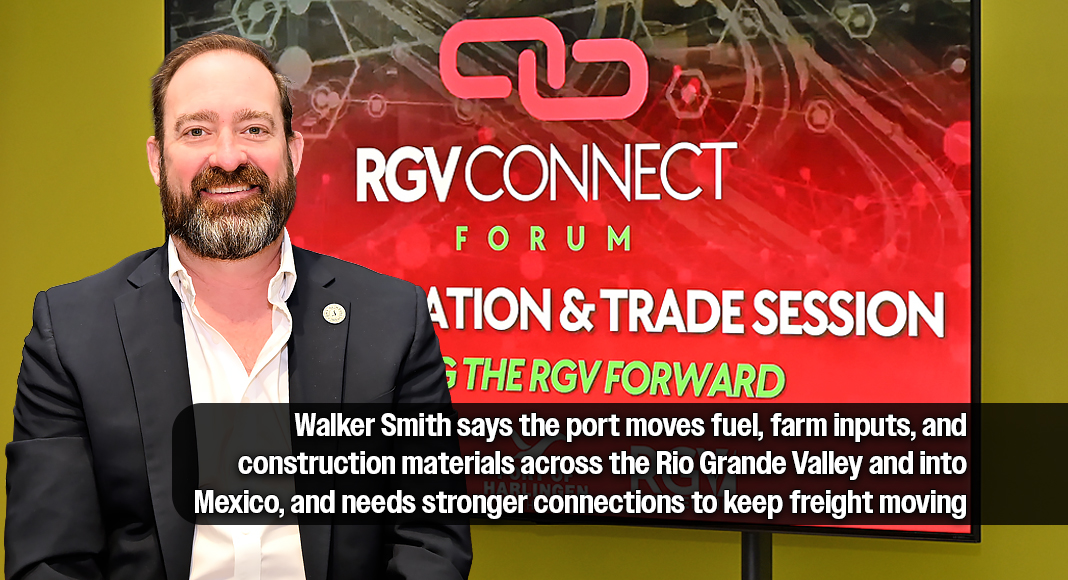
At an RGV Connect panel on trade and transportation, Walker Smith, port director and CEO of the Port of Harlingen, said the port plays a larger role in the Rio Grande Valley economy than many residents may realize, as the newly launched regional forum highlighted infrastructure priorities across South Texas.
The event was part of RGV Connect, a new initiative led by Rio Grande Valley Partnership President and CEO Paco Sanchez to bring together leaders from across the four-county region. Sanchez said the forum is designed to align priorities and strengthen advocacy. “We bring together business leaders, community stakeholders, and elected officials to discuss key issues, establish regional priorities, and take those priorities to Austin and Washington, D.C.,” he said.

He emphasized the need for a unified regional approach. “The Rio Grande Valley is not siloed, and our challenges are not isolated. They affect all of us,” Sanchez said, adding that RGV Connect will help guide the Partnership’s legislative agenda.
Within that framework, Smith outlined the scale and impact of the Port of Harlingen’s operations. “Most people don’t really realize that Harlingen, Texas, has a water port,” he said, noting it is “the second largest port in the Rio Grande Valley” and handles fuel, agricultural products, and industrial materials.
He said the port’s main commodities include refined fuels exported to Mexico, fertilizer, agricultural chemicals, and aggregates such as sand for concrete. Located about 26 miles inland from the Gulf Intracoastal Waterway, the port connects to Gulf states and inland markets across the Midwest.
Smith described the port as critical to the region’s fuel supply. “If you put gas in your car this morning, most likely that came through the Port of Harlingen,” he said. He added that fuel accounts for about “85% of what we handle,” and that a prior study found roughly “70%” of the region’s fuel once came through the port.
He said cargo arrives primarily by barge, is transferred to storage, and then loaded onto trucks for distribution across the Valley and into Mexico through the Los Indios Free Trade Bridge.
Looking ahead, Smith said the port’s biggest needs are improved connectivity and infrastructure. He stressed the importance of separating heavy and hazardous cargo from everyday traffic and highlighted the lack of connection between existing overweight corridors. “Those three corridors are not connected in any way whatsoever,” he said, referring to corridors serving the Port of Harlingen, the Port of Brownsville, and Hidalgo County.
Smith also identified rail as the port’s top priority. He said the port currently has only “3,500 to 3,700 feet of rail,” limiting growth. “Our priority for us is our rail system, for sure,” he said, noting a planned expansion project estimated at $30 million.
He added that the port is investing about $10 million in upgrades to docks, roads, and drainage, and is studying a $35 million expansion of the turning basin. The port, he said, is one of the few in the region with access to “road, rail, pipeline, and water.”
Smith tied those needs to broader state investment, noting Texas ports previously received $200 million in funding. “For every dollar invested in a port, $56 is returned to the state of Texas,” he said.
Sanchez said RGV Connect is intended to turn discussions like these into coordinated action. “RGV Connect and our legislative efforts are about making sure the region speaks with one voice,” he said.
See related stories: