







Texas Border Business

Texas Border Business
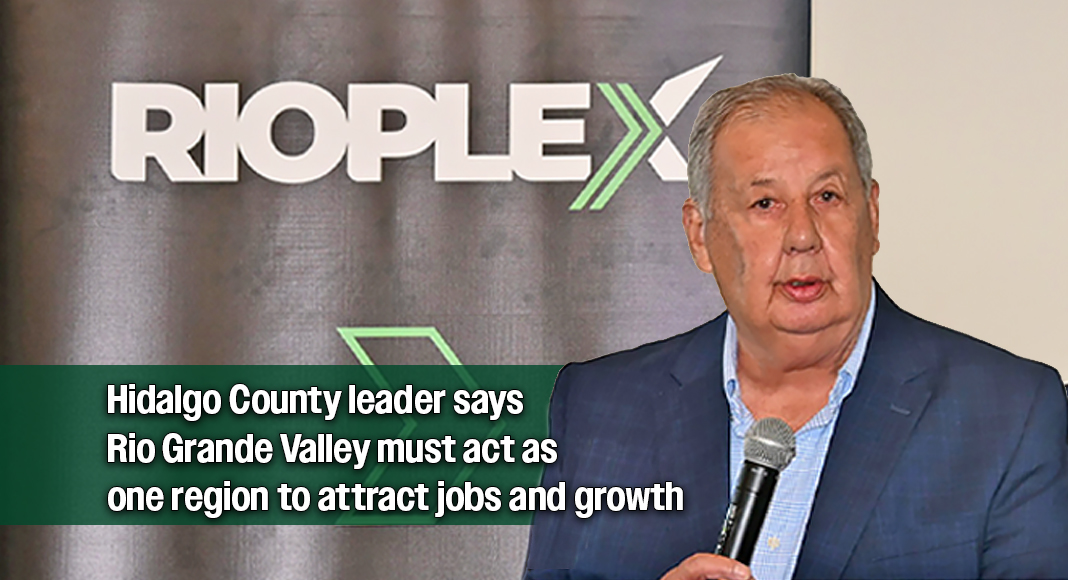
Hidalgo County Judge Richard Cortez told regional leaders that the Rio Grande Valley must work as a single, unified region if it wants to compete for major investment and long-term economic growth.
Speaking at a RioPlex meeting at South Texas College in Weslaco on Jan. 17, Cortez said the Valley can no longer afford to promote itself city by city or county by county.

“We have to make a choice,” Cortez said. “Do we keep doing what we’ve been doing in the past, or do we really aim higher and move toward something stronger and better?”
Cortez said Rioplex was created because business leaders repeatedly told local officials that companies outside the region did not understand where the Rio Grande Valley was or what it had to offer.
“One of the reasons that Rioplex came to be is because the businesspeople were telling us that when they went out to conduct business around the world, no one knew where we were,” he said. “They told us, ‘You need to create a region that you can promote.’”
He said that is why leaders are pushing to market the area as a unified region rather than separate cities or counties.

“We want RioPlex to be understood the same way people understand the Rio Grande Valley or the Magic Valley,” Cortez said. “That didn’t happen overnight. It took years, and that’s what we’re doing now.”
Cortez stressed that large companies looking to invest do not evaluate communities in isolation. He said they look for regions that can meet multiple needs at once.
“They’re looking for reliable power, reliable water, a ready workforce, rail, air, ground, and sea access, and quality of life,” he said. “No single city or county can provide all of that by itself.”
He warned that if local governments continue working independently, the region will lose out to larger metropolitan areas.
“If we keep responding as individual communities, we’re going to lose,” Cortez said. “Other regions win because they speak with one voice.”
Cortez said RioPlex provides that unified voice by presenting the Rio Grande Valley and northern Tamaulipas as a combined region of 3.5 million people.
“Why short ourselves?” he said. “Between the Valley and Mexico, we have 3.5 million people. That’s the region we should be talking about.”
He pointed to the region’s growing assets, including universities, medical schools, ports of entry, manufacturing, aerospace, logistics, and health care.
“We have over 100,000 college students, growing industries, international bridges, ports, hospitals, and universities,” Cortez said. “We can present all of that if we market ourselves correctly.”
He emphasized that RioPlex is focused on industrial development because it leads to long-term economic stability.
“We’re interested in industrial development because that’s how you create prosperity,” he said. “That’s how you create better jobs and a stronger future for the people who live here.”
Cortez credited the Prosperity Task Force, formed several years ago, for helping shape the regional strategy now being carried out through RioPlex.
“That’s why we’re here today,” he said. “To make sure we’re aligned, working together, and moving in the same direction.”
He closed by urging continued cooperation across city and county lines.
“This is our moment,” Cortez said. “If we commit to working as a region, we can bring in better jobs, stronger infrastructure, and new opportunities. We have the resources. We have the talent. What we need now is the will to move forward together.”
See related story: