







Texas Border Business

By Army Pfc. Andre Gremillion Jr., 100th Mobile Public Affairs Detachment
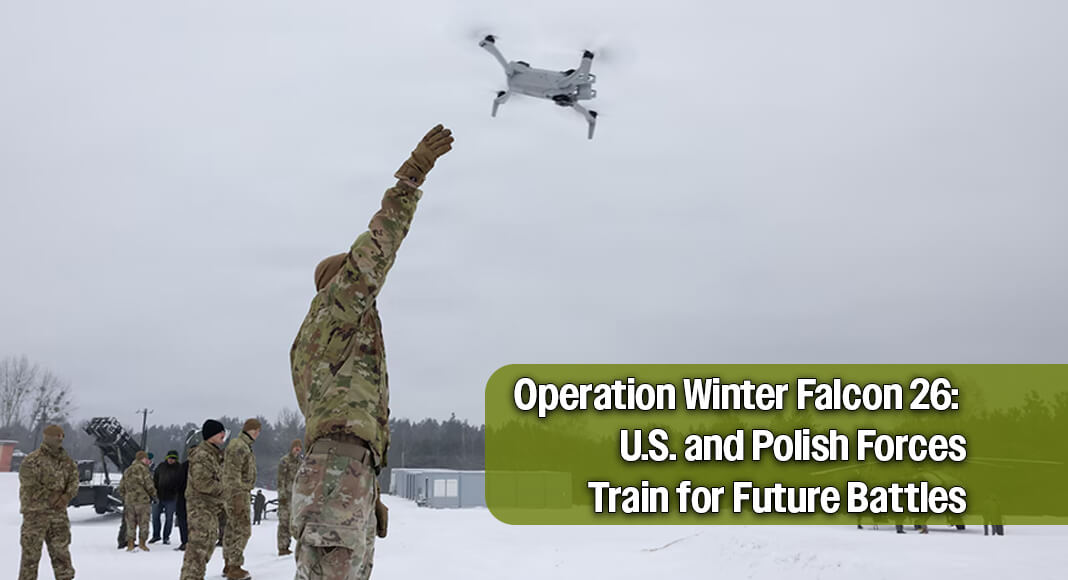
Soldiers assigned to the 3rd Battalion, 66th Armored Regiment, 1st Armored Brigade Combat Team, conducted an armored live-fire exercise and technology demonstrations during Operation Winter Falcon 26 at the Drawsko Combat Training Center in Oleszno, Poland, Jan. 13.
The event demonstrated how modern military operations rely on integrating multiple systems, including unmanned aerial systems and counter-UAS capabilities, to strengthen defensive capabilities. The demonstration reflected how the United States and its NATO allies are modernizing to reinforce defenses in Poland and across the alliance.

Polish and U.S. forces fired their M1A2 Abrams tanks side by side on the firing line. This marked the first time Polish forces fired their M1A2 SEPv3 Abrams tanks alongside U.S. forces, demonstrating both the platform’s firepower and the coordination among partner nations. The commander of the 1st Armored Brigade Combat Team, Army Col. Matthew Kelley, emphasized the importance of communication when building relationships to deliver interoperability.
“We train to be ready for anything that might happen in the future,” Kelley said. “There is no way you could do that on your own.”
The commander also spoke about the importance of training in Poland and the value it brings to his troops.
“The strength of our allies together is how we demonstrate that resolve, that commitment, and you’ve [got to] do that in the place you may have to defend,” he said.

After the live-fire exercise, a static display of UASs featured drones that can provide reconnaissance for ground and armored forces and engage enemy vehicles while the pilot remains in a secure position.
Polish vehicles, such as the M142 High Mobility Artillery Rocket System and the AH-64D Apache helicopter, were displayed alongside U.S. technology systems to counter opposing UAS.
The static display illustrated how both UAS and counter-UAS systems complement armored platforms such as the Abrams by providing reconnaissance, identifying potential threats at a distance and preventing adversaries from locating friendly forces.
When presented together, the systems demonstrated the growing role of UAS and counter-UAS technologies in reinforcing NATO’s defensive posture along Poland’s eastern region.
Operation Winter Falcon 26 underscored the importance of innovation for NATO’s armed forces in modern military operations. By linking armored elements, such as the Abrams tank, with UAS, U.S. and NATO forces demonstrated how coordinated technologies enhance readiness and strengthen overall defense.
Information source: U.S. Department of War