






Texas Border Business

By Roberto Hugo González / Texas Border Business
Water leaders from the United States and Mexico gathered in McAllen, Texas, in early November for the 2025 Rio Grande/Río Bravo Binational River Symposium as drought, rising demand, and aging infrastructure continued to strain the river system. The three-day event, hosted by the Texas Water Foundation, focused on what organizers described as a shared “2050 vision for the river” and the growing consequences of water uncertainty for communities and economies on both sides of the border.
The symposium took place in November, and Mexico began partial water deliveries under the 1944 Water Treaty at the end of December 2025, prompting a central question for farmers and water managers alike: Is the water arriving in time to save winter crops in South Texas? The question is especially pressing given the warnings delivered on November 7, 2025, by Dante Galeazzi, president and CEO of the Texas International Produce Association, during a session focused on agricultural risk.

The discussion was framed by Enrique Prunes, Rio Grande Manager for the World Wildlife Fund, who asked how changes in the Rio Grande’s predictability could affect winter fruit and vegetable production across North America and what adaptive strategies might exist. Galeazzi’s response made clear that for many producers, the damage is already done.
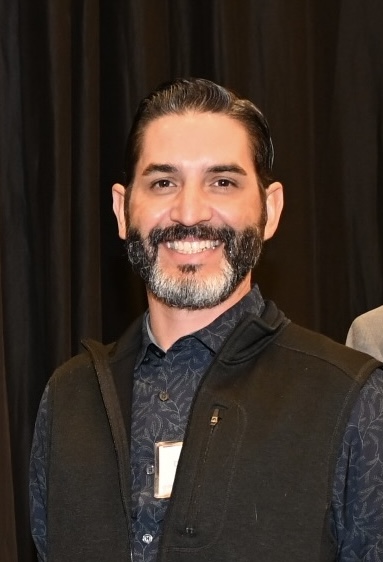
“There are only three regions in the United States that can grow fruits and vegetables from October through May,” Galeazzi said. “Southern Florida, southern Arizona, and southern Texas. We are one of three domestic production zones in the U.S.,” He added that water shortages are already forcing a shift in production patterns. “Without water,” he said, “we are shifting production patterns.”
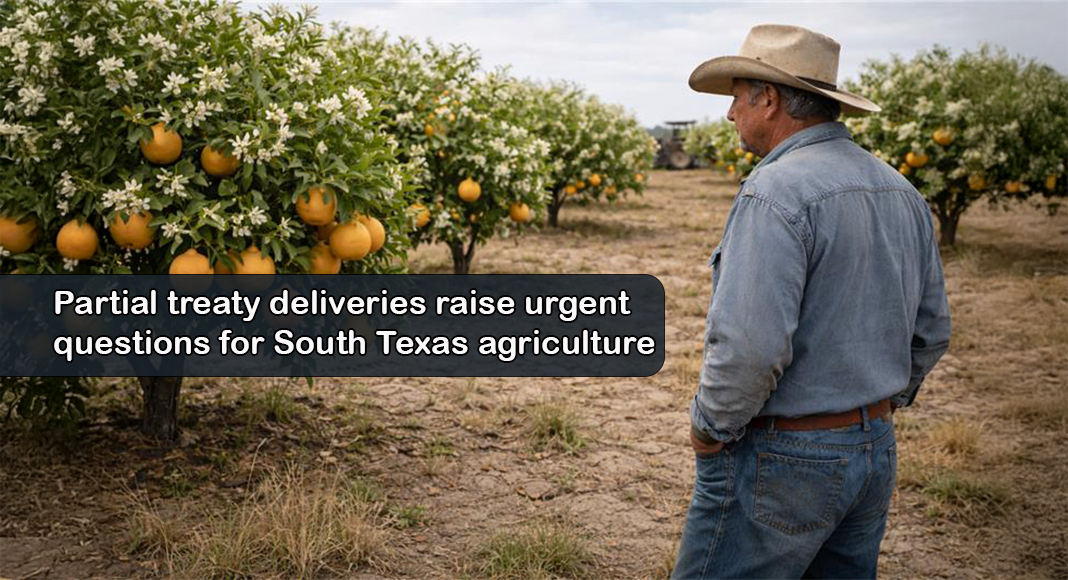
Galeazzi explained that South Texas farmers, particularly citrus growers, have entered multiple consecutive seasons with limited water supplies. “This is now the fourth season that they are going in with limited water supplies,” he said, referring to Texas grapefruit. Smaller fruit sizes and lower yields have pushed grocery buyers to look elsewhere. “They have turned to partners like Morocco, Egypt, and South Africa,” he said, noting that imports from those countries have more than tripled.
The economic impact has been immediate and severe. “Our Texas grapefruit producers, who have had a minimal crop, somewhere between 50 and 70 percent of a normal crop yield, are now having to compete with an outside market order that has dropped the price from about $20 a box to about six or seven dollars a box,” Galeazzi said. “You have lost $16 per box because you didn’t have water.”

Asked whether new or partial treaty water deliveries could reverse those losses, Galeazzi emphasized timing as the critical factor. Farmers, he explained, make planting decisions months in advance, based on whether water is guaranteed. “The first thing our farmers do when they don’t have water is they either don’t plant or they plant less,” he said. Last year, acreage was reduced by about one-third. “Guess what we’re going to plant this year?” he added. “Probably about a third less.”
For many winter crops, the window to plant has already passed. Galeazzi compared the situation to a worker being asked to do the same job for less pay. “You’re going to have the same bills, the same amount of work, but I’m going to pay you a third less,” he said. “That’s where farmers are at right now.”
Water scarcity is also changing what farmers grow. Galeazzi said crops like broccoli, which require precise watering at specific times, are increasingly avoided. “If you don’t have water guaranteed, you’re not going to grow the broccoli,” he said. Instead, farmers turn to crops like onions and cabbage, but even those are not profitable. “The cost to produce a 50-pound bag of onions here in Texas is about $7.15,” he said. “They’re selling for four to five dollars a bag.”
Because of these conditions, Galeazzi cautioned against assuming that late-arriving water can easily fix the problem. “This is the long-term impact of water shortages,” he said. “You fundamentally change your supply chain.” Once buyers move away from Texas producers, he explained, they do not automatically return when water improves. “When the water does come back,” he said, “Texas farmers are going to be the last on that list to get a phone call.”
While Mexico’s partial treaty payment may provide some relief for municipal systems or future planning, Galeazzi’s remarks suggest it is unlikely to save the current winter crop season fully. Planting decisions, capital investments, and market relationships have already been altered. “That’s not something our farmers can easily come back and change,” he said.
The symposium closed with a shared warning from participants on both sides of the border: water scarcity along the Rio Grande/Río Bravo is no longer a future risk but a present constraint, as Galeazzi’s remarks underscored, even when water arrives, timing matters. Without predictable and reliable supplies, recovery becomes harder, markets shift permanently, and the long-term viability of winter agriculture in South Texas remains uncertain.