






Texas Border Business

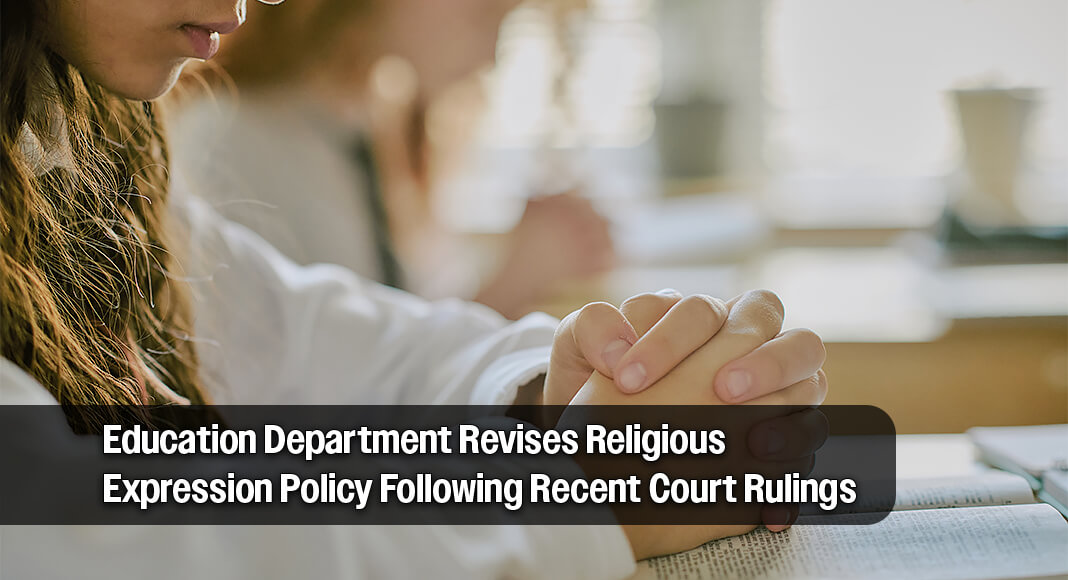
The U.S. Department of Education (the Department) issued guidance on constitutionally protected prayer and religious expression in public elementary and secondary schools.
The guidance, required by the Elementary and Secondary Education Act of 1965 to be updated periodically, makes clear that parents and children have a constitutional right to take part in public school in ways that align with their sincerely held religious beliefs. School officials should allow members of the public school community to act and speak according to their faith, as long as:
They respect the rights of others;

The school itself does not engage in religious activities or speech as an institution; and
The school does not favor secular views over religious ones or one religion over another.
“The Trump Administration is proud to stand with students, parents, and faculty who wish to exercise their First Amendment rights in schools across our great nation,” said U.S. Secretary of Education Linda McMahon. “Our Constitution safeguards the free exercise of religion as one of the guiding principles of our republic, and we will vigorously protect that right in America’s public schools.”
The purpose of this guidance is to provide information on the current state of the law concerning prayer and religious expression in public schools. This updated guidance supersedes and replaces the Department of Education’s Guidance on Constitutionally Protected Prayer and Religious Expression in Public Elementary and Secondary Schools (2023) issued under the Biden Administration. That document is no longer in effect.

Key Points of the Guidance:
Students, teachers, and other school officials have a right to pray in school as an expression of individual faith, as long as they’re not doing so on behalf of the school.
Public schools may not sponsor prayer nor coerce or pressure students to pray. For example, a school principal may not lead a prayer at a mandatory school assembly.
Public schools can regulate student speech that “materially disrupts classwork or involves substantial disorder or invasion of the rights of others.” For example, a student can’t pray out loud during math class in a way that prevents others from learning, provided such disruptions are handled consistently with other forms of speech.
Religious speech should be treated the same as secular speech. For example, an essay with religious content should be graded by the same academic standards as a secular essay of similar quality.
Religious student organizations should likewise be treated the same as secular student organizations. For example, if a school offers support or recognition to secular student clubs, it must provide the same support to religious student clubs.
Background:
In recent years, the Supreme Court has ruled substantively on issues of religious expression and related matters of religious freedom in public schools—most notably in Kennedy v. Bremerton School District (2022) and Mahmoud v. Taylor (2025).
Today’s guidance involves three key protections under the First Amendment: 1) The right of parents and children to freedom of speech; 2) The right of parents and children to freely practice their religion; and 3) The obligation of public schools to avoid establishing or endorsing religion.
In addition, this guidance is in accordance with parents’ longstanding constitutional right—recognized under the Fourteenth Amendment—to direct the education and upbringing of their children.
On February 7, 2025, President Trump signed an Executive Order establishing the White House Faith Office to “honor and enforce the Constitution’s guarantee of religious liberty and to ending any form of religious discrimination by the Federal Government.”
On May 1, 2025, President Trump signed an Executive Order establishing the Religious Liberty Commission “to safeguard and promote America’s founding principle of religious freedom.”
On September 8, 2025, President Trump previewed today’s guidance during a speech at the Religious Liberty Commission’s hearing on religious liberty in public education.
View the 2026 Guidance on Constitutionally Protected Prayer and Religious Expression in Public Elementary and Secondary Schools below: