








Texas Border Business

By Roberto Hugo González / Texas Border Business
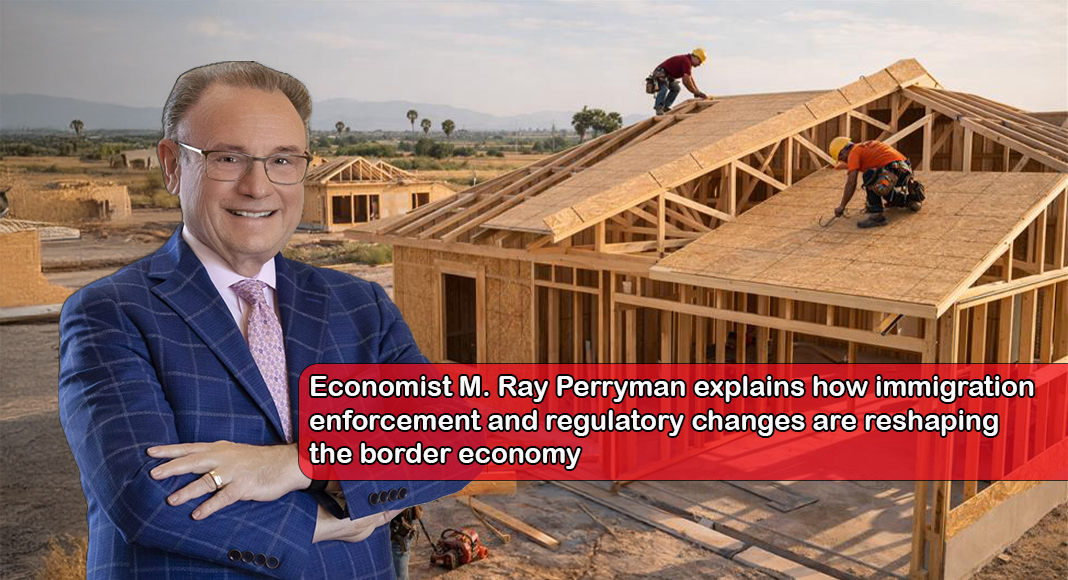
Recent changes to immigration enforcement and regulatory rules in Texas are producing wide-ranging economic effects in the Rio Grande Valley. Economist Dr. M. Ray Perryman said the impacts are complex, still evolving, and difficult to measure precisely. “There is not sufficient data available at this point to address most of the specific questions,” he said. “Because of the sheer complexity of the issue, I will offer a few thoughts from a big-picture perspective.”
Perryman noted some short-term benefits. “There were clearly some strains in some communities due to the large influx of people, and a more measured approach would generally be preferable,” he said, citing overburdened hospitals, stressed infrastructure, and crime-related challenges. “Reducing the number of immigrants to more manageable levels has improved public safety,” he added. He also said construction of roads, barriers, and related infrastructure “has generated some temporary local jobs and opportunities for businesses.” The presence of additional state and federal personnel increased local spending, although he noted that “many of them were relying on local food banks and social services during their tenure.”

Despite these limited gains, Perryman said the overall economic effects have been negative. A major concern is the decline in cross-border commerce. “Mexican consumers crossing into Texas to shop are vital to the local retail sector,” he said. “Stricter border enforcement, or even the threat of enforcement, has diminished that flow.” Manufacturing is also deeply tied to Mexico. “With three decades of free trade, and an even longer period under the maquiladora program, the Valley, the entire border region, and Mexico have formed manufacturing relationships based on comparative advantage,” he said. Goods often cross the border multiple times during production. “Tariffs significantly raise the costs of such integrated activity, and uncertainty about future policies frustrates investment opportunities,” he said. Borderland crossings and the Port of Brownsville are also affected.
Labor supply is another challenge. Perryman said fewer immigrant workers are tightening the local and statewide workforce. “Agriculture, construction, hospitality, and a number of other sectors have historically been critically dependent on immigrant workers,” he said. Employers are facing “higher labor costs, reduced production, or even closures.” He added, “The simple truth is that the U.S. has assumed the availability of these workers and built them into the economy.” Perryman cited estimates that “about 40% of the Texas construction workforce is comprised of undocumented labor,” with higher shares likely in border areas. “The impact of ICE raids and other deterrence measures has profound effects,” he said.
Perryman also warned that aggressive enforcement can strain community relations. “This is a region with deep cross-border business, social, and familial ties,” he said. Fear of arrest or deportation may discourage workers and businesses from settling in the region. He criticized policies that eliminate reimbursements for health providers serving undocumented individuals. “They don’t eliminate the underlying need for care,” he said. “They simply shift the burden to local communities, many of which already have some of the lowest per capita incomes in the country.”
Despite the challenges, Perryman emphasized the region’s strengths. “The Rio Grande Valley and the entire border region are a wonderful place with incredible people, natural beauty, fertile land, and a young workforce,” he said. He pointed to investments in higher education, health facilities, and infrastructure, and said the region has “enormous opportunities for future growth and improved living standards.” He concluded, “On balance, the current policies are posing significant impediments to realizing this potential, and the associated uncertainty is creating additional problems.”
Dr. Perryman is the founder of The Perryman Group, an economic research and analysis firm based in Waco. He earned his undergraduate degree from Baylor University and his doctorate in economics from Rice University.