














Texas Border Business




The Editorial Board of Texas Border Business
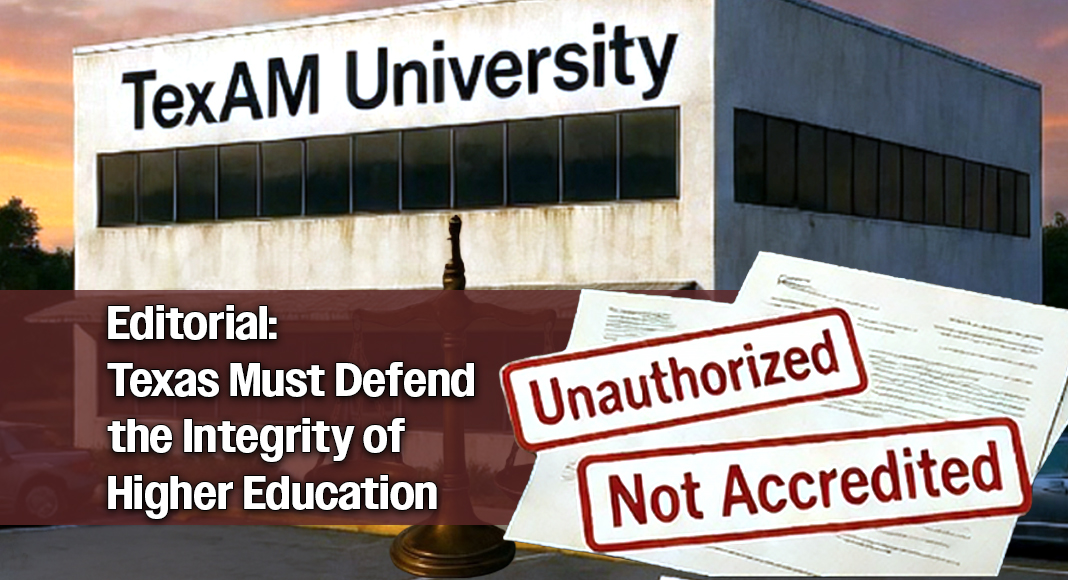
Texas has every right to defend the name, reputation, and legal standing of The Texas A&M University System. The decision to issue cease-and-desist orders against the entity operating as “TexAM University” is not only justified, it is necessary to protect students, families, and the integrity of higher education in this state.
According to the Texas Higher Education Coordinating Board, the organization calling itself “Texas American Muslim University at Dallas” or “TexAM” does not possess the Certificate of Authority required under Texas law to operate as a degree-granting institution. State officials said the entity has been advertising STEM degree programs, recruiting students, and using protected terms such as “university” without authorization.




The facts are clear. Texas law requires any private postsecondary institution offering degrees to obtain state approval before operating. The Coordinating Board stated that TexAM “has never been granted a Certificate of Authority to operate in Texas.” The agency warned that violations could carry criminal penalties, civil liability, administrative fines, and enforcement under the Texas Deceptive Trade Practices Act.
This issue is not about religion. Religious freedom is protected in Texas and across the United States. Faith-based schools operate legally throughout the country when they comply with state and federal requirements. The issue here is authorization, transparency, and public trust. No organization, religious or otherwise, should market itself as a university without meeting the legal standards required to protect students and families.
Public reporting indicates the organization began operations in late 2025. Founder Shahid A. Bajwa told JNS that the institution’s first semester started on Oct. 25, 2025, with 24 online students, followed by a second semester in March 2026 with 32 students. Bajwa also acknowledged the institution still lacked state authorization and accreditation.
That admission alone raises serious concerns. Students pursuing higher education invest time, money, and trust in institutions that promise academic credentials and career opportunities. If a school is not authorized to grant degrees, students risk obtaining credentials that employers, universities, and licensing boards may not recognize.
The use of the name “TexAM” compounds the problem. Texas A&M University is not merely another university brand. It is one of the most respected public institutions in the United States and a cornerstone of Texas identity. Its reputation was built over generations through academic achievement, military tradition, research, public service, and the loyalty of millions of former students and Texans.
Texas A&M belongs to the people of Texas. Its name carries public trust earned through more than a century of work and sacrifice. No private entity should be permitted to trade on that reputation by creating branding that invites confusion or implies affiliation where none exists.
The Coordinating Board also stated that the use of protected terms such as “university” without authorization violates Texas Education Code Section 61.313. State officials ordered the organization to immediately stop advertising, enrolling students, and using those protected terms.
This enforcement action sends an important message. Texas will not lower higher education standards. Institutions seeking to operate in this state must comply with the same legal and academic requirements expected of every legitimate college and university.
The Editorial Board of Texas Border Business supports decisive enforcement by state regulators and by The Texas A&M University System. Protecting students from misleading educational claims is a public obligation. Protecting one of Texas’s most respected university names is equally important.
The state should continue investigating whether students were misled, whether unauthorized academic claims were made, and whether additional enforcement actions are warranted under Texas law. Texans deserve transparency, accountability, and confidence that institutions operating as universities are legally authorized to do so. At the time this editorial was published, the website for the entity presenting itself as a university remained active online.
SOURCES: https://texam.education/texam/Home?utm_source=chatgpt.com
See related story: