










Texas Border Business



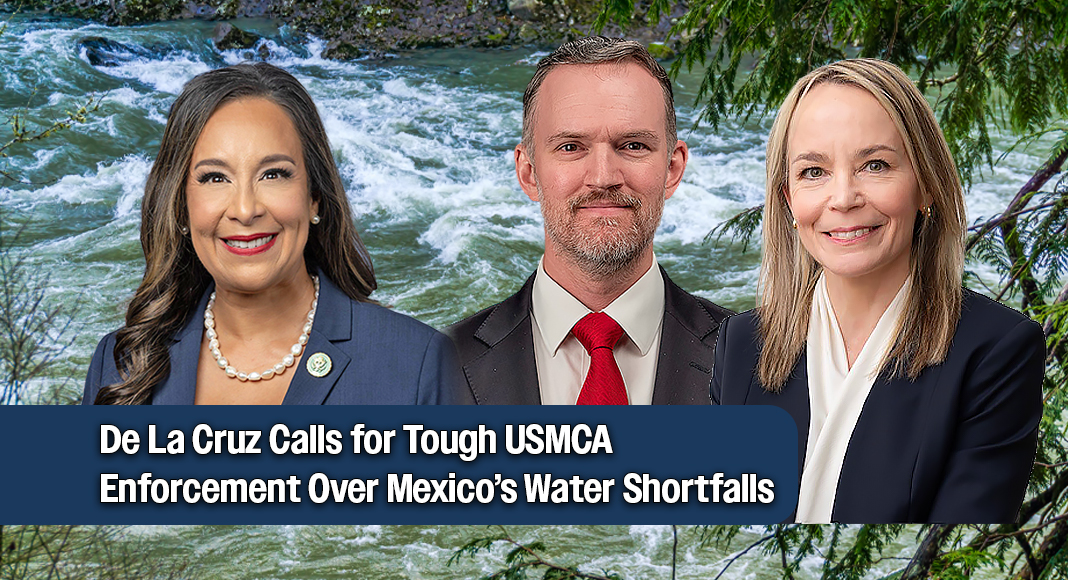
WASHINGTON – Congresswoman Monica De La Cruz (TX-15), along with a dozen members of the Texas Congressional Delegation, sent a letter to the United States Trade Representative (USTR) Ambassador Jamieson Greer and Chief Agricultural Negotiator Ambassador Julie Callahan, urging the Administration to use the upcoming USMCA renegotiations to ensure the Government of Mexico’s compliance with 1944 Water Treaty deliveries.
By incorporating strict enforcement mechanisms into the trade agreement, the Mexican government will face stricter consequences if they fail to comply with the 1944 Water Treaty delivery obligations.
The letter is co-signed by House Budget Committee Chairman Jodey Arrington (TX-19), House Small Business Committee Chairman Roger Williams (TX-25), Republican Study Committee Chairman August Pfluger (TX-11), Science, Space, and Technology Committee Chairman Brian Babin (TX-36), Congressman Michael Cloud (TX-27), Congressman Troy Nehls (TX-22), Congressman Lance Gooden (TX-05), Congressman Jake Ellzey (TX-06), Congressman Wesley Hunt (TX-38), Congressman Randy Weber (TX-14), Congressman Keith Self (TX-03), and Congressman Morgan Luttrell (TX-08).
Read the full letter here or below.



Dear Ambassador Greer and Ambassador Callahan,
We appreciate your team’s continued engagement with our offices as you prepare for the upcoming renegotiations of the United States–Mexico–Canada Agreement (USMCA). Since its enactment under the first Trump Administration in 2020, USMCA has delivered fairer market access for America’s agricultural producers. Through agreements struck since the beginning of the Administration, President Trump has reduced the agricultural trade deficit by 42%[1] and has opened key markets such as the European Union, China, India, and the United Kingdom to many American agricultural products. This increased market access will directly benefit the agriculture producers in our districts.
As the Administration moves forward with the USMCA’s mandatory review process, it is critical that your team prioritizes the elimination of trade deficits with Canada and Mexico, and seizes this opportunity to enforce Mexico’s on-time, annual payments of water deliveries from the 1944 Water Treaty.
Regions across the United States are experiencing drought conditions that have become exacerbated by Mexico’s disregard of the 1944 U.S.-Mexico Water Treaty. The treaty outlined specific thresholds of water quantities that each country must provide to the other, including Mexico’s responsibility to provide 350,000 acre-feet of water to the United States, annually.
For years, the Texas Delegation has been pursuing the repayment of Mexico’s water debt and the needed enforcement of the 1944 U.S.-Mexico Water Treaty. Secretary Rollins has worked extremely hard to get Mexico to deliver the water owed to us per year, but ultimately the United States remains at the mercy of Mexico’s compliance without any enforced consequences.
The effects of not including strong enforcement mechanisms for the 1944 U.S.-Mexico Water Treaty are clear. In 2023 alone, South Texas suffered an economic impact of almost $1 billion due to the water shortage.[2] This included the closure of the last sugar mill in Texas, resulting in the loss of 500 jobs and $100 million from the state’s economy. A long term solution to this perennial issue requires robust enforcement mechanisms.
Specifically, we ask for the inclusion of the following into the USMCA:
- Annual, predictable and enforceable water deliveries; and,
- Utilize the USMCA’s dispute settlement procedures to address instances of non-compliance; and,
- Transparent monitoring and reporting to track water deliveries and identify potential violations; and,
- Explore strict enforcement mechanisms for non-compliance with the 1944 U.S Mexico Water Treaty which USTR deems to properly manage trade relations and ensures adherence to the agreement.
Incorporating the 1944 U.S.-Mexico Water Treaty in the USMCA would prove more conducive to the resolution of the issue than any singular vow to resolve the existing water debt. Enforcement mechanisms would free South Texas communities from having to depend on Mexican goodwill for their prosperity.