






Texas Border Business

By Roberto Hugo González
Stakeholders from Nuevo Laredo and Laredo participated in introducing the Rio South Texas Region Binational Auto Cluster and its first phase, the Rio South Texas Region Industrial Data System. The digital platform is designed to centralize strategic information about manufacturing companies in Northern Tamaulipas and South Texas, enabling the mapping of key industrial sectors, identifying regional capabilities, and generating reliable data for investors.
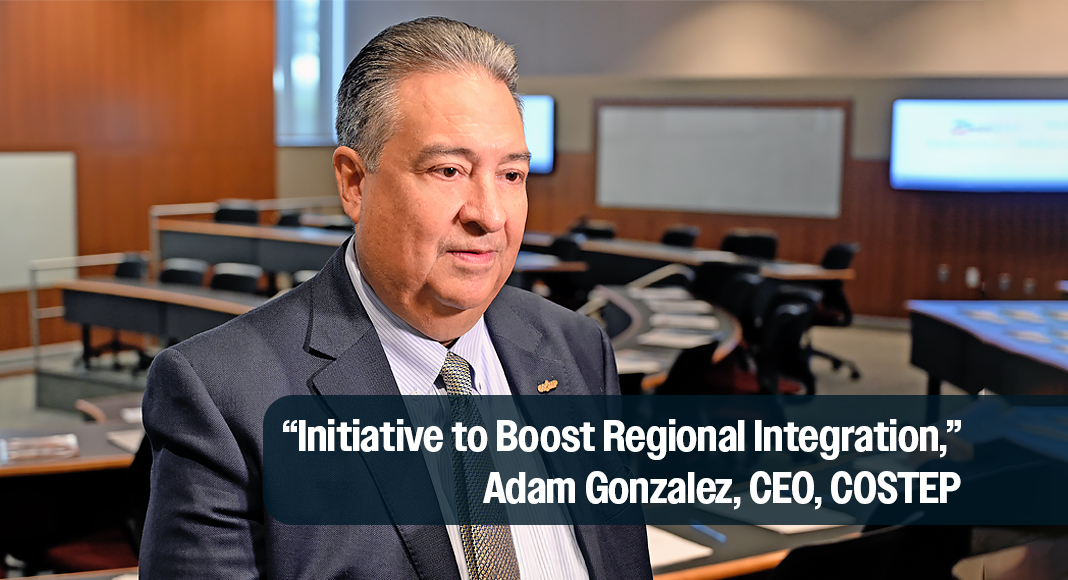
Adam Gonzalez, CEO of the Council for South Texas Economic Progress (COSTEP), delivered the first presentation.

Gonzalez provided background on COSTEP: “For those who may not know, COSTEP is a nonprofit organization that was established in 1972, and we have worked in this part of the region—what we call South Texas—for many years, with the education system, with colleges, with universities, and with the families of students preparing to continue their studies. So, we’re not new in that sense. But when it comes to economic development, we are new. We started this initiative in 2019.”
He explained that small communities often struggle to attract international investment on their own. “If we’re talking about 200,000 or 250,000 people, for a company in Europe, Asia, or Canada, that looks very small. But if we begin to promote ourselves as a region, then we can achieve something greater.”
The goal, Gonzalez said, is to “attract new companies or help existing companies here expand, bringing more investment into the region so that the manufacturing system can grow. That way, students who graduate in this region won’t have to leave elsewhere; they can stay here, serve their community, and continue investing in it.”
He also addressed the name Rio South Texas, clarifying that it was not a rebranding. “The name ‘Rio’ covers seven counties, from Cameron County to Webb County, and within this area, there are two recognized regions: the Rio Grande Valley and the Laredo region. We also work in partnership with the ten municipalities of Tamaulipas that correspond to us, from Nuevo Laredo to Matamoros.”

A video presentation reinforced the message. Gonzalez stated: “Welcome to the Rio South Texas Region, where vibrant communities on both sides of the Rio Grande River come together to create unparalleled global opportunity. This Texas–Mexico border is more than a dividing line. It’s a strategic gateway powering global development. The strength of Texas and Tamaulipas united is the power of two countries combined: the best of the U.S. and the best of Mexico.”
Additional video segments highlighted the workforce and business environment. One message noted: “The success and growth of business in this area has been because of the people. The workforce here is hardworking, committed, and a driving force behind regional progress.” Another emphasized that companies quickly “realize this is the place where they can grow, thrive, and succeed.”
The final segment described the vision: “Located at the heart of the North American supply chain, this region allows businesses to leverage an incomparable wealth of North American assets. Here, two nations flourish as one region, where people and industry thrive together.”
Looking ahead, Gonzalez underlined the importance of collaboration and the Industrial Data System. “This is a call to action. The Industrial Data System is a digital tool developed with our partners at ICP and others. Our goal is to collect non-invasive data—information that doesn’t compromise company secrets—so we can promote the region effectively. And that’s one of the things I love about our region—we are all bilingual, and we can make this collaboration happen across borders.”
The event was hosted by the A.R. Sánchez, Jr. School of Business at Texas A&M International University in Laredo.