












Texas Border Business




warning the South Texas traveling public about the threat of the New World Screwworm through a public awareness campaign.
CBP Laredo Field Office has developed an informational tearsheet in English and Spanish that advises about the threat of NWS and is distributing the tearsheet at the eight ports of entry from Brownsville to Del Rio, Texas that comprise the Laredo Field Office area of responsibility. CBP Laredo Field Office is amplifying this same message via Director, Field Operations Donald Kusser’s social media accounts on X, Instagram, and Facebook.
“We are working to increase public awareness regarding New World Screwworm so that the public can help prevent this invasive pest from reaching the U.S. and adversely affecting U.S. livestock and pets,” said Director, Field Operations Donald R. Kusser, Laredo Field Office. “By distributing these tearsheets and amplifying via social media, we are hoping to bring this message to the widest audience possible.”



NWS has been detected within 55 miles of the U.S.-Mexico border. The U.S. Department of Agriculture has ratcheted up the production and dispersal of sterile flies to expand domestic response capacity to approach approximately 500 million sterile flies per week. Importation of live cattle from Mexico has been suspended by the U.S. Government since May 2025 due to the emergence of a NWS outbreak in the central regional states of Mexico.
NWS (Cochliomyia hominivorax) is an invasive pest. The female adult fly lays eggs in the living tissue of fresh wounds in warm-blooded animals. The larvae (maggots) feed on the host causing the animal to become systemically ill from secondary bacterial infections. NWS can infest livestock, pets, wildlife, occasionally birds, and in rare cases, humans. NWS is not contagious from animal to animal.
The pest was eradicated in the United States in the 1960s. Since then, it occasionally reemerges and has resurfaced in Central America and Mexico. Effective eradication strategies center on controls on the movement of animals, strong surveillance systems, public outreach and the use of proven sterile insect technology. However, the USDA and their partners, including the Animal and Plant Health Inspection Service continue to explore additional innovative strategies to defeat the pests.
Renewed attention to this parasite is crucial, as it may pose future risks to livestock and wildlife.
Keeping NWS out of the United States is crucial to protect the livestock industry, economy and food supply chain.
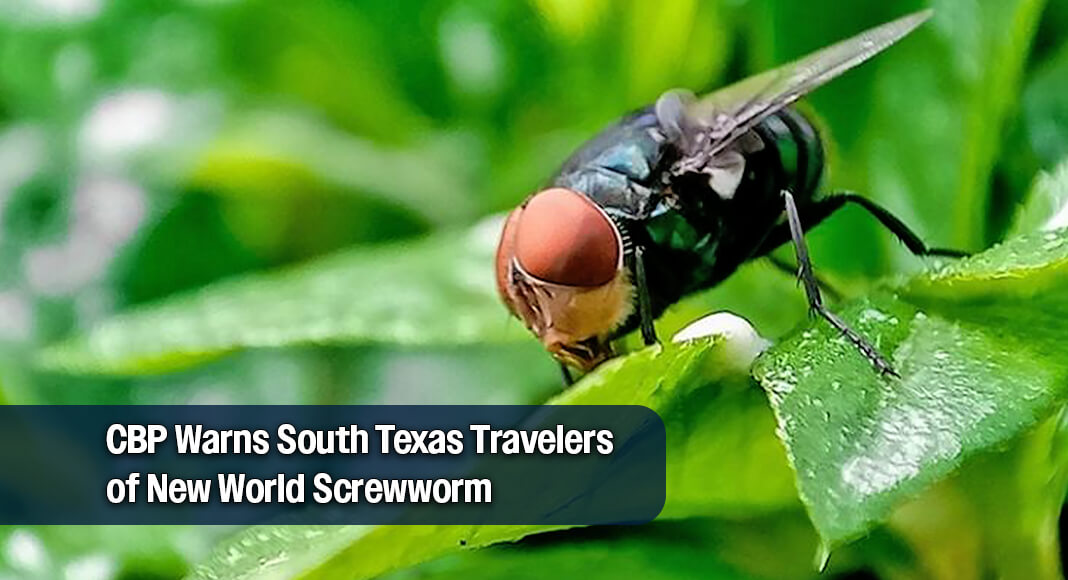
Adult screwworm flies are about the size of a common housefly (or slightly larger). They have orange eyes, a metallic blue or green body, and three dark stripes along their backs.
Report livestock, wild animals, and pets with the following signs:
- Irritated behavior
- Head shaking
- The smell of decay
- Presence of fly larvae (maggots) in wounds
If you think you have found a screwworm, report it immediately to your local veterinarian, State animal health official and APHIS office. This will allow APHIS and partner agencies to respond quickly and remove the screwworms before a population becomes established.
For more information, read Stop Screwworm: Unified Government Response To Protect the United States.