








By Roberto Hugo González / Texas Border Business

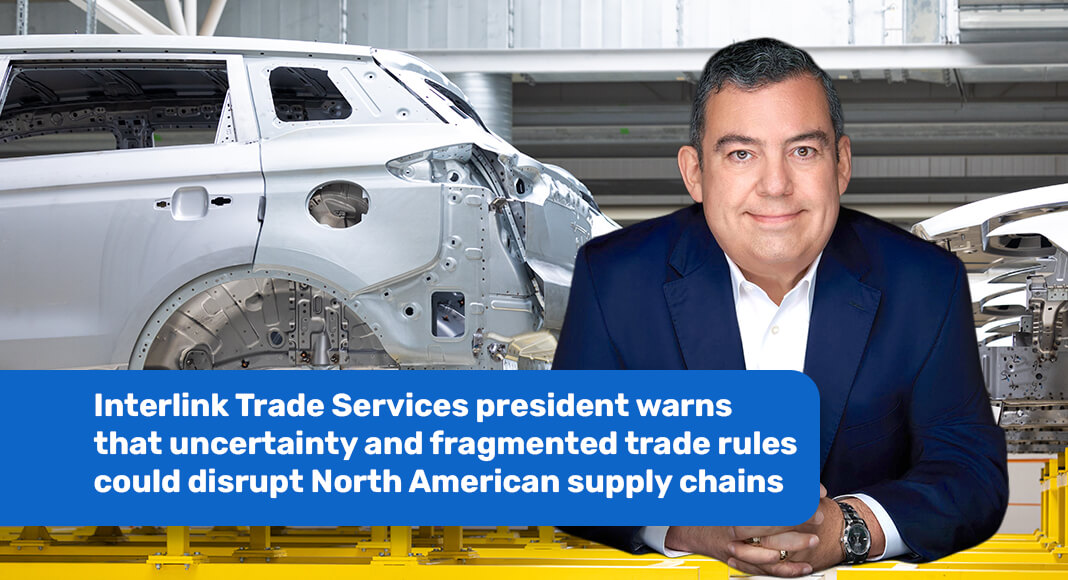
An overhaul or replacement of the United States–Mexico–Canada Agreement would create significant operational challenges for automakers and suppliers, according to Jorge Torres, president of Interlink Trade Services and a specialist in international commerce.
Torres said the most immediate and practical change for the auto industry would be the loss of a single set of rules governing trade across North America. “The biggest practical change will be having different rules of origin to qualify goods for preferential treatment under separate treaties,” he said. “The automotive supply chain in North America is heavily integrated, and having different sets of rules for Mexico and Canada will be a challenge.”
Rules of origin determine how much of a vehicle or auto part must be made within a trade bloc to qualify for lower or zero tariffs. Under a unified agreement, companies follow one framework. Torres said splitting that framework into separate U.S.–Mexico and U.S.–Canada agreements would complicate compliance and disrupt supply chains that cross borders multiple times.

He said uncertainty surrounding trade policy can be as damaging as tariffs themselves. “Uncertainty is the enemy of growth and expansion,” Torres said. “Companies cannot make decisions while there is a high degree of uncertainty.” He added that frequent changes in trade rules can “delay shipments, increase operational costs or higher tariffs, and expose companies to potential penalties for lack of compliance.”
Torres said adapting to multiple, overlapping trade rulebooks would be particularly difficult for automakers and major suppliers. “Having different rules of origin and different conditions under separate agreements will complicate matters from a compliance and supply chain perspective,” he said. “This will translate into higher operating costs, which will be passed to the consumer.”
The current agreement, he noted, has already reshaped how vehicles are built in North America. “Both NAFTA and USMCA allowed the automotive industry to expand in North America,” Torres said. He pointed to significant changes under the USMCA, including an increase in regional value content for vehicles to 75 percent, up from 62.5 percent under NAFTA, along with requirements that at least 70 percent of steel and aluminum come from the region and that 40 to 45 percent of vehicle content be made by workers earning at least $16 an hour.
“If these requirements change or are allowed to lapse, it will bring many challenges to the industry,” Torres said. He said those challenges could include reduced investment in North America and higher prices for vehicles and auto parts.
With a mandatory review of the USMCA scheduled for 2026, Torres said companies should begin preparing now for a range of outcomes. “We are recommending companies to look for alternate suppliers not only in North America but globally,” he said. He also urged businesses to run cost studies under different scenarios. “They need to be ready to react to possible changes on the horizon, whether the USMCA rules change or if the USMCA is allowed to lapse and bilateral agreements are put in place.”
Trade compliance, Torres said, has become central to corporate strategy. “Trade compliance has become a critical part of the decision-making process of many companies, and the automotive industry is one of them, and maybe the most critical of all,” he said.