








Texas Border Business

By Art Leatherwood Revised by William V. Scott, Handbook of Texas Online
Published by the Texas State Historical Association
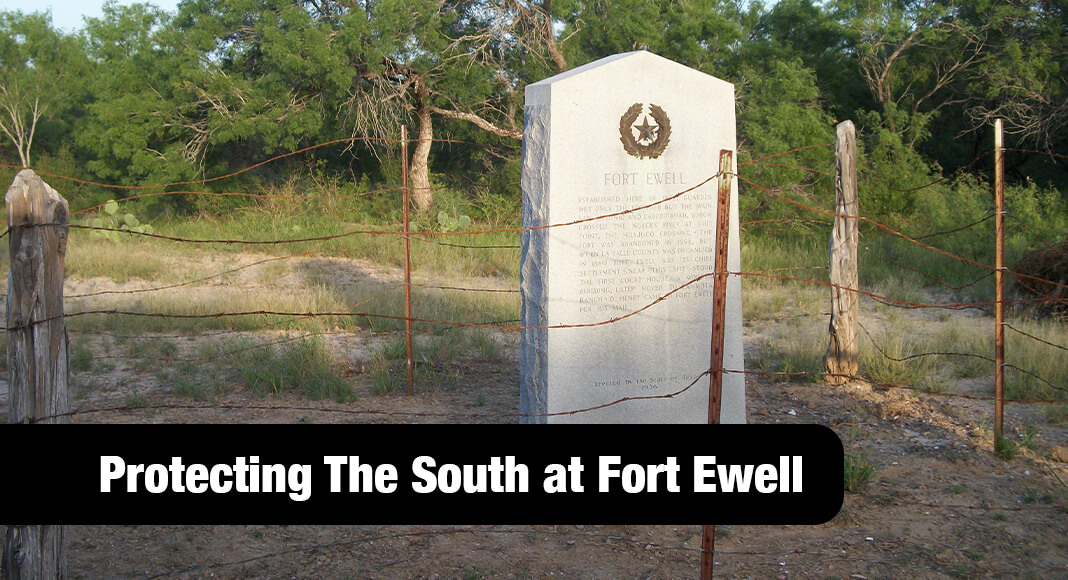
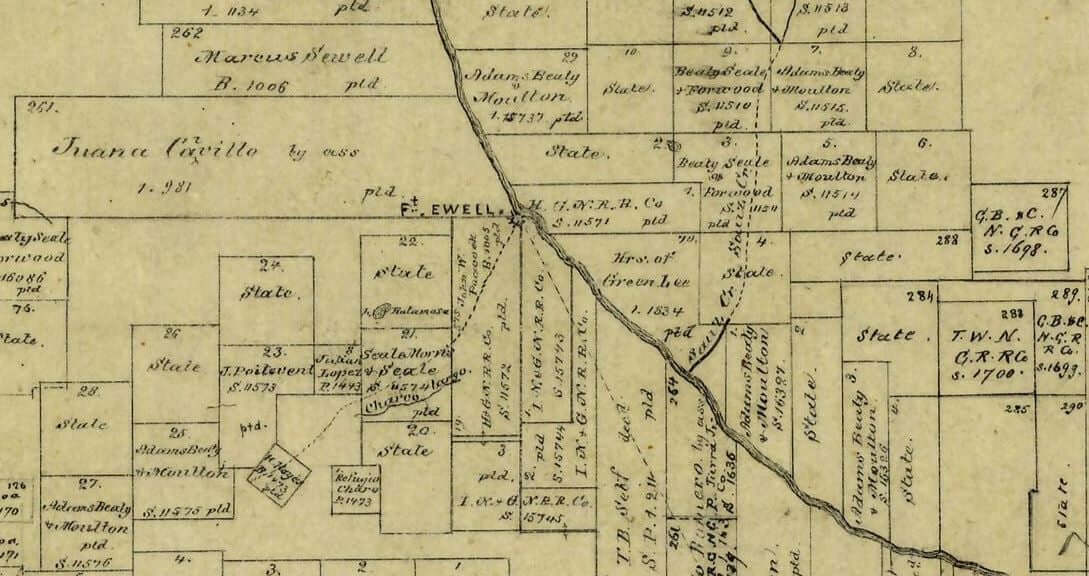
Fort Ewell was located on the south bank of the Nueces River at the crossing of the San Antonio-Laredo Road in what is now La Salle County. Gen. Persifor F. Smith, commander of the Eighth Military Department responded to American Indian raids and filibustering actions by Jose María De Jesús Carbajal in the South Texas borderlands by establishing a new fort between the Rio Grande and Nueces River. General Smith and his party left Fort Merrill on April 25, 1852; his party consisted of an escort of Capt. Andrew J. Lindsey and Bvt. Capt. Gordon Granger and thirty men of the Mounted Rifles accompanied by Bvt. Lt. Martin Luther Smith of the Topographical Engineers. General Smith described the new post as unconventional due to terrain and purposes. He described the location of the fort as hard ground that approached within a few yards of the Nueces River with a grove of Elm trees at the bottom. Fort Ewell’s position commanded the crossing of the roads from Eagle Pass, Laredo, Corpus Christi, San Antonio, and Fort Inge. The post was named for Lt. Thomas Ewell, who was president of a small school in Tennessee and later served during the Mexican War in the newly-formed Regiment of Mounted Rifles. Ewell was killed in the battle of Cerro Gordo on April 18, 1847, while leading Company F, which later founded the fort that bore his name.

Fort Ewell was established on May 18, 1852, and was garrisoned by Capt. Andrew J. Lindsey and Companies F and H of the Regiment of Mounted Rifles. Within the first month the fort’s population grew from 149 men to 492 men, which would be the largest population during its operation. When Bvt. Col. William W. Loring took command of Fort Ewell from Captain Lindsey and Bvt. Lt. Col. Andrew Porter, the garrison included other officers of Companies B, C, D, E, F, G, and H. The command staff of the Mounted Riflemen left the post on July 1, 1852, for Fort Merrill only to return on July 19. According to Order No. 23 on July 28, 1852, Bvt. Col. William W. Loring became commander of the units in the Rio Grande frontier, a sub-district of the Eighth Military Department. While trying to enforce the Neutrality Law in Texas, General Smith wrote an official report in July 1852 that cited reasons for “profilibustering propaganda” that filled newspapers. Smith also cited some Texans’ desire for revenge on Mexicans for previous acts, plotted invasions by slave owners to reclaim fugitive slaves who took refuge in Mexico, and the restlessness of mustered-out Texas Rangers. He pointed out that smugglers violated customs regulations and filibustering activities took attention away from the smuggling. General Smith hoped the U. S. government would establish more camps and forts as a preventative measure to stand against filibustering movements.
The intensifying situation on the Texas-Mexico borderlands forced Governor Peter Hansborough Bell into action on August 2, 1852. Governor Bell ordered Col. James S. Gillett to Brownsville to organize three companies for the protection of the lower Rio Grande. He wrote to President Millard Fillmore describing a desperate situation resulting from depredations of lawless bands of American Indians and Mexicans and requested recognition from the federal government. His request put the Texas Mounted Volunteers under the command of the U. S. Army officer Colonel Loring. Fort Ewell became the regimental headquarters of the Regiment of Mounted Riflemen on August 9, 1852, by Order No. 32. The fort served in this capacity until May 28, 1853, when the headquarters moved up the Nueces River to Fort Inge.
Permanent Standing Orders No. 5 assigned Asst. Surgeon Edward W. Johns to the post on August 18, 1852, to replace Asst. Surgeon Richard F. Simpson, who had been temporarily assigned to the post on June 25, 1852. Food and clothing were at a premium at the fort, and troops were often sick and suffered from scurvy. From 1852 to 1854 the residents were sick an average of once every three months. From September to October of 1852 the population of Fort Ewell fell dramatically from 234 to 67. The remaining soldiers were from Companies B and G, while the rest were put into the field. Fort Ewell was made headquarters of the Rio Grande frontier on October 21, 1852, by Special Order No. 5. The location along the Nueces and its proximity to Fort Merrill, Los Ojuelos, Remond’s Ranch, Ringgold Barracks, and Fort McIntosh made the post an ideal headquarters in the region. Nonetheless, the headquarters was moved to Fort Inge on May 28, 1853.
Col. William Grigsby Freeman made an official visit to Fort Ewell as Inspector General on June 11 and 12, 1853. Lieutenant Colonel Freeman reported the fort was in a poor location and insisted, “a less inviting spot for occupation by troops cannot well be conceived.” The Nueces River frequently overflowed its banks, which covered the nearby bottoms and salt marshes and made the fort inaccessible. The location suffered from poor grazing areas for the animals and a shortage of suitable timber for construction. Soldiers built structures using soft adobe, which was not strong enough to support a roof without bracing. Most of the buildings were covered with canvas instead of shingles. The outpost consisted of a commissary storehouse, a blacksmith’s shop, and two sets of company quarters. Multiple attempts to grow kitchen gardens failed due to lack of rainfall. Lieutenant Colonel Freeman advised relocating the fort to Willow Crossing, which was forty miles North along the Nueces River. At the time of Freeman’s inspection of Fort Ewell the post commander was Bvt. Maj. John S. Simonson of Company G. During the inspection, Lieutenant Colonel Freeman performed a review of the three companies of soldiers. The group included Capt. Noah Newton of Company B, who was briefly held under arrest at the fort. Capt. Newton was released and served as post commander in July 1853, but died shortly afterward. Col. Freeman remarked that the troops in review showed “steadiness and regularity,” and remarked that the soldiers wore uniforms and caps from 1851 that were not ideal for the Texas climate.
The Regiment of Mounted Riflemen at Fort Ewell was re-designated as the First Regiment of Mounted Riflemen in 1853 to accommodate a second regiment that never fully formed. The number of soldiers at the fort varied between 120 and 200 soldiers until July 1854 when the garrison dropped to less than one hundred men. Many soldiers deserted and crossed the border into Mexico. A Report to the secretary of war in Washington on December 1, 1853, explained that the Eighth Military Department was establishing new posts in more favorable locations to enable the department to dispense with smaller and less essential posts. The U. S. Army utilized Texans to help protect against raids from Mexico. Additionally, the problem of runaway slaves escaping into Mexico enflamed international tensions. Carvajal even enlisted local men in the effort, including one who held a permit from the governor of Texas for the recovery of runaway slaves from Mexico. To complicate the matters, slave owners often pursued their runaway slaves with hunting parties crossing into Mexico without permission to reclaim their property. These actions persisted throughout the existence of Fort Ewell as Carvajal continued to cause havoc on both sides of the Rio Grande.
Fort Ewell was abandoned by the U. S. Army on October 3, 1854, after 2nd Lt. Hyatt C. Ransom and Company G of the First Regiment of Mounted Rifles departed the post. In late 1855 Company G, along with Battery B (Light Company) of the Fourth U. S. Artillery, camped at the abandoned site of Fort Ewell. This camp served troops traveling from San Antonio to Fort McIntosh. The Fort Ewell site continued to be used as a town and trading post in the years after the departure of the U.S. Army. LaSalle County was created from the Bexar District on February 1, 1858, and settled by a Tennessean, William Allen “Peg-leg” Stewart, among others. Stewart married a Mexican woman and held great influence with Mexican people in the region. He became a prominent citizen and property owner of the Fort Ewell settlement.
In the Spring of 1861 Fort Ewell was beset by raids of lawless bands and American Indians. During the Civil War, Fort Ewell was utilized as a camp for state and Confederate forces and served the Cotton Road which transported Confederate cotton from various points to Laredo and Eagle Pass where it was crossed into Mexico. In late December 1863 Col. James Duff ordered the Thirty-First Brigade of Texas State Troops to Fort Ewell. In February 1864 Col. Santos Benavides had 150 soldiers at the location when Col. John S. “Rip” Ford established this former fort as his headquarters, a depot for supplies, and mustering location for his troops. Ford’s headquarters soon reported having 1,500 well-armed and provisioned mounted soldiers. In anticipation of a conflict arising at Piedras Negras, Ford ordered three companies of rangers to Eagle Pass. The next month, Ford prepared to attack the Federal forces stationed at Brownsville. His force of 2,100 men were stationed at Fort Ewell on the Nueces River. Col. Ford’s command marched from Fort Ewell and arrived at Laredo on April 17, 1864.
William A. Stewart applied to the U. S. Post Office Department to make Fort Ewell an official post office location in June 1871, and he became the first postmaster of LaSalle County on October 23. The post office was named Fort Ewell, but it was located in the town of Guajoco, which developed after the fort was abandoned. Fort Ewell was designated as the county seat until it was moved to Cotulla in 1883. In April 1878 the last raid of the region, often referred to as the Mexican and Indian Raid of 1878, occurred. The raid lasted six days and killed at least eighteen persons and penetrated northward from the Rio Grande to the vicinity of Fort Ewell. As a result of the murders, both the U. S. Army and the Texas Rangers patrolled around Fort Ewell. The Fort Ewell post office in Guajoco was decommissioned in 1886, and the community began a steady population decline.