Rio Grande Valley Sector Border Patrol (RGV) agents interdicted three marijuana smuggling events between October 28 and November 3, 2022, resulting in more than a quarter million dollars’ worth of marijuana seized.USCBP Image
Texas Border Business
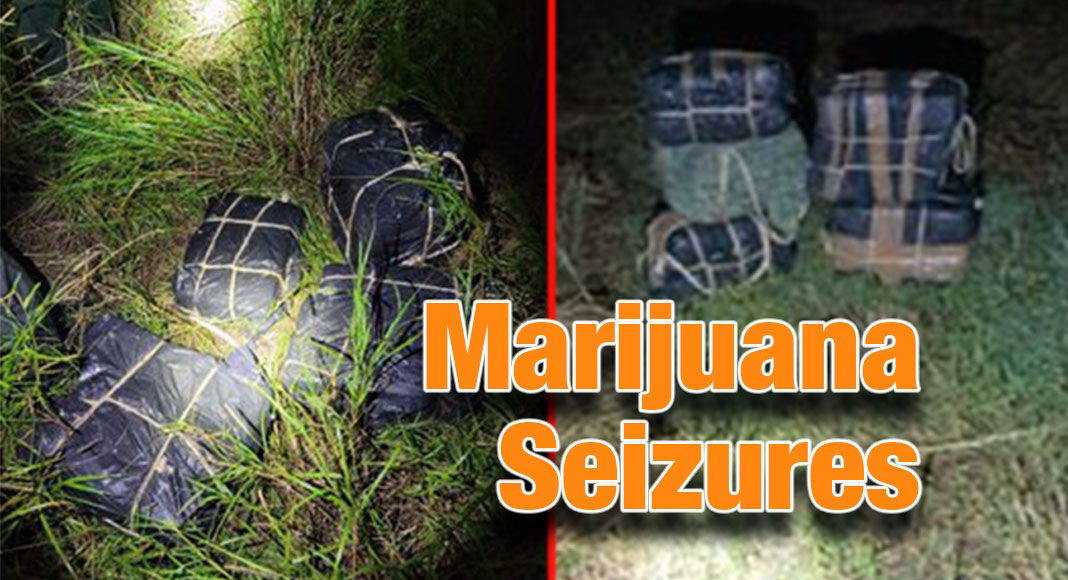
EDINBURG, Texas – Rio Grande Valley Sector Border Patrol (RGV) agents interdicted three marijuana smuggling events between October 28 and November 3, 2022, resulting in more than a quarter million dollars’ worth of marijuana seized.
On October 28, McAllen Border Patrol Station (MCS) agents seized over 76 pounds of marij0uana when camera operators observed subjects carrying bundles of drugs near Hidalgo. MCS agents responded to the area and seized two bundles abandoned in the brush near the Rio Grande. Agents searched the surrounding area but did not locate any subjects. The marijuana is valued at more than $60,000 USD.
Just after midnight on November 3, 2022, Rio Grande City Border Patrol Station (RGC) agents responded to suspicious activity near the river in Garceno, Texas. Agents interdicted approximately eight narcotic smugglers in the brush. The smugglers dropped their bundles of marijuana and fled toward the river and absconding into Mexico. Agents seized five bundles of marijuana with a total weight of 136 pounds and valued at more than $109,000 USD.
Shortly after, RGC agents working with the RGV Horse Patrol Unit interdicted another marijuana smuggling attempt not far from the previous seizure. During this event, agents again encountered eight subjects who abandoned four bundles of marijuana and absconded into Mexico. The marijuana weighed 112 pounds and is valued at almost $90,000 USD.
“I am very proud of the work RGV agents are doing on a daily basis to secure our border. In addition to the immigration challenges our agents face every day, they remain watchful of other criminal activities facing our communities. Since the beginning of the fiscal year, October 1, our agents have seized more than 3,000 pounds of marijuana,” stated Rio Grande Valley Sector Chief Gloria I. Chavez.
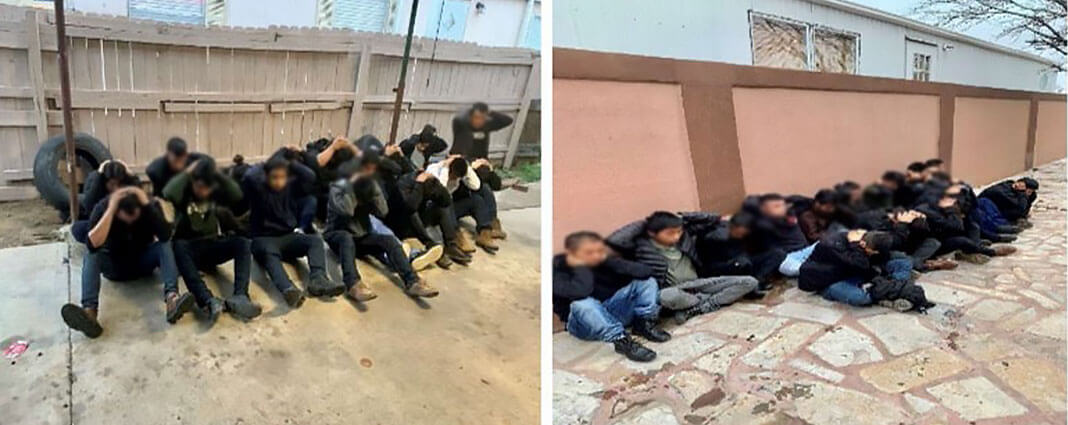
As part of Operation Lone Star, DPS discovered two stash houses in Webb County containing a total of 31 illegal immigrants after noticing suspicious activity at the residences. Photo: Texas DPS
Texas Border Business
AUSTIN, Texas – Governor Greg Abbott, the Texas Department of Public Safety (DPS), and the Texas National Guard are continuing to work together to secure the border; stop the smuggling of drugs, weapons, and people into Texas; and prevent, detect, and interdict transnational criminal behavior between ports of entry.
Since the launch of Operation Lone Star, the multi-agency effort has led to over 321,000 migrant apprehensions and more than 21,400 criminal arrests, with more than 18,900 felony charges reported. In the fight against fentanyl, DPS has seized over 350 million lethal doses of fentanyl during this border mission.
Texas has also bused almost 8,300 migrants to our nation’s capital since April, over 3,500 migrants to New York City since August 5, and more than 1,100 migrants to Chicago since August 31. The busing mission is providing much-needed relief to our overwhelmed border communities.
Operation Lone Star continues to fill the dangerous gaps left by the Biden Administration’s refusal to secure the border. Every individual who is apprehended or arrested and every ounce of drugs seized would have otherwise made their way into communities across Texas and the nation due to President Biden’s open border policies.
After 84 illegal immigrants were discovered by DPS concealed in a dump truck last week, DPS Lt. Chris Olivarez spoke with Fox News about how enhanced border security resources available through Operation Lone Star are enabling troopers to keep up with cartels’ increasingly cunning methods of smuggling.
“The smuggling organizations are always finding ways to bypass law enforcement and checkpoints, because it’s all about profit,” said Lt. Olivarez. “They treat these immigrants as a commodity, and they will continue doing so as long as there are immigrants coming across our borders. Tragically, we’re going to see more loss of life.”
DPS troopers stopped a Mercedes SUV in Zavala County this week, and three illegal immigrants bailed out and ran toward the brush. The driver from Houston and passenger, a known member of the Tango Blast gang, were arrested and charged with human smuggling and unlawful carrying of a weapon. Six illegal immigrants—four males, one female, and a 9-year-old—were found inside the vehicle.
DPS Lt. Chris Olivarez discussed with Fox News how law enforcement continues to see increases in human smuggling along the border, especially in the Eagle Pass and Del Rio areas. Drivers from major Texas cities are also being lured to the border to serve as human smugglers. With nearly 1 million total gotaways reported in fiscal years 2021 and 2022, as well as 98 terrorists attempting to cross the southern border last year, President Biden’s reckless open border policies have created a significant national security crisis.
“We know [smuggling is] a multibillion-dollar trade, and criminal organizations are making more money on human smuggling than they are on drugs,” said Lt. Olivarez. “The border crisis impacts not just border communities but the entire country when we talk about crime.”
DPS troopers were led on a high-speed pursuit in Kinney County by an illegal immigrant from Honduras who is a previously deported felon. The driver was arrested for smuggling of persons and evading arrest. Four illegal immigrants were apprehended and referred to Border Patrol.
After local ranchers in the highly trafficked Eagle Pass region agreed to start pursuing criminal charges for trespassing, DPS has been arresting illegal immigrants on private property in the area. DPS recently arrested one group of 59 illegal immigrants on criminal trespassing charges on a private ranch.
“You never know who you’re encountering out here on these private ranches; that’s why it’s very important our troopers are out here,” said Lt. Olivarez. “In some cases, [illegal immigrants] are going to try to make the attempt again to enter the United States. It’s an ongoing cycle all based off the policies in place now and the fact that there are no consequences on the federal side for these individuals who are coming across.”
Texas National Guard soldiers continue working alongside DPS troopers and law enforcement partners to secure the border against transnational criminal activity. As part of Operation Lone Star, soldiers apprehend individuals criminally trespassing on private property, most of whom are illegal immigrants, and prevent the cross-border trafficking of illegal drugs like fentanyl.
“It’s not just DPS who thank us, we have people when we’re in town coming up to us all the time to thank us for our assistance,” said SGT Michael Thomas, Kilo Co. medic and team leader in Laredo.
A human smuggler led DPS troopers on a vehicle pursuit in Kenedy County. The driver and three illegal immigrants bailed out and ran toward the brush. A total of four illegal immigrants were apprehended and referred to Border Patrol.
DPS Discovers Two Stash Houses In Webb County Hiding 31 Illegal Immigrants
Photo: Texas DPS
As part of Operation Lone Star, DPS discovered two stash houses in Webb County containing a total of 31 illegal immigrants after noticing suspicious activity at the residences. The first stash house, located in east Laredo, resulted in the discovery of 15 illegal immigrants. The second, located in south Laredo, uncovered 16 illegal immigrants in hiding.
All illegal immigrants are from Mexico or Guatemala and have been referred to Border Patrol.
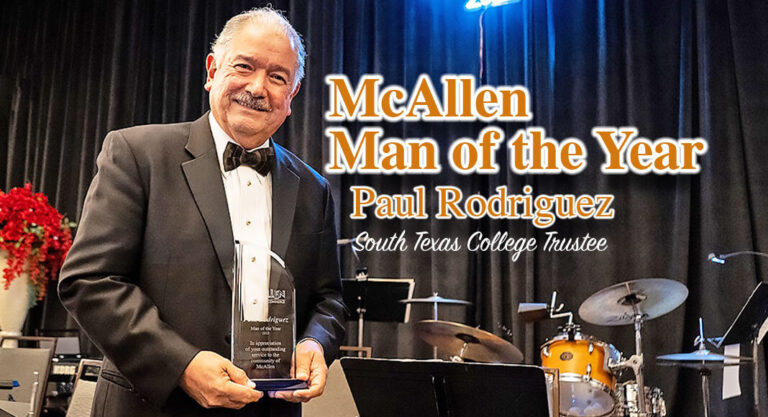
The McAllen Chamber of Commerce has named South Texas College Trustee Paul Rodriguez McAllen Man of the Year. STC Image
Texas Border Business
By Amanda Sotelo
The McAllen Chamber of Commerce has named South Texas College Trustee Paul Rodriguez McAllen Man of the Year.
“This came as a great surprise…Man of the Year – it’s humbling,” said Rodriguez. “I never imagined that I would be bestowed this honor. I do what I do, because I like serving my community and making it a better place, not for the recognition.”
Rodriguez has served as a trustee of STC since 2012, representing District 3 which includes south McAllen, southwest Pharr, Hidalgo, Sharyland, southeast Mission and Granjeno.
He is also the president and chief executive officer of Valley Land Title Co., a real estate title insurance agency with four offices in Hidalgo County and is the current president of the Texas Land Title Association (TLTA), making him the first Rio Grande Valley native to hold this state title.
It is Rodriguez’s work and volunteerism that have earned him the title of Man of the Year, in what’s become a tradition in the McAllen community since 1995.
McAllen Chamber President and Chief Executive Officer Josh Mejia said annually a selection committee, comprised of a variety of stakeholders from the public and private sector select the Man and Woman of the Year.
To be considered for the honor, the recipient must have been nominated by someone in his/her community.
“To be considered by the selection committee, you have to embody the character, experience and background of an individual unconditionally committed to the betterment of the city of McAllen,” said Mejia. “We are proud to announce Mr. Paul Rodriguez, alongside Sony Rego, as the newest members of this exclusive list of extraordinary people who keep McAllen, Texas at the center of all they do.”
As a trustee of STC, Rodriguez serves as a member of the Education and Workforce Development Committee and the Finance, Audit and Human Resources Committee.
In addition to his position on the board, he is also Chairman of Municipal Utility District No. 1 and board member of Affordable Homes of South Texas.
In addition, Rodriguez’s community service expands into various roles dedicated to the Mission Economic Development Authority, Mission Regional Medical Center, Texas Department of Housing and Community Affairs, Sharyland Independent School District, Juan Diego Regional Catholic High School and Valley Alliance of Mentors for Opportunities and Scholarships.
“It is a privilege serving my community and an honor to be recognized for it,” said Rodriguez. “My goal is to always serve STC, a catalyst for economic development in the Valley and for creating a college-going culture in our region; the constituents who have entrusted me with this responsibility and the community in which I live. All of this is surreal, and I thank my family, friends and supporters.”
STC President Ricardo J. Solis said it makes him proud having someone of integrity and dedication like Rodriguez on the STC Board of Trustees serving the college and its students.
“We are so proud of him, his service and all he has accomplished,” said Solis. “He is so deserving of this honor…he has been our ‘Man of the Year’ every year since 2012 and we’re glad that the city of McAllen sees that as well. Congratulations to him from everyone at STC.”
Trade delivers a host of benefits for Americans, but what are the benefits for America’s small businesses? Image for illustration purposes
Texas Border Business
US Chamber of Commerce
By John G. Murphy Senior Vice President for International Policy
Trade delivers a host of benefits for Americans, but what are the benefits for America’s small businesses?
America’s small business owners are hailed as heroes of free enterprise, not least because they have accounted for two out of every three jobs added to the U.S. economy in the past 25 years.
In other words, trade is the engine that drives many small businesses. These firms account for nearly one-third of U.S. merchandise exports, according to the U.S. Department of Commerce. The number of small and midsized firms that export has risen about threefold over the past two decades.
However, we can and must do more. Only about one in every 100 of America’s 30 million small businesses export. In countries such as Germany and Switzerland, the share of small firms that sell their products abroad is five to ten times larger.
To expand export opportunities for small businesses and make it easier for them to tap global markets, the U.S. should pursue a robust trade agenda that supports small businesses and broader economic growth.
To this end, the United States has negotiated trade agreements with 20 other countries. These trade deals have created new opportunities for U.S. farmers, ranchers, manufacturers, and service providers of all sizes. They do so by sweeping away foreign tariffs and other barriers that too often shut out American exports ranging from apples to zucchini and airplanes to x-ray equipment.
The benefits for U.S. small businesses are substantial. By value, approximately one-third of all merchandise exports by America’s smaller businesses go to these markets. More small and medium-sized firms export to Canada than to any other market; by value, these small businesses export more to Mexico than to any other country (data).
While some critics argue that trade agreements only benefit large multinationals, the truth could hardly be more different. Trade agreements require foreign governments to eliminate the tariffs that may be small change to multinationals, but they are a big deal to small businesses. Also, multinationals can rejigger their supply chains and shift some parts of their production to other countries to route around tariff walls — which small businesses can’t do.
Among the provisions that are particularly helpful to small businesses, U.S. trade agreements:
One emerging area in trade agreements is especially important to small businesses: Digital trade.
To get a fresh perspective on the issue, the U.S. Chamber recently issued a report entitled Growing Small Business Exports: How Technology Strengthens American Trade, and it uncovered some surprising findings. Based on a national survey of more than 3,800 small businesses and a related economic analysis, the report produced a new estimate that 9% of U.S. small businesses currently export goods or services, a figure considerably higher than indicated by official statistics.
These larger-than-the-official-statistics results indicate that digital trade is already contributing to the expansion of U.S. small business exports and job creation, chiefly in these three ways:
Digital advertising plays an overlooked but critical role in allowing U.S. small businesses to economically reach potential foreign customers in a targeted fashion. Small businesses simply had no such tools in the pre-internet era: print advertising in newspapers or direct mail were never feasible options for U.S. small businesses trying to tap even nearby and familiar markets such as Canada.
Modern digital tools are revolutionizing payment collection, cited by small business exporters as a top challenge. Uncertainty around international payment collection was a principal brake on small business exports even a few years ago, but such risks and foreign exchange complexities can now be managed in a cost-effective manner by digital payment services.
International shipment firms, including express delivery companies, today provide comprehensive services that handle customs clearance procedures and costs for small business owners who lack the expertise and time to tackle the minutiae of such matters. The evidence supports the view that online channels reduce transaction costs associated with international trade significantly.
One takeaway is that digital trade allows small business exporters and larger firms to prosper together. Some of the services mentioned above in areas such as digital advertising are fostering new trade ecosystems of mutual benefit.
In addition to trade agreements, tariff relief programs like the Generalized System of Preferences are important to U.S. small businesses that depend on imports — and Congress should act this year to renew the lapsed GSP program.
In sum, policymakers should think globally as they consider how to foster a business environment in which entrepreneurs and small businesses can flourish. Tearing down trade barriers through new trade deals is vital for firms of all sizes.
Attorney General Paxton has joined a Florida-led amicus brief in the San Francisco-based U.S. Court of Appeals for the Ninth Circuit in support of Arizona’s efforts to strike down the federal contractor vaccine mandate. Image for illustration purposes
Texas Border Business
AUSTIN, Texas – Attorney General Paxton has joined a Florida-led amicus brief in the San Francisco-based U.S. Court of Appeals for the Ninth Circuit in support of Arizona’s efforts to strike down the federal contractor vaccine mandate.
The brief highlights the many ways President Biden and his Office of Management and Budget (OMB) far exceeded their legal authority to try and enact theCOVID-19 vaccine mandate, which they presented as a public health measure. A district court previously recognized the Biden Administration’s unlawful actions and enjoined the policy, preventing it from taking effect. The Administration has since appealed that decision.
The brief filed by Texas and other states notes that while the Biden Administration claims this mandate will protect the U.S. labor market, it would likely do the opposite by exacerbating the current national labor shortage.
“[R]oughly two-thirds of the unvaccinated say they would quit their job in response to a vaccine mandate. Instead of addressing the alleged threat of temporary labor shortages caused by periodic sick leave, the mandate threatens contractors with mass terminations and resignations. . . . . [T]he President did not possess credible evidence at the time he issued the Executive Order that increased vaccination among employees would meaningfully reduce COVID transmission—and that has only become more clear with respect to newer variants,” the brief states.
The amicus brief was filed following a recent, related decision by the Atlanta-based U.S. Court of Appeals for the Eleventh Circuit, which declared that the Biden Administration’s unconstitutional mandate exceeded its legal authority. Attorney General Paxton, a leader in the fight against the left’s illegal mandates, filed two amicus briefs over the summer in opposition to the federal contractor mandate.
Laredo Sector Border Patrol agents assigned to the Laredo South Station arrested a convicted felon at Laredo, Texas. USCBP Image for illustration purposes
Texas Border Business
LAREDO, Texas – Laredo Sector Border Patrol agents assigned to the Laredo South Station arrested a convicted felon at Laredo, Texas.
On Nov. 2, Border Patrol agents were working their assigned duties when they apprehended a group. One of the persons in the group was identified as Gustavo Macias- Ruvalcaba, a 36-year-old male Mexican citizen. Record checks revealed he had a prior arrest and conviction for Aggravated Sexual Assault of Child, which he was sentenced to ten years probation.
Gustavo Macias-Ruvalcaba was also deported earlier this year in Laredo, Texas for immigration violations. He was charged with 8 USC § 1326 – Illegal Re-entry after Deportation.
He remains in custody pending further investigation.
U.S. Customs and Border Protection welcomes assistance from the community. Citizens are encouraged to report suspicious activity to the U.S. Border Patrol while remaining anonymous by calling 1-800-343-1994.
U.S. Customs and Border Protection (CBP) Field Operations officers at the Progreso International Bridge arrested a man returning from Mexico Thursday afternoon after learning he had an outstanding warrant for Sexual Assault of a Minor out of the Solano County Sheriff’s Office in California. USCBP Image for illustration purposes
Texas Border Business
PROGRESO, Texas – U.S. Customs and Border Protection (CBP) Field Operations officers at the Progreso International Bridge arrested a man returning from Mexico Thursday afternoon after learning he had an outstanding warrant for Sexual Assault of a Minor out of the Solano County Sheriff’s Office in California.
“The arrest of a man wanted for sexual assault of a minor that occurred over 2,000 miles away is a prime example of the continuous commitment CBP officers exercise to safeguard our country and community,” said Port Director Walter Weaver, Progreso/Donna Port of Entry.
The apprehension occurred on Thursday, Oct. 27, at the Progreso International Bridge after a male subject returned from Mexico traveling by foot. CBP officers queried the traveler using CBP databases and referred him to secondary due to a possible match to an outstanding warrant. The man was referred for secondary for further inspection and identity confirmation.
In secondary, CBP officers conducted a biometric fingerprint check and utilizing national law enforcement databases confirmed his identity as 46-year-old Rudy Winters, a United States citizen, wanted in Solano County, California on an outstanding warrant for sexual assault of a minor. CBP officers turned Winters over to the Hidalgo County Sheriff’s Office for adjudication of the warrant. Charges and allegations contained in criminal complaints are merely accusations. Defendants are presumed innocent unless and until proven guilty.
Laredo Sector Border Patrol working collaboratively with Texas Department of Public Safety (DPS), shut down two stash houses in Laredo, Texas. USCBP Image for illustration purposes
Texas Border Business
LAREDO, Texas – Laredo Sector Border Patrol working collaboratively with Texas Department of Public Safety (DPS), shut down two stash houses in Laredo, Texas.
On Nov. 1, Border Patrol agents working with DPS arrived at two separate residences one was located on Balcones Drive and the other at Creosote Loop, where they took into custody a total of 34 individuals.
After record checks were conducted, it revealed that they were all in the country illegally from the countries of Mexico and Guatemala.
All the individuals were transported to the Laredo South Station and will be processed accordingly.
U.S. Customs and Border Protection welcomes assistance from the community. Citizens are encouraged to report suspicious activity to the U.S. Border Patrol while remaining anonymous by calling 1-800-343-1994.
Since 2000, the Dual Credit Program at South Texas College has saved its partnering school districts and its dual credit students $340 million dollars. STC Inmage
Texas Border Business
By Amanda Sotelo
Since 2000, the Dual Credit Program at South Texas College has saved its partnering school districts and its dual credit students $340 million dollars.
STC’s dual credit program is unique as it waives tuition for its 21 Hidalgo and Starr County partnering school districts and families to begin their college journey while in high school.
“These savings further validate South Texas College’s success in offering dual credit opportunities to the community,” said Rebecca De Leon, STC Dean for Dual Credit Programs and School District Partnerships. “School districts, students and their families are taking advantage of this great program which saves students time and money. Affording a college education may be challenging for many families therefore completing two years of college while in high school is a game changer, especially in our region.”
According to De Leon, annually, STC has nearly 10,000 dual credit students enrolled from local school districts.
One of those school districts is the Pharr-San Juan-Alamo Independent School District with 7 of its high school campuses participating in STC’s dual credit programs.
In 2021-2022 Academic Year, the district had a cost savings of $7.6 million and over the decade of its partnership with STC, has had a total savings of more than $73 million, the highest cost savings among STC’s partnering schools.
PSJA Superintendent Jorge L. Arredondo, Ph.D., said the relationship they have with STC is setting their students up for success.
“Our parents and students value the expectation we provide our students with a first-class education that includes dual credit courses, and as the leading district, we appreciate the partnership and relationship with South Texas College,” said PSJA Superintendent, Dr. Jorge L. Arredondo. “We want to position our students ahead in their trajectory with post-secondary opportunities, and that is why we make an annual investment close to $2 million for our students and families to lesson economic barriers in achieving post-secondary readiness. When you factor the dual investment made by both PSJA and STC, it really is a big win for our students and families.”
One of those students taking advantage of the partnership between his school district and STC is Paul Gonzalez, a senior at Preparatory for Early College High School in Rio Grande City.
The 18-year-old has taken dual credit course since his freshmen year, beginning in the spring of 2020.
“I’ve always had high scholastic goals and I found dual credit courses to be beneficial and fundamental for me and my family,” said Gonzalez. “It has allowed me to finish nearly two years of college, giving me a head start, saving me time and money. And for students here in the RGV, that’s a big deal. Thank you to STC and my school district for giving us this opportunity.”
Gonzalez will be earning his associate degree in Interdisciplinary Studies from STC this December.
De Leon said that the mission of STC’s dual credit programs is creating a college-going culture, like it has for Gonzalez.
“The future of our region is looking much brighter, as we continue to provide high school students the opportunity to earn a college credential prior to graduating with their high school diploma,” she said. “Establishing partnerships with school districts such as PSJA and Rio Grande City Grulla ISD, is key to ensure that we are able to reach more students. STC’s Dual Credit Programs is committed to our partners, students, and community to increase educational attainment and minimize barriers.”
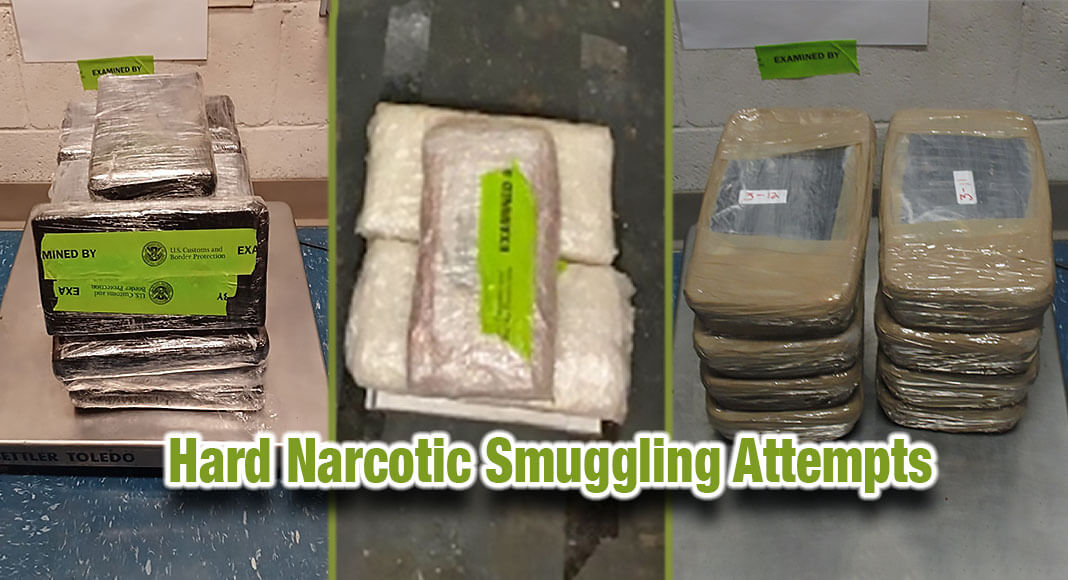
U.S. Customs and Border Protection officers working at El Paso area ports of entry intercepted 22 pounds of methamphetamine and a combined 84 pounds of cocaine in separate unrelated incidents over the past few days. USCBP Image
Texas Border Business
EL PASO, Texas – U.S. Customs and Border Protection officers working at El Paso area ports of entry intercepted 22 pounds of methamphetamine and a combined 84 pounds of cocaine in separate unrelated incidents over the past few days.
“CBP officers remain focused on their narcotic interdiction mission while also processing legitimate trade and travel,” said CBP El Paso Director Field Operations Hector A. Mancha. “Smugglers will try to blend into regular traffic in an attempt to introduce drugs to the U.S.”
On Oct. 28, CBP officers working at the Paso Del Norte border crossing intercepted 12.61 pounds of cocaine from a 34-year-old male U.S. citizen who arrived from Mexico via the vehicle lanes. The man was also accompanied by a 28-year-old female Mexican citizen and two minor children. The vehicle was referred for a secondary CBP canine and non-intrusive inspection leading CBP officers to locate multiple cocaine filled bundles hidden within the vehicle.
A few hours later, CBP officers working at the Bridge of the Americas border crossing intercepted 22.17 pounds of methamphetamine from an 18-year-old male U.S. citizen who arrived from Mexico via the vehicle lanes. A primary CBP officer referred the vehicle for a secondary inspection where a non-intrusive exam was conducted leading CBP officers to locate several bundles concealed within the vehicle.
On Nov. 1, CBP officers working at the Bridge of the Americas border crossing intercepted 37 pounds of cocaine. The interception occurred shortly after 2:20 p.m. when a 22-year-old male U.S. citizen arrived from Mexico via the vehicle lanes. CBP officers conducting pre-primary inspections searched the vehicle and discovered several cocaine filled bundles concealed within.
Later, CBP officers working at the Port of Ysleta intercepted 35 pounds of cocaine. The interception occurred shortly after 3:20 p.m. when a 46-year-old male U.S. citizen arrived from Mexico via the vehicle lanes. A CBP officer conducting primary inspections located bundles upon search of the vehicle. Additionally, with the aid of a CBP canine CBP officers located multiple cocaine filled bundles inside the vehicle.
The subjects arrested by CBP officers were turned over to Homeland Security Investigations special agents or state and local authorities for prosecution.