






Texas Border Business

Texas Border Business
The Rio Grande Valley is likely to experience a warmer and drier winter than usual, according to a seasonal outlook released by the National Weather Service covering December 2025 through February 2026.
The outlook places the Valley in an area with a higher probability of above-normal temperatures during the three-month winter period. The forecast notes a “medium-high” confidence level, estimated at 60 to 80 percent, that temperatures will run warmer than the historical average for South Texas.

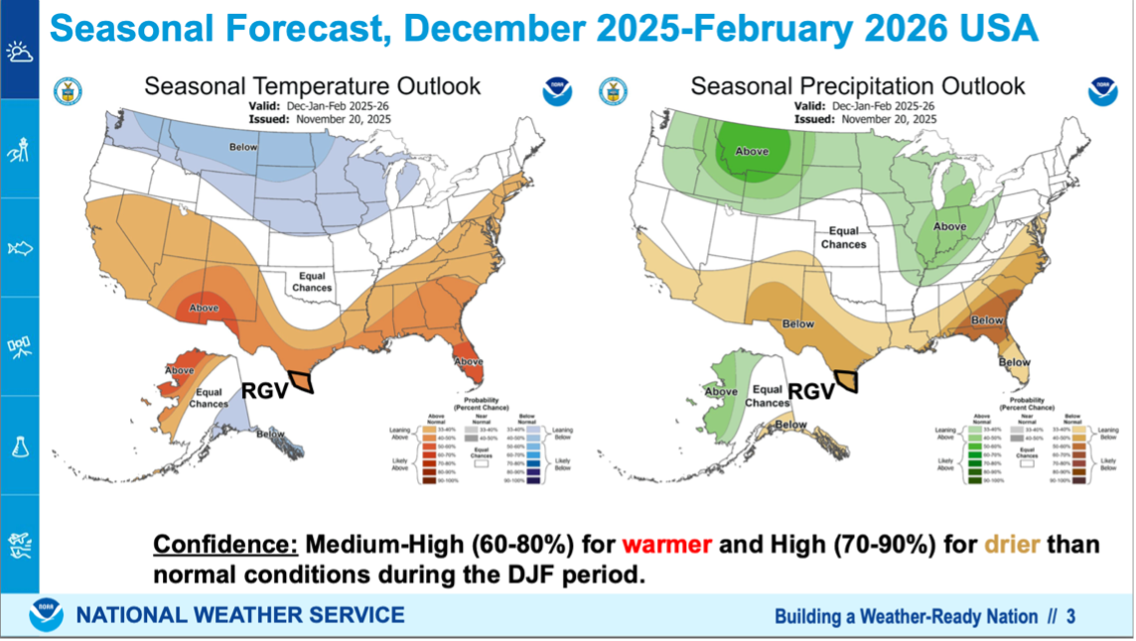
On the precipitation outlook, the Rio Grande Valley is shown in a zone where below-normal rainfall is more likely. The National Weather Service assigns a “high” confidence level, ranging from 70 to 90 percent, that the region will receive less rainfall than usual during the winter months.
The forecast combines December, January, and February into a single seasonal outlook, often referred to as the DJF period. According to the National Weather Service, the outlook reflects long-range climate trends rather than daily or weekly weather conditions. The agency emphasizes that the maps show probabilities, not guarantees, and that cold fronts and rain events can still occur even during a warmer and drier overall pattern.
The seasonal temperature outlook map labels the Rio Grande Valley as “Above,” meaning warmer-than-normal conditions are favored. The precipitation outlook labels the region as “Below,” indicating drier-than-normal conditions are more likely. The confidence statement on the graphic summarizes the forecast by stating there is “medium-high (60–80%)” confidence for warmer conditions and “high (70–90%)” confidence for drier-than-normal conditions during the winter season.
Meteorologists note that warmer and drier winters in South Texas can result in fewer strong cold fronts, reduced rainfall totals, and longer stretches of dry weather. Such conditions can affect water resources, agriculture, and wildfire risk, while also leading to milder winter temperatures for residents.

The National Weather Service advises that seasonal outlooks provide a broad picture of expected trends. Short-term forecasts will continue to be updated regularly to track individual cold fronts, chances of rain, and temperature changes as winter progresses.