







Texas Border Business

The Port of Brownsville
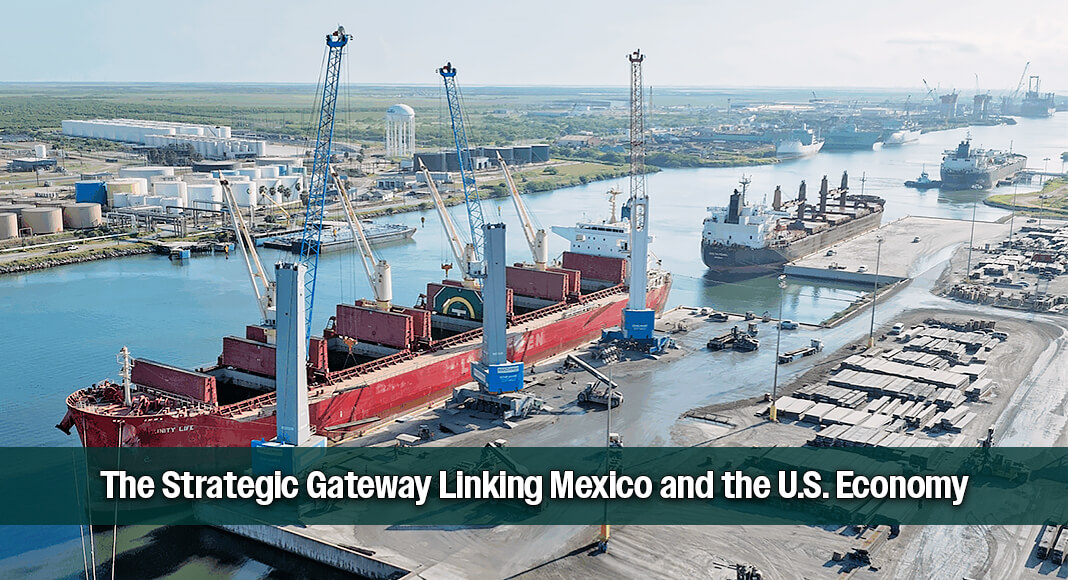
Economic integration between Mexico and the United States isn’t limited to trade agreements or annual trade figures; it’s a daily reality along the border, where thousands of industries depend on a constant and precise flow of goods. Within this complex network, the Port of Brownsville — in southeast Texas — has become a strategic hub for northeastern Mexico, a point where manufacturing, logistics, and trade converge. For companies in Monterrey, Saltillo, Reynosa, and Matamoros, the Port of Brownsville isn’t just a destination, but an operational extension of their supply chains, a corridor that accelerates processes, reduces costs, and ensures regional competitiveness. This is no coincidence: nearly 90% of the port’s business is directly linked to Mexico, confirming the depth of this interdependence.
This deep integration, stronger than any political tension, is the focus of the conversation with William Dietrich, General Manager of the Port of Brownsville, and Ervey González, Business Development and Economic Development Associate. In an interview with T21, both emphasize that the binational ecosystem operates with an interdependent logic that cannot be halted by short-term debates. “We are a region, a highly integrated economy,” González states, underscoring that the production cycle between Brownsville and Mexico is a living example of the United States-Mexico-Canada Agreement (USMCA): raw materials arrive at the port, are processed in Mexico, and return as finished goods to the United States or Canada.

Dietrich adds a dimension that rarely appears in federal discussions: the border as a shared community. “We don’t see Mexico as another country. For us, it’s part of our community,” he says. What for many is a dividing line, for the inhabitants of this region is a continuous territory where social life and economic activity intertwine. This reality explains why the seaport operates as a binational agent, and why any political clash immediately impacts logistical efficiency.
Slower border, growing risk
Despite this, Dietrich acknowledges that the relationship between Mexico and the United States is going through a period of stagnation. His concern points to a greater risk: that Asia will capitalize on these uncertainties and move forward in attracting investments that could otherwise be consolidated in North America. “The world is in an economic war, and if Asia comes to build its factories here, that money won’t go to our people,” he states. For him, the region has already demonstrated that cooperation works; what is lacking is ensuring that political decisions don’t disrupt this balance.
One of the areas where these tensions are most evident is at border crossings. Delays and duplicated processes generate losses in the millions and disrupt just-in-time operations. “These delays in supply chains are very costly,” González points out. For this reason, both insist on reviving the joint customs model, which has already worked on this border and is currently operating in other locations with positive results. “The door is open, but we have to move faster,” Dietrich emphasizes, noting that border efficiency is key to preventing the region from losing global competitiveness.
Meanwhile, the Port of Brownsville is moving forward with projects aimed at expanding its capacity and attracting additional investment. The deepening of the navigation channel—from 42 to 52 feet—will allow the port to receive deeper-draft vessels, reducing logistics costs and opening new opportunities for maritime trade. In addition, a presidential permit has been granted to construct an international bridge dedicated exclusively to cargo, a rare authorization that Dietrich describes as “gold” and one that could transform cross-border trade. However, its execution requires immediate coordination between both governments, something that, according to the executive, can no longer be postponed.

Expanding Industrial Platform
The port’s industrial park is also expanding rapidly. With fully developed infrastructure, the Port of Brownsville has begun attracting companies such as Westa Foods, which will produce sunflower oil for major retail chains. Other companies are transforming steel and components directly at the port, strengthening a growing trend: adding value at the point of origin.
“We are going to become more of a manufacturing industry,” González states. With more than 40,000 acres, the port is positioning itself as an industrial hub prepared to absorb part of the nearshoring activity arriving in the region. This evolution takes on additional symbolic significance as a key date approaches: the port is set to celebrate its 90th anniversary on May 16, 2026, a milestone that coincides with one of the most transformative logistical periods in its recent history.
The economic impacts are already evident. The Port of Brownsville contributes approximately $12 billion to the Texas economy and generates more than 66,000 direct and indirect jobs. But that growth, port officials say, depends on resolving a critical issue: the USMCA.
“Businesses do not want to invest money in something that could come to a halt. We need to fix the USMCA today,” Dietrich insists. His position is clear: uncertainty suppresses investment and puts at risk the stability of a region whose trade depends on continuity and certainty.
This integrated vision also reveals a reality both executives consider unavoidable: the region cannot afford to operate under outdated assumptions. Global competition—shaped by subsidies, technological alliances, and the strategic relocation of manufacturing plants—demands that Mexico and the United States act as a single economic bloc that prioritizes fluidity, security, and certainty.
Dietrich maintains that the border has the potential to become a world-class industrial corridor but warns that the opportunity could evaporate if governments fail to update regulatory frameworks and promote coordinated investment. González agrees and emphasizes that the port is already receiving inquiries from companies seeking to integrate into the North American market, but many are waiting for political clarity before committing capital. For both leaders, logistical integration must be accompanied by clear rules, robust infrastructure, and a shared vision capable of sustaining regional growth.
The Port of Brownsville: Ready for What’s Next
In this context, the port’s future depends not only on its infrastructure, but also on its ability to serve as a catalyst for confidence amid global uncertainty. The Port of Brownsville has demonstrated that it can adapt, attract investment, and operate under competitive standards, but it requires both Mexico and the United States to protect the binational ecosystem that has enabled this development. If achieved, the region could consolidate itself as the most dynamic productive corridor in North America—an example of cross-border cooperation where logistics do not divide, but rather unite economies, communities, and opportunities on both sides of the border. According to both executives, the Port of Brownsville is prepared to take that leap.
The seaport not only boasts robust infrastructure, but also a strategic vision that recognizes the interdependence between Mexico and the United States as not an obstacle, but its greatest strength. At a time when the USMCA faces tension, the port is assuming an active role in maintaining certainty and facilitating the flow of trade that supports thousands of businesses.
For Dietrich and González, the region already operates as a single economic unit and should be treated as such: a space where efficiency, technological collaboration, and regulatory coordination will be decisive in competing against Asia and Europe. The Port of Brownsville, they affirm, is ready for those challenges. It has the talent, the location, the industrial support, and above all, the conviction that this binational zone—deeply intertwined in its daily life, commerce, and history—can become the strategic engine that secures the shared economic future of both nations.
Information source: The Port of Brownsville.
Editor’s Note: This article was originally featured at www.t21.us