






Texas Border Business

By Roberto Hugo González / Texas Border Business
U.S.–Mexico trade is facing a new wave of uncertainty after a Dec. 4 Reuters report noted that U.S. President Donald Trump “could decide next year to withdraw from the United States-Mexico-Canada trade agreement (USMCA),” according to comments made to Politico by U.S. Trade Representative Jamieson Greer. Greer told Politico that “the reason why we built a review period into USMCA was in case we needed to revise it, review it, or exit it.” He also raised the possibility of splitting the current trilateral deal into separate agreements with Canada and Mexico.
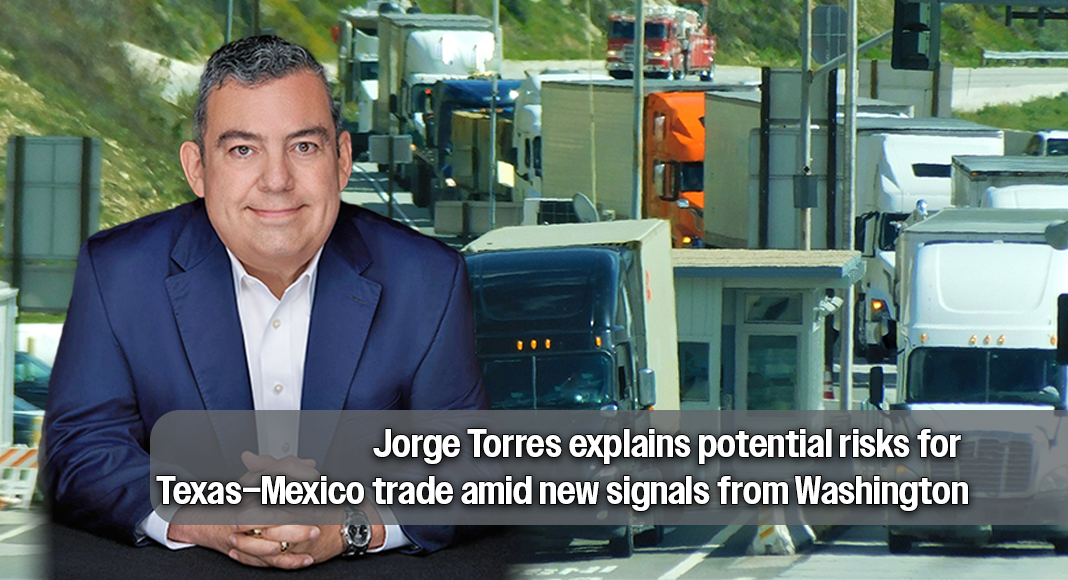
Against that backdrop, Texas Border Business spoke with Jorge Torres, President of Interlink Trade Services, drawing on his expertise in customs brokerage, logistics, and international trade, and on the recent reports suggesting President Trump may consider withdrawing from USMCA. The conversation focused on what such a move could mean for cross-border commerce, especially in the Rio Grande Valley and northern Mexico.

Asked what would happen if the U.S. were to initiate a formal withdrawal from USMCA, particularly for supply chains in the Rio Grande Valley and northern Mexico, Torres said that from a day-to-day operational point of view, “from a cross-border operational standpoint, there will not be much disruption.” However, he warned that “because of potential additional duties and tariffs, commercial border crossing will eventually decrease, having a substantial negative economic impact on the region, particularly for regional manufacturers (IMMEX companies), logistics companies, customs brokers, and transportation companies.”
On whether a USMCA withdrawal would change tariff levels and legal terms, Torres said, “Yes, a USMCA withdrawal will revert duty rates to Most Favored Nation (MFN) rates, which in the U.S. average about 2%.” He added that this would not happen in isolation: “However, under the current trade scenario, there will be other sectorial tariffs such as IEEPA Fentanyl of 25% (possibly going up to 30%) and Section 232 tariffs (particularly for auto parts, which are at 25%), which will apply to Mexico without USMCA preferential treatment.”
From the perspective of customs brokers and compliance professionals, Torres stressed that the first and most substantial impact would be financial rather than procedural. “The most significant impact will be financial,” he said when asked what operational or regulatory changes importers and exporters should prepare for in the first 6–12 months of a potential withdrawal. “A USMCA withdrawal will increase duties and tariffs for Mexican goods being imported to the U.S. Therefore, proper financial planning, including cash flow management and strategies to pass these duties and tariffs to their customers, will have to be implemented.”
Torres noted that companies have already been under pressure in the current trade climate. “2025 has been a challenging year from a trade perspective,” he said when asked whether clients are developing contingency plans for possible changes in rules of origin, tariffs, or documentation requirements. “Companies are finally adapting and taking trade compliance very seriously and have integrated it as part of their strategic planning. Companies need to continue improving trade compliance and integrating it into their strategic planning to ensure that they can fully understand the impact of the current trade environment and adapt and react accordingly.”
The USMCA includes a formal joint review in 2026, six years after it replaced NAFTA, giving any party the option to allow the agreement to wind down if concerns are not resolved. Asked how that scheduled review, combined now with open talk in Washington about possible withdrawal, is shaping investment decisions, Torres said, “Most analysts and experts (and even government officials) are confident that USMCA will continue. However, there is always the possibility that the U.S. will withdraw from USMCA if the administration does not get what it wants.” In his view, “USMCA is being used as a negotiating tactic. If the U.S. eventually withdraws from the USMCA, it will have a very negative impact on foreign direct investment, not only in Mexico, but in the U.S. as well.”
When asked which industries would face the greatest operational and cost impacts if the U.S. left USMCA, Torres did not single out only one sector. “All these that you mention will be impacted,” he said of automotive, electronics, and produce, “plus the metallurgy (steel, aluminum) and manufacturing/heavy equipment industries.”
Greer’s comments to Politico included the possibility of “dividing the agreement into two parts” and negotiating separately with Canada and Mexico. When asked what that would mean for integrated North American supply chains, Torres said, “This might bring a new set of rules and conditions, including new rules of origin to qualify goods for preferential treatment,” adding that it would force companies “to go back to the drawing board and perform new analysis for preferential treatment, which of course will take time, effort and money.” He also addressed what federal and state officials should do if the administration signals a serious intent to withdraw from USMCA, stating that “the consensus in our state and region is that USMCA should continue,” and urging elected officials, economic development groups, and the private sector “to push for its continuity,” while warning that if the U.S. leaves the agreement, “a different and more aggressive strategy will have to be put in place to provide financial and fiscal incentives to companies to offset the negative economic impact.”
Taken together, Torres’s comments portray a region that can keep trucks and cargo moving in the short term but could face higher costs, lower investment, and more complex rules if USMCA is changed or abandoned, and he advised businesses on both sides of the border to strengthen compliance, plan for higher duties, and stay closely engaged with policymakers as the 2026 review — and the political decisions around it — draw closer.