







Texas Border Business

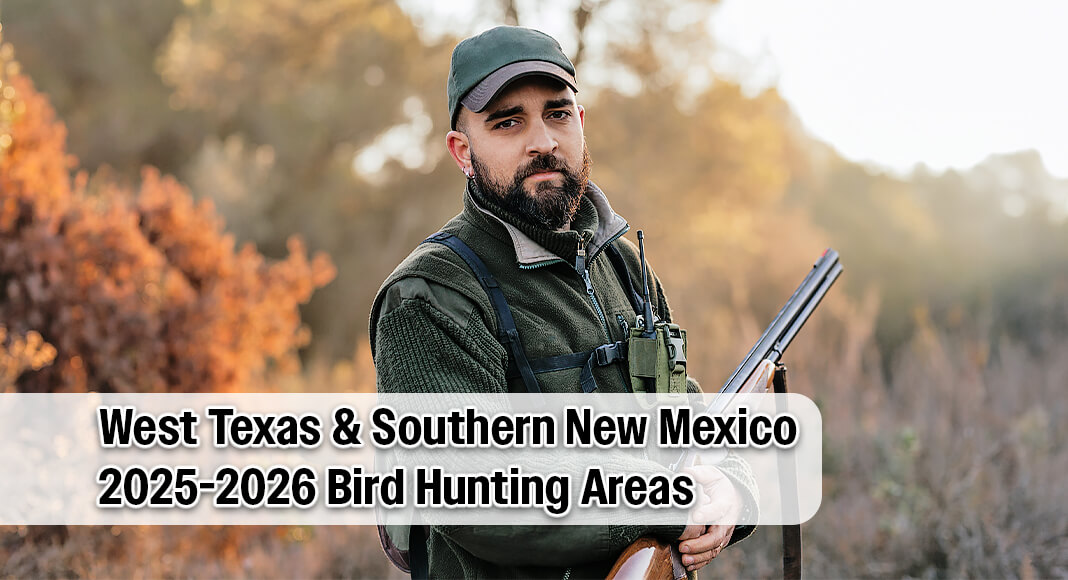
The U.S. Section of the International Boundary and Water Commission (USIBWC) has released information regarding migratory and game bird hunting areas on USIBWC lands along the Rio Grande in El Paso and Hudspeth counties, Texas, and in Doña Ana and Sierra counties, New Mexico, for the 2025 -2026 bird hunting season, starting with dove season on September 1, 2025.
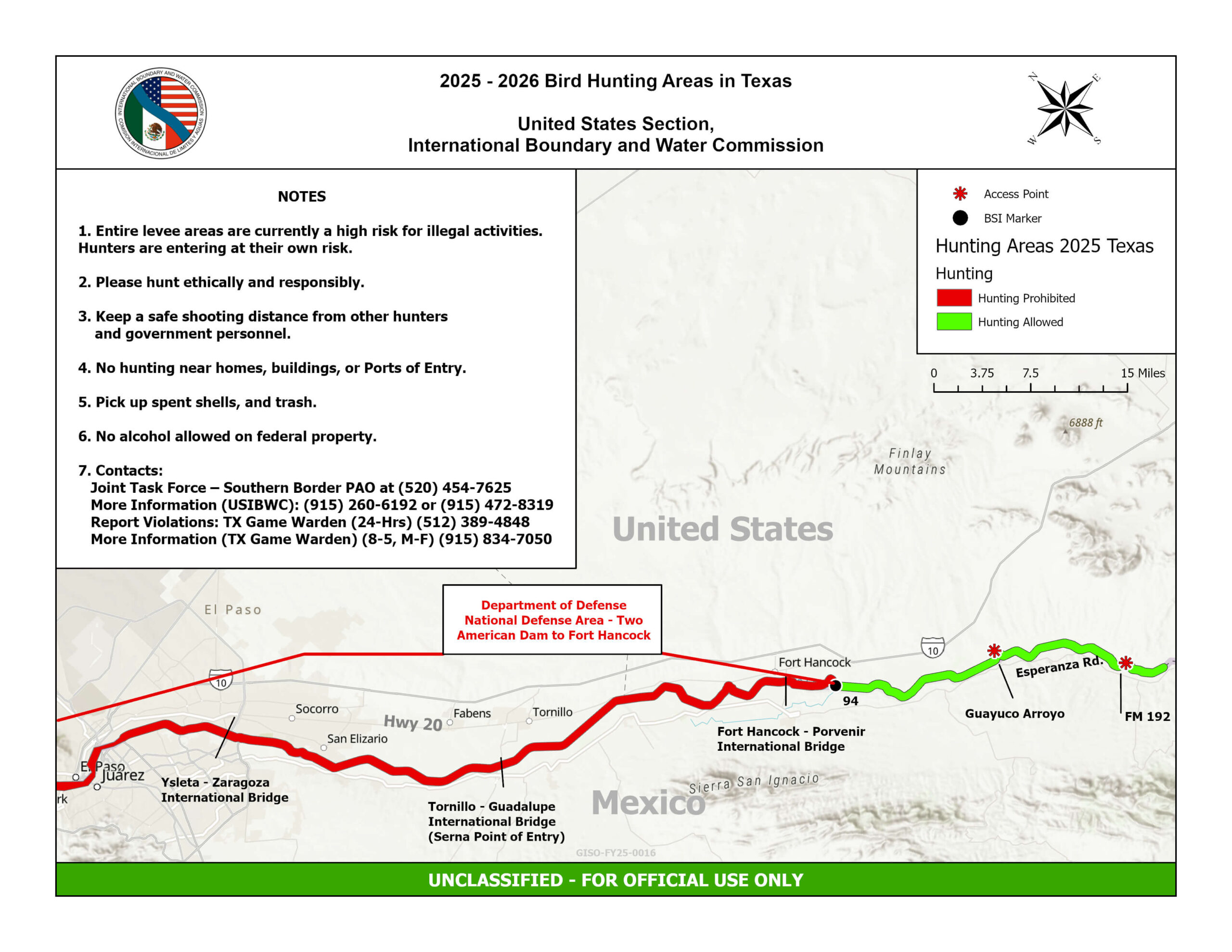
USIBWC land in Texas that was previously accessible to the public has been transferred to the administrative control of the U.S. Army in support of national security operations and the establishment of a National Defense Area (NDA). As a result, areas that were previously designated for hunting may no longer be accessible to the public. Individuals are advised to exercise caution and verify access restrictions before entering these areas.
Unauthorized entry may result in trespassing on federally controlled land managed by the military. We appreciate your cooperation in respecting these changes and supporting national security efforts.

HUNTING MUST BE CONDUCTED IN COMPLIANCE WITH ALL HUNTING RULES AND REGULATIONS.
Hunting is prohibited near homes, businesses, bridges, Ports of Entry, and areas where people are recreating.
In Texas, all authorized bird hunting areas are along the international border and not within designated National Defense Areas.
The attached map uses the numbering system of the U.S. Department of Homeland Security Border Security Initiative (BSI) markers on the border fence and corresponding markers in Mexico to indicate hunting areas. The markers are blue signs approximately 2-feet-square with yellow neon numbers.
Access will be from Hudspeth County as shown on the Texas map. During the 2025-2026 season, hunting will be permitted as follows:
- Between markers 94 and FM192: South of Fort Hancock Port of Entry and downstream to the vicinity of FM 192 road.
- Only migratory and bird hunting is allowed. No other hunting or target practice is permitted.
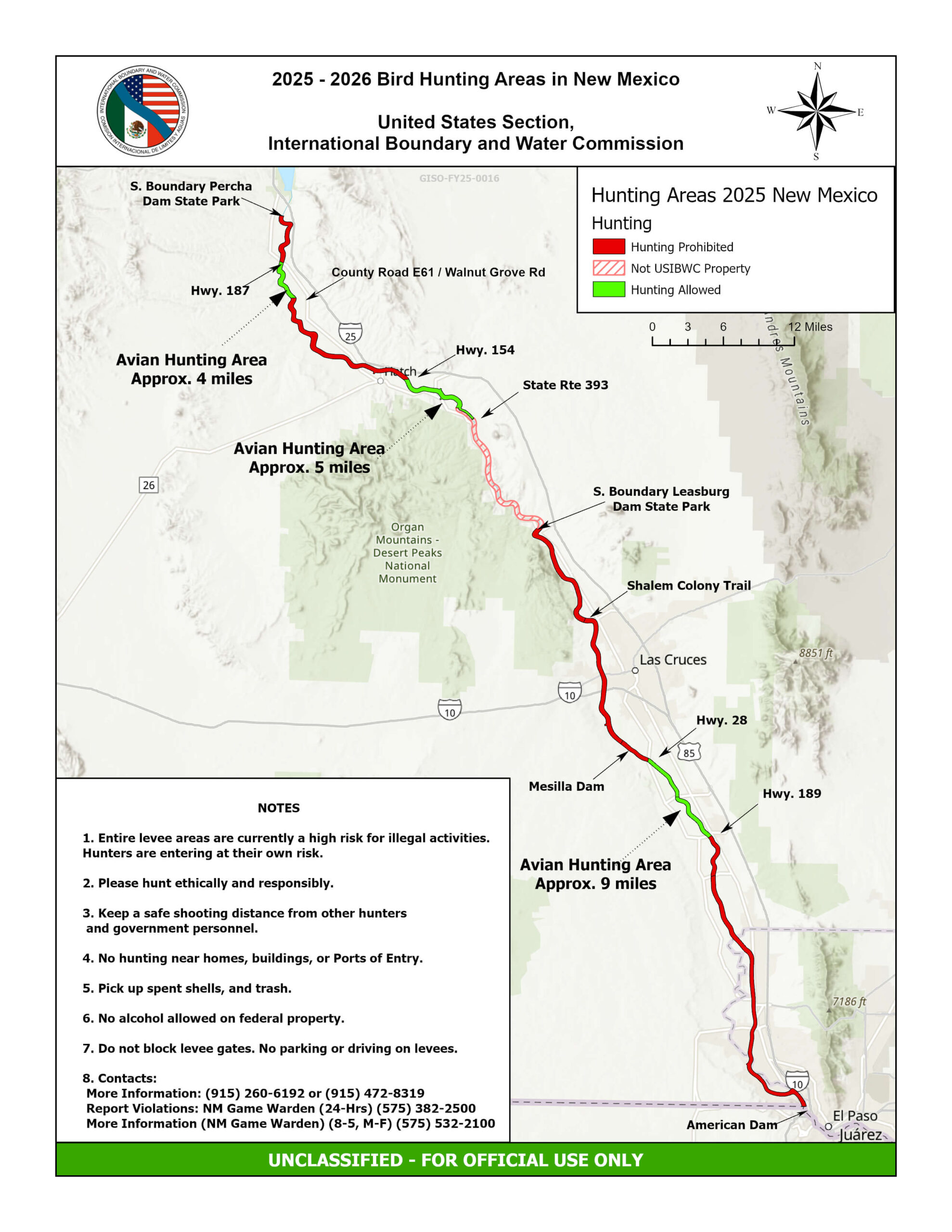
In New Mexico, the USIBWC authorizes bird hunting in three different areas, totaling approximately 18 miles along the Rio Grande.
- New Mexico Highway 187 Bridge (Garfield Bridge) near Derry to County Road E61/Walnut Grove Road, which is near the river’s east bank (4 miles). The landmark for both sides of the river is the river’s sharp tum with a wide west floodplain and narrow east floodplain.
- New Mexico Highway 154 Bridge in Hatch (Rincon Bridge) to State Route 393, which is on the east floodplain near Rincon (5 miles).
- New Mexico Highway 28 Bridge (Santo Tomas) south of Mesilla to Highway 189 Bridge in Vado (9 miles).
See attached map for specific locations in New Mexico.
In New Mexico, the USIBWC levee gates in the authorized hunting areas will remain closed during bird hunting season.
Vehicle access is prohibited on the levee in areas where there are levee gates. Vehicles should not block levee gates. In all areas, law enforcement will enforce towing of any abandoned or unauthorized vehicles.
While on USIBWC property in New Mexico:
- Hunters are responsible for identifying legal access points to reach hunting areas and must respect private property as well as all municipal, state, and federal agency property, including USIBWC.
- Do not damage vegetation in the floodplain.
- Remove your trash, including shell casings, to avoid future hunting restrictions.
- No alcoholic beverages.
- Do not discharge firearms within 600 feet of homes, businesses, or people.
- Hunters who hunt on USIBWC lands do so at their own risk. In areas where no vehicles are allowed, hunters must access hunting areas using non-motorized transportation.
- Hunters must have all applicable hunting licenses, follow all hunting laws, and use appropriate firearms. New Mexico Game Wardens will enforce state hunting laws on USIBWC lands.
- Only migratory and bird hunting is allowed. No other hunting or target practice is permitted.
To ensure public safety and protect USIBWC infrastructure, all hunters accessing USIBWC-managed lands in New Mexico and Texas must follow established safety protocols and comply with federal property regulations. These lands, located along the Rio Grande and popular with bird hunters, fall under USIBWC jurisdiction only on the river side of the levee.
Hunters are expected to observe all applicable federal, state, and local laws. For personal safety, individuals should inform others of their hunting location, ensure reliable cell phone coverage, and carry a first aid kit.
USIBWC operations may be active at any time. If heavy equipment or emergency services are encountered, hunters must yield the right of way and avoid interfering with agency activities. This is essential to maintaining uninterrupted flood control operations and ensuring the safety of all individuals in the area.
The USIBWC is dedicated to protecting Americans from exposure to Mexican sewage, maintaining and operating critical infrastructure, and ensuring the U.S. gets its fair share of water. We are committed to working with our federal, state, and local partners and our Mexican colleagues to spearhead these issues.
Information about bird hunting in Texas is available from the Texas Parks and Wildlife Department, and information about New Mexico hunting regulations is available from the New Mexico Department of Game and Fish.