







Texas Border Business

Texas Border Business
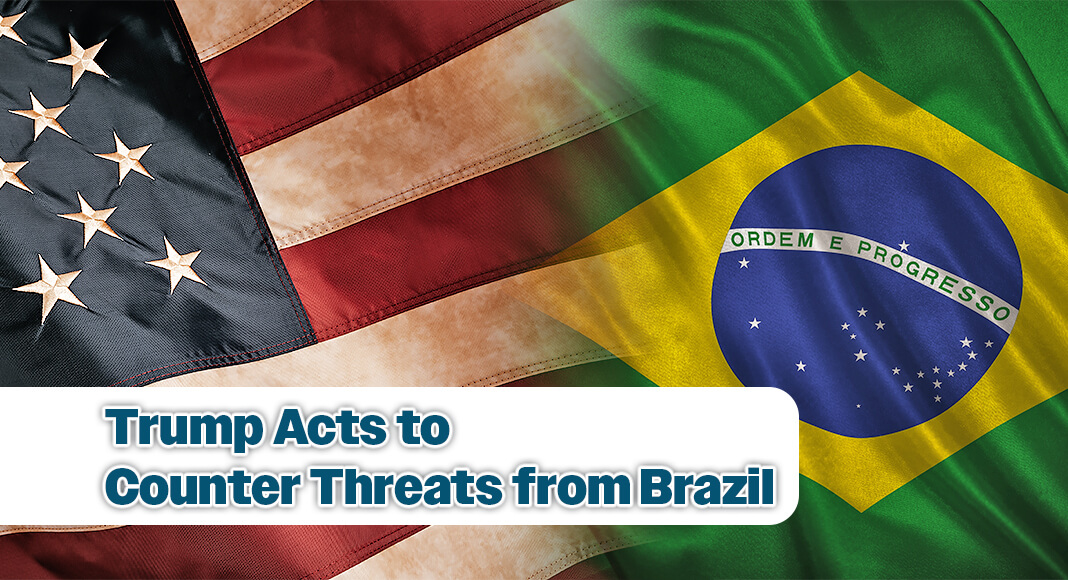
On July 30, 2025, President Donald J. Trump signed an Executive Order imposing a 50% tariff on goods from Brazil. This includes a new 40% tariff on top of an existing 10%, aimed at responding to actions by the Government of Brazil that, according to the President, “constitute an unusual and extraordinary threat to the national security, foreign policy, and economy of the United States.”
The move invokes the International Emergency Economic Powers Act of 1977 (IEEPA) and declares a new national emergency in response to Brazilian policies. President Trump stated that these policies involve “politically motivated persecution, intimidation, harassment, censorship, and prosecution” of former Brazilian President Jair Bolsonaro and his supporters. The Executive Order describes these as “serious human rights abuses” that undermine the rule of law in Brazil and interfere with U.S. interests.

The Executive Order further accuses Brazil’s Supreme Federal Court, particularly Justice Alexandre de Moraes, of targeting U.S. companies through “unprecedented actions to tyrannically and arbitrarily coerce U.S. companies to censor political speech.” The order alleges that Justice de Moraes has pressured American tech platforms to remove content and hand over user data, using threats of heavy fines, criminal prosecution, and even market exclusion. According to the order, “Justice de Moraes has unilaterally issued hundreds of orders to secretly censor his political critics,” often in coordination with other government officials.
In one case cited by the White House, de Moraes is said to have “frozen the assets of a U.S. company in Brazil” to enforce censorship demands. The administration also pointed to ongoing criminal investigations in Brazil into Americans, including U.S. resident Paulo Figueiredo, for speech made on U.S. soil—an act the Executive Order describes as a violation of American sovereignty and free speech rights.
President Trump’s administration maintains that this action is not only about defending U.S. businesses but also about standing up for free expression and the rule of law. “President Trump is defending American companies from extortion, protecting American persons from political persecution, safeguarding American free speech from censorship, and saving the American economy from being subject to the arbitrary edicts of a tyrannical foreign judge,” the statement reads.
The move aligns with the administration’s broader “America First” policy agenda. On his first day in office, President Trump issued an “America First Policy Directive” instructing the State Department to prioritize U.S. interests in all foreign relations. In accordance with that directive, Secretary of State Marco Rubio announced a visa restriction policy on May 28, 2025, targeting foreign nationals responsible for suppressing speech protected by the U.S. Constitution.

Following that policy, the President recently directed Secretary Rubio to revoke visas belonging to Justice de Moraes, his allies on the court, and their immediate family members. The decision was made in response to what the administration calls “human rights violations against Brazilians and free speech violations against Americans.”
This is not the first time President Trump has used tariffs to respond to foreign threats. “President Trump has successfully used tariffs in the past to advance America’s interests and address other urgent national security threats and is doing so again today,” the administration said in its statement.
In addition to tariffs and visa restrictions, the White House indicated that further measures could follow if Brazilian officials continue what the U.S. government characterizes as authoritarian actions. The administration emphasized its commitment to ensuring that “foreign policy reflects U.S. values, sovereignty, and security.”
As President Trump put it, the goal is clear: “Preserving and protecting the free speech rights of all Americans and defending American companies from coerced censorship will remain at the forefront of President Trump’s America First foreign policy strategy.”