








Texas Border Business


The amount of natural gas produced and marketed in the United States reached a record high in 2025, up by 5.3 billion cubic feet per day (Bcf/d) to average 118.5 Bcf/d, according to data from the Energy Information Administration (EIA). About two thirds of production occurs in three regions—Appalachia, the Permian Basin, and the Haynesville Shale. These three areas accounted for 81% of the growth last year.
The Appalachia region in the northeastern US produced 31%, followed by the Permian Basin with 23%. Production growth in Appalachia had been slowing due to pipeline constraints, but the situation is improving.
The Permian Basin experienced the largest gain (up 11%), about half of overall gains last year. Most of the growth in the region is due to associated gas produced along with oil, and during much of 2025 crude prices were high enough to support significant activity.

Production is also expanding in the Haynesville region of Louisiana and Texas. Wells are more expensive to develop in that area, but proximity to liquefied natural gas (LNG) export terminals reduces transportation costs.
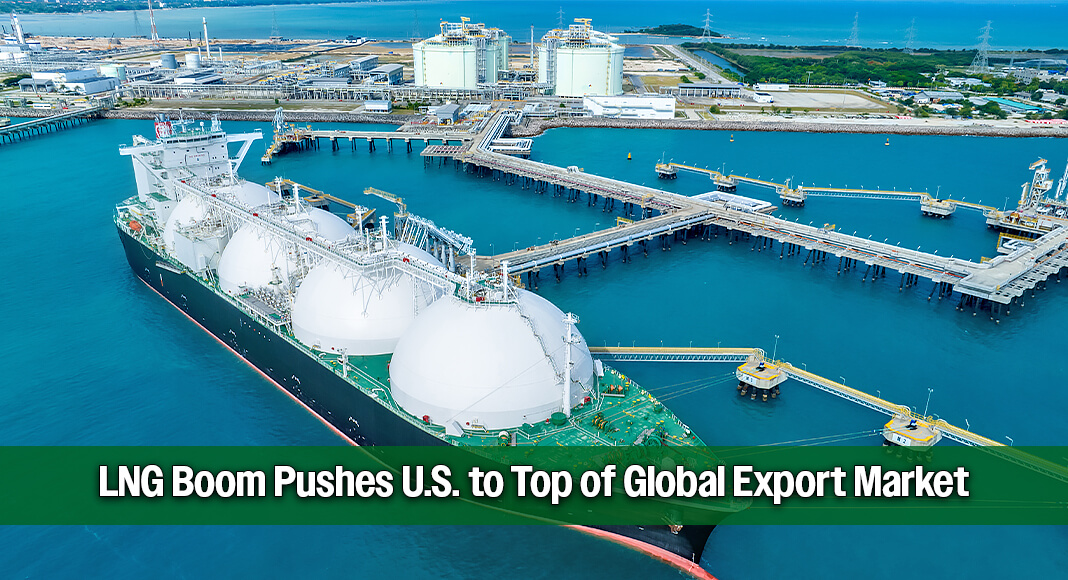
Virtually all LNG facilities are located along the Gulf Coast of Texas and Louisiana. Exports have grown sharply over the past decade, from near zero in 2016 to 569.3 billion cubic feet for the month of December 2025. The US is now the largest source of LNG shipments, and current construction could double capacity over the next few years. It is noteworthy that, even with this growth, natural gas prices have not risen substantially, and, in fact, hit a low not seen in decades in March 2024.
Pipelines from the Permian Basin connect to the Gulf Coast, and the addition of new lines in recent years has somewhat reduced an extreme shortage of takeaway capacity. What was once a major problem, having too much associated gas stuck in West Texas (as proven by extremely low and even negative prices at times at the nearby Waha hub), has become a valuable resource.
The rapid growth in US LNG exports is beneficial from a variety of perspectives. It provides access to additional markets for US production, supporting development of resources and infrastructure. It has also been crucial to energy security in Europe and Asia. For example, since Russia invaded Ukraine, US LNG has been crucial to filling the gap in Europe and preventing a major supply crisis. The rapid expansion of energy-intensive AI data centers is also spurring demand for domestic use to generate electricity.
Development of the US natural gas market and LNG capacity stabilizes critical access, thus reducing supply shocks and price escalation during major geopolitical conflicts. As recent events have dramatically demonstrated, that can be very good thing! Stay safe!
_______________________
Dr. M. Ray Perryman is President and Chief Executive Officer of The Perryman Group (www.perrymangroup.com), which has served the needs of over 3,000 clients over the past four decades.