






Texas Border Business

By Roberto Hugo González / Texas Border Business
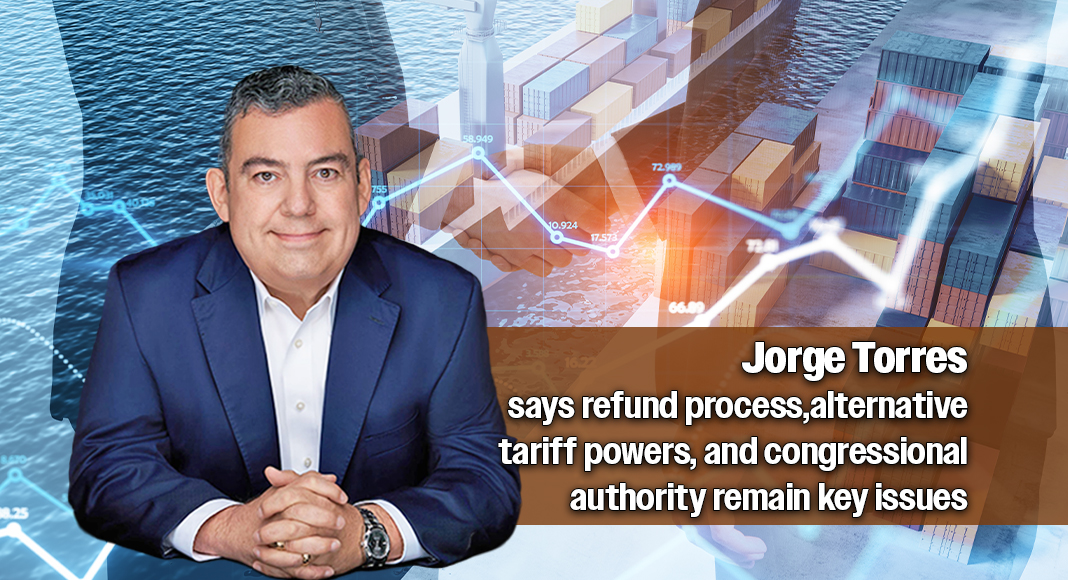
On February 20, 2026, Jorge A. Torres, President and CEO of Interlink Trade Services, discussed the legal and administrative implications of the U.S. Supreme Court’s decision finding tariffs imposed under the International Emergency Economic Powers Act unlawful.
Torres, a U.S.-licensed customs broker based in McAllen, Texas, said the court determined that the IEEPA tariffs “were imposed illegally by the president,” but did not specify how refunds would be handled. “This will be up to the court of international trade (CIT) and CBP,” he said.

He pointed to a historical precedent from 1998, when the Harbor Maintenance Fee was deemed unconstitutional for exporters in the U.S. Shoe Corp. case, and fees were refunded. While there is consensus that the IEEPA tariffs must be refunded because they were imposed illegally, Torres said there will be procedural challenges in carrying out large-scale reimbursements.
Addressing whether judicial estoppel could constrain the government if it reverses prior assurances about refunds, Torres referenced statements by Treasury Secretary Scott Bessent that funds would be available if the tariffs were ruled illegal. However, Torres said “the administration might put hurdles in place to delay or limit the refund process,” noting that the procedural framework will be determined by the Court of International Trade and U.S. Customs and Border Protection, though the administration may influence timing and complexity.
Torres said that under 28 U.S.C. § 1581(i) and standard customs procedures, refunds will go to the importer of record, the entity that paid the tariffs. “There is no explicit legal mechanism to force the importer to pass the refund downstream,” he said. Any compensation for downstream businesses or consumers would need to be resolved on a case-by-case basis through contractual agreements.
He also addressed the trade policy landscape, noting that although the IEEPA tariffs were struck down, other tariff authorities remain in effect. The administration continues to rely on Section 232 and Section 301 tariffs. In addition, a 10 percent tariff, and possibly 15 percent, has been implemented under Section 122 for 150 days, after which congressional approval would be required for extension.

“This will give the administration time to evaluate additional tariffs under Sections 232 and 301,” Torres said. He added that Secretary Bessent has indicated that tariff revenue is not expected to decline in 2026 despite the IEEPA decision, which Torres described as “a clear indication of where the administration is headed.”
On potential reforms, Torres said Congress has constitutional authority to impose tariffs, while the executive branch may implement tariffs under statutes such as Sections 122, 232, and 301 if the conditions under this status are met. “This creates conflict and a power struggle between both branches,” he said, adding that clearer legislation is needed to define tariff authority, though he acknowledged that such decisions are often political rather than economic.
Torres described the Supreme Court’s ruling on the IEEPA tariffs as “historical and critical for future legal precedent,” not only for tariff imposition but also for defining limits on executive authority. “We hope that the executive will think twice about taking unilateral and aggressive decisions in the future and involve Congress and other government departments, such as CBP, in order to have a more logical and sensible approach to trade matters,” he said.