







Texas Border Busienss

By Roberto Hugo González
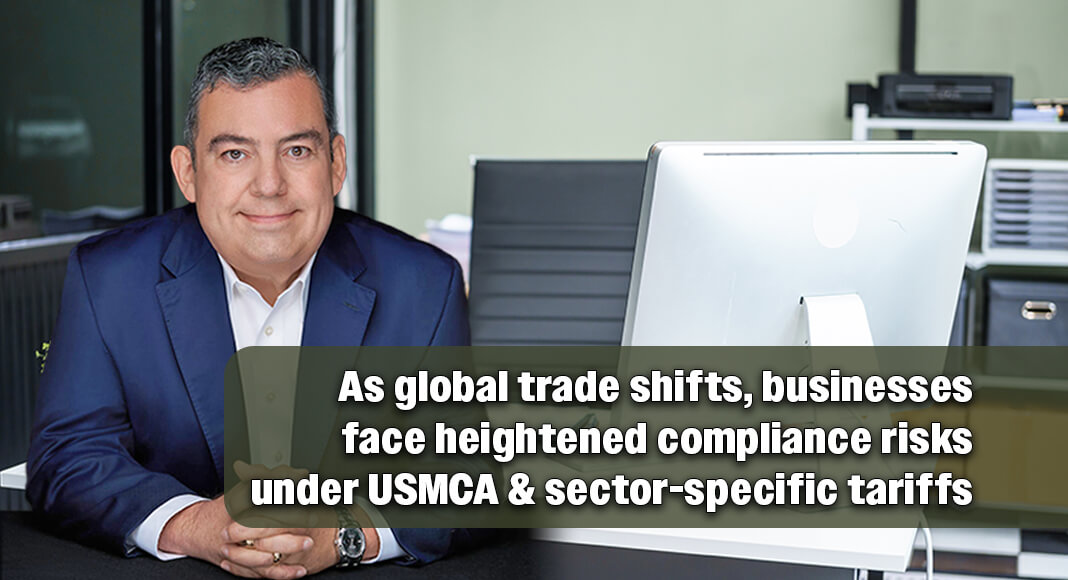
Jorge Torres, President of Interlink Trade Services and a widely respected authority in international commerce, has issued a series of urgent warnings for importers navigating today’s volatile trade environment. With global regulations shifting and enforcement tightening, Torres stressed that assumptions and shortcuts could expose businesses to costly penalties.
“Importers cannot afford to make assumptions in this environment,” Torres cautioned. “Precision in compliance is no longer optional—it is essential.”
He also underscored the broader challenges shaping today’s trade environment. “Currently, we are living through somewhat complex times in the field of foreign trade in the United States,” Torres said. “The constant changes regarding tariffs, material content declarations, and customs valuation, along with the lack of clarity in their interpretation and implementation, expose importers, exporters, and customs brokers to making serious mistakes before CBP, which can be very costly.”
At the heart of his message is a widespread misconception about the United States–Mexico–Canada Agreement (USMCA). “Do not claim USMCA preferential treatment just because a good is made in Mexico or Canada,” Torres explained. “You need to perform a USMCA qualification analysis based on the specific USMCA rule of origin for the good.”
Torres also warned against assuming that production location automatically determines country of origin. Under U.S. regulations, including the marking rules of 19 CFR 102 and the substantial transformation test, the true origin may remain tied to a component rather than the assembly site. “It is possible that a good will retain the country of origin of the component that imparts the essential character, even if it went through a production process in Mexico or Canada,” Torres noted. This distinction, he added, can subject goods to IEEPA reciprocal tariffs, regardless of their eligibility under the USMCA.
Even when goods qualify for USMCA preferential treatment, they may still face additional duties under laws targeting specific industries. “If a good qualifies for USMCA preferential treatment, it does not mean that you will not be subject to sectoral tariffs such as Section 232 or Section 301,” Torres explained. He highlighted that while certain auto parts currently enjoy exemptions from Section 232 tariffs, these policies remain subject to change.

For companies importing metals such as steel, aluminum, and now copper, Torres emphasized the importance of meticulous documentation. “Do not rely on estimates or assumptions for declaring metal content values, countries of melt/pour/cast for goods under Section 232,” he said. “You have to support these declarations with documentary evidence in case of a CBP review or audit.”
Torres’s guidance reflects a greater reality: international trade has entered a period of complexity in which compliance errors can have significant and far-reaching consequences. His advice carries weight across the industry, where he is regarded as a leading expert on customs and cross-border operations.
“As the rules evolve, importers must evolve with them,” Torres concluded. “Those who prepare carefully and invest in compliance will not only avoid penalties but also position themselves to thrive in this new trade era.”