







Texas Border Business

Texas Border Business
The Rio Grande Valley will be able to observe the total lunar eclipse during the early morning hours, just before sunrise.
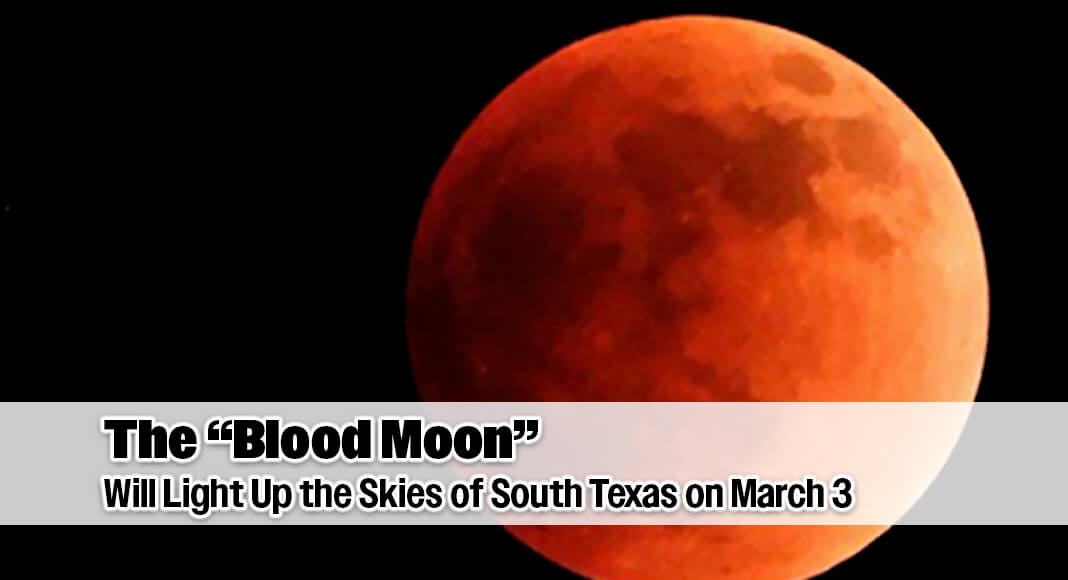
The skies over South Texas will offer an unforgettable spectacle in the early morning hours of Tuesday, March 3, 2026, when a total lunar eclipse transforms the full Moon into a striking “Blood Moon.”

Residents of McAllen and Brownsville, along with those in the entire Rio Grande Valley (RGV), will be able to watch the full event, weather permitting.
What Time to Look Up
The event will take place before dawn. Here are the approximate times in local time (CST) for South Texas:
| 🌘 2:44 a.m. — Penumbral eclipse begins |
| 🌗 3:50 a.m. — Partial eclipse begins |
| 🔴 5:04 a.m. — Totality begins (the Moon turns red) |
| 🌕 5:33 a.m. — Maximum eclipse |
| 🌑 6:02 a.m. — Totality ends |
| 🌙 6:54 a.m. — Moonset |
The total phase — when the Moon takes on its characteristic reddish color — will last about one hour.

Where to Look from the RGV During totality (between 5:04 and 6:02 a.m.):
The Moon will appear in the western sky. As sunrise approaches, it will descend toward the west-southwest horizon.
Observers should find a location with a clear view of the western horizon, such as open fields or areas away from tall buildings.
Sunrise shortly afterward may create a dramatic contrast between the brightening sky and the red-tinted Moon.
Why Does It Turn Red? The reddish hue occurs because Earth moves directly between the Sun and the Moon. Earth’s atmosphere filters sunlight, scattering blue wavelengths and allowing red and orange tones to reach the lunar surface.
Unlike a solar eclipse, no special eye protection is needed to safely observe a lunar eclipse. It can be viewed with the naked eye without risk.
Viewing Tips: Choose a location with minimal light pollution.
Check the weather forecast the day before.
Use binoculars or a small telescope for enhanced detail.
Arrive at your viewing spot at least 20 minutes before totality begins.
The early morning of March 3 promises to be one of the most memorable astronomical moments of 2026 for South Texas. As Earth’s shadow fully covers the Moon, the skies over the Rio Grande Valley will glow red — a powerful reminder of the precision and beauty of our universe.