





Texas Border Business

By Roberto Hugo González
Texas Border Business
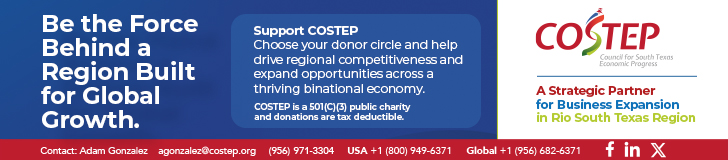
Jorge Torres, President of Interlink Trade Services and a recognized authority in international commerce, believes that the recent tariffs imposed by the U.S. government are already transforming supply chains and will soon have a significant impact on consumers. With more than three decades of experience in customs brokerage, logistics, and trade compliance, Torres has closely analyzed the implications of the Trump administration’s tariff policies.
On U.S.–Mexico trade relations, Torres emphasized Mexico’s unique position under the United States–Mexico–Canada Agreement (USMCA). “In the case of U.S.–Mexico trade relations, having the USMCA gives Mexico a competitive advantage, and I expect to see Mexico play a more strategic role in reshaping the global supply chain,” he explained. Products that qualify under USMCA rules can enter the U.S. duty-free and are not subject to tariffs under the International Emergency Economic Powers Act (IEEPA). While some sector-specific tariffs remain—such as Section 232 measures on steel and aluminum—Torres highlighted that Mexico’s ability to offer tariff reductions is increasingly “a key element in companies’ growth strategies.”
Industries most exposed to rising costs, according to Torres, include those tied to Section 232 and Section 301 tariffs. “Steel, aluminum and copper products and products that contain these metals, automobiles and auto parts, Chinese-origin products, and non-USMCA originating products that are subject to IEEPA Reciprocal Tariffs” face the greatest vulnerabilities, he noted. Even food products such as fruits, vegetables, and coffee are being affected.
While some businesses initially absorbed tariff costs, Torres warned that this is not sustainable. “Importers and exporters were able to absorb tariffs because they had imported inventories at pre-tariff or lower-tariff rates,” he said. “However, newer inventories are currently being imported with higher tariffs. It is forecasted that these tariffs will eventually be passed on to the consumer, starting in Q4 2025, and will increase during 2026.” He added that in the long run, “the burden of the tariffs will ultimately be passed on to consumers.”
To mitigate risks, Torres advised U.S. businesses to reevaluate their sourcing strategies. “It is essential to rethink their supply chains and source from countries with lower tariff rates,” he said, stressing the importance of negotiating with suppliers and customers to share the impact. Although this will reduce profit margins and raise prices, he described it as a “shared risk that needs to be addressed.”

Mexico, meanwhile, could benefit significantly. Torres sees opportunities for nearshoring and reshoring on both sides of the border. “This will materialize in the next few years if the USMCA continues among the three parties,” he said.
When asked whether tariffs serve as negotiating leverage or are primarily disruptive, Torres offered a balanced view. “There is no question that tariffs are being used for negotiating leverage by the current administration,” he observed. While progress is slower than anticipated, he said, “major trading partners are negotiating trade deals with the U.S., and we can expect to see more of these deals being negotiated soon.” For now, however, he cautioned that tariffs create “significant uncertainty for future investments on both sides of the border.”
Looking ahead, Torres expects uneven effects on U.S. competitiveness. He predicted that tariffs would “lead to additional production and manufacturing in the U.S.,” but cautioned that such shifts take time. “Moving or opening a factory in the U.S. cannot be done overnight. It can take more than five years to do so, from site selection to incentives, supply chain realignment, and finding skilled labor,” he explained.
Torres urged policymakers to adopt a measured approach when designing trade policy. “We all want for the U.S. to prosper and grow. However, a strategic, logical, and balanced approach is necessary to accomplish this,” he said. He emphasized the importance of international cooperation: “The reality is that the U.S. needs its trading partners to continue providing critical materials and components. 100% vertical integration no longer exists. Domestic producers will always need to import raw materials and components, which should be taken into account when making trade policy. Taking drastic and disruptive measures can be dangerous and create more bad than good.”
For more information about the firm, please visit www.interlinktrade.com.