






Texas Border Business

By Roberto Hugo González / Texas Border Business
In an environment marked by shifting trade policies and heightened tariff enforcement, few voices are as closely connected to the day-to-day realities of cross-border commerce as Jorge Torres, President and owner of Interlink Trade Services. With deep experience in customs brokerage, trade consulting, and logistics, Torres works directly with companies navigating the operational, financial, and compliance challenges created by today’s tariff landscape. In this interview with Texas Border Business, he offers a ground-level perspective on how tariffs are reshaping clearance processes, supply chains, and investment decisions across North America.
Torres said tariffs have fundamentally changed the way imports are cleared through U.S. Customs and Border Protection. “The clearing processing has become more complicated since we must provide additional information to CBP,” he said, citing “additional tariff items for each sectoral tariff, metal breakdown, and country of origin of metal.” While these requirements initially caused delays, Torres noted improvement as companies adjust. “Companies are learning to adapt to the new reality,” he said. Compliance, he added, has become critical due to both cost and risk. “Trade compliance has become crucial for importers… because of the exposure to penalties by CBP for non-compliance.”
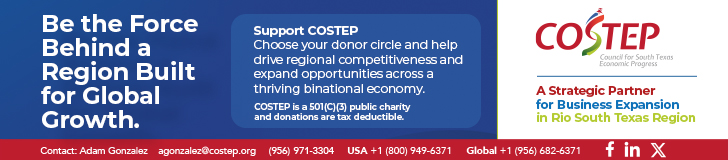
From a consulting standpoint, Torres said the time companies now spend on compliance is unprecedented. “The time spent on trade compliance has increased so drastically that it is hard to quantify,” he said. Many companies are responding by adding staff. “Companies are hiring more compliance personnel,” he explained, noting that compliance now plays a central role in business decision-making.
Tariffs are also reshaping logistics strategies. Torres said some companies are changing import routes altogether. “Some companies are importing into Mexico or Canada directly,” he said, while others are using bonded warehouses and Foreign Trade Zones to defer or avoid the tariffs and better manage costs.
Financial pressure remains a dominant issue. “The financial impact of tariffs is directly impacting the financial position and cash flow of companies,” Torres said. Many are passing costs to customers, increasing administrative burdens. He also noted longer payment terms. “We see customers requesting 60 days, 90 days, and even 120 days.”
Despite arguments that tariffs serve national security, Torres said the business view is clear. “There is no question that importers see tariffs as operational and financial burdens.”

Uncertainty around trade policy has further slowed investment. “Companies hate uncertainty,” Torres said, adding that many expansion projects are on hold. “Hopefully 2026 will bring some much-needed certainty.”
Tariffs are also driving sourcing shifts. “Companies are looking to source from countries that have lower tariff rates,” Torres said, pointing to General Motors asking suppliers to stop sourcing Chinese-origin components. He added that this could benefit the USMCA region.
Looking ahead, Torres urged policymakers to consider a more targeted approach. “We can accomplish the goal… with a more surgical approach,” he said, calling for “case-by-case” tariff decisions, especially with Mexico and Canada.