









Texas Border Business

Federal Bureau of Investigation (FBI)
Bank: “Current balance: $0.00″
Customer: “What? Where’s all my money?”

The realization you are the victim of a scam can be a sickening shock.
Certainly, there is no good time to be a victim of a scam. But getting scammed during the holidays—a time of giving and good cheer—can add an extra sting.
Scammers know money and time are in short supply this time of year. They know some consumers will act too fast when they see a bargain that will stretch their spending budget or beat a shipping deadline.
“We always see an uptick in fraud around the holidays. A lot of it’s because you have more people shopping online,” said Greg Heeb, deputy assistant director of the FBI’s Criminal Investigative Division.

“Scammers are opportunistic; they will take advantage of the holidays to attempt bank impersonation scams, charity scams, non-payment or non-delivery scams, and romance scams, among others,” added Rebecca Keithley, an assistant section chief in the division.
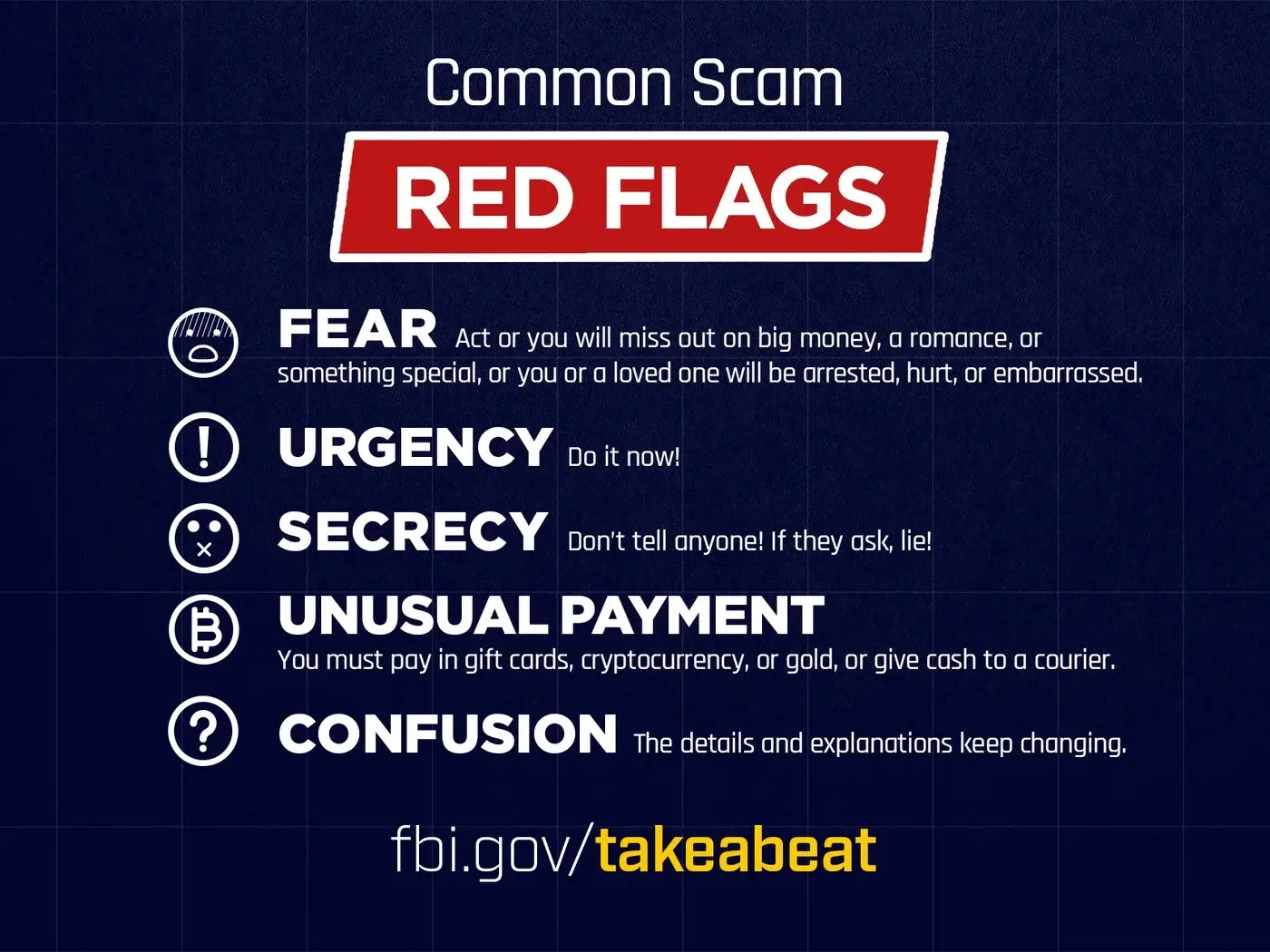
For this reason, the FBI encourages everyone to “take a beat” this holiday season—to slow down, think before acting, verify all the information is correct, and be certain the deal or offer is legitimate.
Don’t let scammers ruin the holidays.
Watch a video form the FBI below:
Criminals use different tactics to manipulate victims. Pitches may be direct and immediate, or they may be part of a drawn-out scheme. Some scammers spend months—or longer—building relationships with their target before taking action to separate you from your money.
Urgency is particularly common in investment schemes, with scammers claiming “deals of a lifetime” or opportunities to unload an unwanted timeshare. Scammers tell their targets to act now or lose out or that money is needed immediately to help someone in crisis.
Fear—often coupled with urgency—is another red flag. Targets may be told that, if they don’t act immediately, they will lose their savings or access to their financial accounts or that a loved one will be hurt or imprisoned.
Another red flag is a request for unusual methods of payment, such as gift cards, cryptocurrency, gold bars, cash by courier, or wire transfers. Legitimate businesses and government agencies do not demand or accept these forms of payment.
Sales fraud can take several forms. Victims may never receive the items they bought online, or they may receive a different or poor-quality version of the advertised item. Criminals may also use victims’ personally identifiable information to open credit card or bank accounts, apply for loans, or commit financial crimes and fraud.
On the other end of online commerce, some victims who sell items online are not paid for the items they already shipped.
Criminals also cash in on holiday generosity by seeking donations for fake or spoofed charities. The money never makes it to any legitimate charity; the fraudsters simply pocket the donations or wipe out entire bank accounts.
Using tech to scam
Advances in technology make it easier than ever to create realistic ads, websites, and other sales pitches. Artificial intelligence also makes it easier to create seemingly authentic audio and video of people to tempt or coerce them to part with their money. Criminals create fake profiles on social media, dating sites, gaming and special-interest forums, auction sites, and crowdfunding platforms.
“We’ve seen exponential growth in scam victimization through the internet and telephone,” Keithley said. “Scams have gone global—highly organized transnational criminal syndicates are running massive scam compounds and call centers. They are using cutting-edge technologies, artificial intelligence, social media, and mobile apps to target and engage with victims at a global scale.”
The FBI encourages all victims to file a report with the FBI’s Internet Crime Complaint Center online at ic3.gov as soon as they realize they have been defrauded. They should provide as much detail as possible.
Unfortunately, recovering money is extremely difficult in many cases.
“Once the money has been sent by way of cash, gift cards, cryptocurrency, it is difficult, if not impossible, to recover,” Keithley said. “The best line of defense against scams is prevention.”
Victims who make payments through a wire transfer should also contact their financial institutions immediately. Some transactions can be canceled or reversed if reported to the IC3 quickly.
Reporting frauds and scams through the IC3 helps the FBI prevent future victimization, both Keithley and Heeb said.
“That’s an important source of information for us as a law enforcement agency,” Heeb said. “We can compile that data not only to investigate these sorts of activities but also to educate the public. It helps us to identify trends that are happening. It really helps us to help the victims.”
The IC3 issues advisories and public service announcements and produces an annual report covering frauds and scams.
The IC3 will not contact victims directly. In fact, anyone claiming to work for the IC3 and seeking additional information from a victim is most likely a fraudster.
Additionally, the FBI’s Victim Services Division also helps victims of federal crimes, which includes many types of scams. FBI victim specialists provide access to useful resources.