








Texas Birder Business

By Joey Gomez
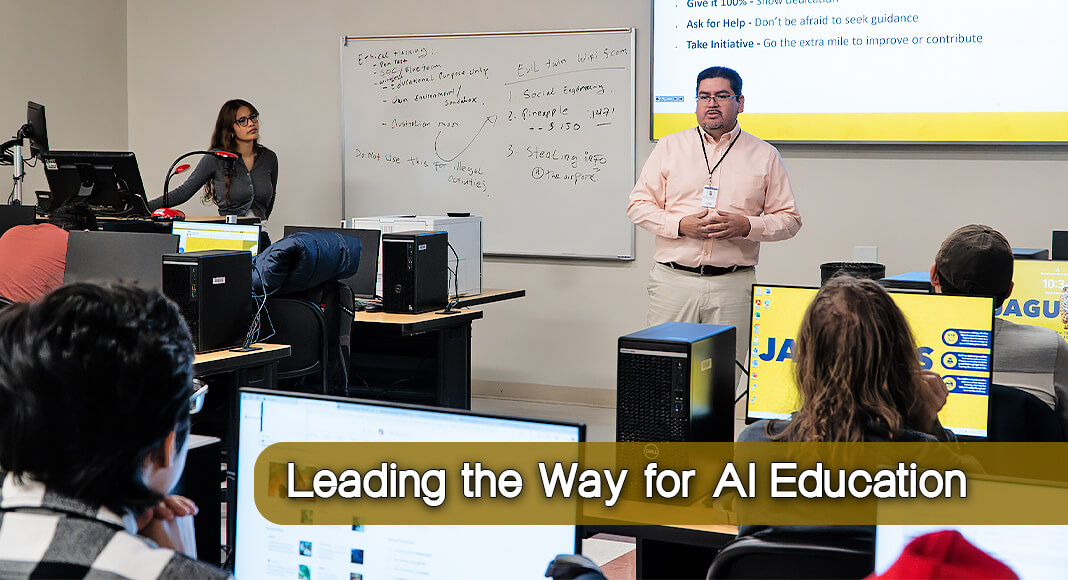
McALLEN, Texas – Artificial Intelligence (AI) is at the core of South Texas College’s Bachelor of Applied Technology in Computer Information Technology (BAT-CIT) program as it pioneers industry certificates on a statewide and national scale for students.
Leadership and faculty with the program say they have now awarded more than 2,250 certificates to students taking BAT-CIT courses in the five years since integrating what the program calls AI-focused “microcredentials” tied to Google and Amazon Web Services (AWS) in fall 2020.

The priority on industry credentials is giving graduates a unique and competitive edge in the job market, according to program Department Chair Saeed Molki.
“In the entire state of Texas and throughout the entire United States, no one has done such a thing,” Molki said, referring to the number of credentials awarded to students. “We do not overstate all the work we have done for students in the last five years.”
Crediting college leadership including STC President Ricardo J. Solis, Ph.D., along with Vice President and Provost for Academic Affairs and Economic Development, Anahid Petrosian, Ph.D., and Dean of Math, Science, IT and Bachelor Programs Ali Esmaeili, Ed.D., for encouraging the push toward microcredentials and AI, Molki said the effort began with a vision to embed industry certifications directly into courses.
The effort culminated this year in 2025 as the program added four new AI-related courses, which includes an Advanced Artificial Intelligence course for fourth-year students and an upcoming Data Science and Machine Learning in Cybersecurity course which begins in spring 2026.

Each course is meant to build on the last to create a progressive pathway to advanced AI concepts, according to BAT-CIT faculty.
“So essentially, students are going to be getting a certificate with every class,” said Assistant Professor of Computer Science, Nicholas Hinojosa. “Last semester, we even implemented that every student who is taking our 1301 class, which is our most basic class, will complete a certificate in Google Artificial Intelligence Essentials. These are students who are coming fresh from high school to STC.”
The BAT-CIT program offers seven industry-recognized certifications, that align with coursework so students earn credentials as they progress through the program.
CIT Assistant Professor Menghung Wu, Ph.D., emphasized that the curriculum builds from Python to machine learning and then to advanced AI which ensures students understand both the technical skills and theory behind AI systems.
“AI is no longer just a tool, it’s the foundation of how technology is advancing,” Wu said. “This is why in our program, we don’t just introduce students to the basics, we guide them step-by-step into the core of artificial intelligence. That deeper knowledge is what will set them apart as innovators in the workplace.”
BAT-CIT student Andrea Rios is the founder and current president of the program’s Computer Science Club and organizes various activities and speakers for students. Reflecting on the priority the program places on AI-related credentials, Rios said faculty are doing a phenomenal job by embracing the new technology and gauging the industry.
“The biggest way the faculty in the BAT-CIT program help students is by understanding the market and the workplace and realizing just how quickly it changes, especially in the technology industry,” Rios said. “At STC, we are taught to adapt and I think that’s the most important thing I have taken from my time here.”
For more information on STC’s Computer and Information Technologies program visit www.southtexascollege.edu/academics/computer-info-tech/index.html.