






Texas Border Business

By Roberto Hugo González
Texas Border Business
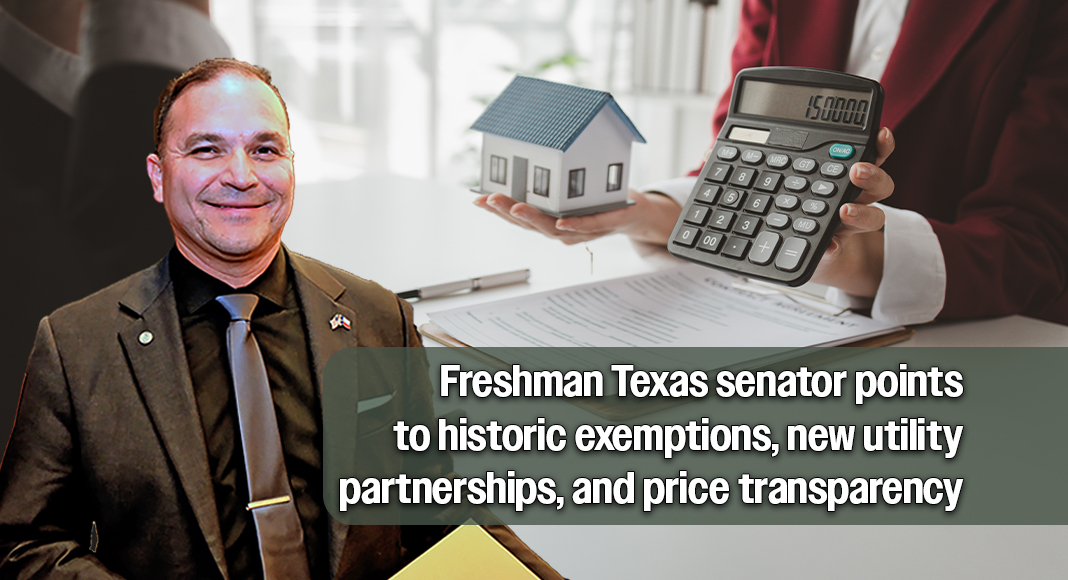
At the McAllen Legislative Wrap-Up Luncheon on October 3, 2025, Sen. Adam Hinojosa (R–District 27) outlined what he described as major achievements of the 89th Texas Legislative Session, focusing on property tax relief, regional water management, and health care access. The luncheon, held at the Embassy Suites Convention Center, was hosted by the McAllen Chamber of Commerce and the McAllen Economic Development Corporation.

Hinojosa said tax relief measures were among the most significant outcomes of the session and will be decided by voters in November. “This November, voters will have the opportunity to decide on Proposition 13, which would increase the homestead exemption from $100,000 to $140,000—and for those 65 or older, up to $200,000,” he said. He also pointed to Proposition 9, which would raise the business personal property tax exemption from $2,500 to $125,000. “That change will essentially eliminate property tax bills for most of our small businesses,” he explained.
The senator also described a bill he authored to help South Texas address flooding and water supply issues through regional collaboration. “One bill I want to highlight…is Senate Bill 1169. I authored this bill to establish public utility agencies,” he said. “It allows any two governmental entities to partner and create a public utility agency that can capitalize on economies of scale to address challenges—such as flooding and water supply—that are often too big for one city to manage alone.” Hinojosa added that the framework would allow access to North American Development Bank funding, matching grants, and public-private partnerships. “By pooling resources and expertise, we can more effectively tackle regional flooding issues…as well as long-term water supply needs,” he said.
Health care was another focus of Hinojosa’s comments. He said lawmakers approved new price transparency measures designed to protect patients from surprise bills. “The transparency is a measure to kind of make sure that all of these services and products…are going to be standardized in a more normal manner,” he explained. He also promoted expanding access to care, particularly in rural areas of his district. “I authored a bill to allow for outpatient services for standalone ERs,” he said, describing it as a more efficient model that could expand services without competing with major hospitals. He added that telehealth expansion was another priority.
Hinojosa tied health access to economic growth, noting the challenges for individuals and small businesses in securing affordable insurance. “As a small business owner, our plan with our employees can save money by having a group plan. The moment you get off of that group plan and try to go find your own health insurance, that’s astronomically more expensive,” he said. He argued that creating more jobs with higher wages and benefits would improve access. “The more people that we have on company plans and paying into the system, the less all this is going to cost,” he said.

Hinojosa also mentioned a bill that will benefit college-bound students across the state. “One of the bills I did author was Senate Bill 2230, and that sets aside one week where college application fees are waived in the state of Texas,” he said, noting that the waiver period will run from October 13 through 19.
Reflecting on his first term in the Senate, Hinojosa emphasized the volume of legislation he advanced. “I had the honor of passing 75 bills out of the Senate—41 of which became law and were signed by the Governor,” he said. “That’s close to a record for a freshman senator.”
“These measures on taxes, water, and health care are about strengthening our region for the future,” Hinojosa concluded. “They will help families, small businesses, and communities across the Rio Grande Valley.”
See related stories: