






Texas Border Business

By Roberto Hugo González
On August 13, 2025, leaders from Nuevo Laredo and Laredo met at the A.R. Sanchez, Jr. School of Business to launch the Rio South Texas Region Binational Auto Cluster. The initiative introduced its first project, the Rio South Texas Region Industrial Data System, a digital platform designed to centralize information on manufacturing in Northern Tamaulipas and South Texas. The event drew government officials, business leaders, and academics, highlighting a regional push for stronger cross-border economic integration.
Adam Gonzalez, CEO of the Council for South Texas Economic Progress (COSTEP), emphasized that this project represents a significant step toward regional economic development. “When the inventory is taken, it’s not going to just focus on auto manufacturing. What we want to do is every manufacturing operation—whether it’s aerospace, whether it’s medical devices—let’s collect it at one time, let’s keep it updated at the same time, because we’re going to promote everything,” Gonzalez explained.
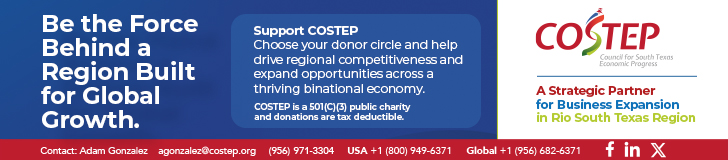
The event attracted leaders from various industries as part of the Rio South Texas Binational Auto Cluster – Initiative Regional Stakeholder Strategy. Dr. Rolando Ortiz, COO of Killam Industries and Killam Development, highlighted the importance of expanding the scope of the data platform beyond manufacturing. “Don’t limit it just for the manufacturers. Let’s try to grab everybody… warehousing, municipality information, colleges, the universities,” Ortiz stated. He stressed that the effort should include distribution and supply chain actors to fully represent the industrial ecosystem.
Ortiz also pointed to potential opportunities outside of the automotive sector, noting that “the aeronautic industry… doesn’t have any second and third tiers” in Mexico. He suggested the region could attract these missing elements of the aerospace supply chain. In addition, he raised concerns about workforce development, particularly for what he described as the “opportunity population”—students who may not complete high school or transition to higher education. “How do we focus on that opportunity population that these kids end up at the bottom?” Ortiz asked, emphasizing the need for educational pipelines that connect youth to careers in transportation, distribution, and advanced manufacturing.
Gonzalez responded by outlining COSTEP’s ongoing role in workforce and educational development. He explained that the organization also manages the Rio South Texas Education and Community Development Foundation (RSTEF), which supports seven counties in the region. “We have given roughly $9.4 million in the last five years for programs,” Gonzalez said, noting investments in nursing, teaching, accounting, and construction sciences. He emphasized that data from the new platform will guide future investments, helping align training programs with in-demand occupations.
Both speakers agreed on the importance of regional cooperation. Gonzalez stressed that economic development organizations should avoid unnecessary competition, saying, “If a company doesn’t land in my town… what we need to do is share that information. If it doesn’t fit here, where else in the region does it fit? So that it can stay here and benefit all of us.”

The introduction of the Rio South Texas Region Industrial Data System represents not only a technological milestone but also a collaborative framework for cross-border integration. As Ortiz concluded, the initiative has the potential to become a catalyst: “There’s a great opportunity here… and I think you all are on the right track.”
The event was hosted by the A.R. Sánchez, Jr. School of Business at Texas A&M International University in Laredo.