






Texas Border Business

By Roberto Hugo González / Texas Border Business
After approximately nine months without an official leader, the Rio Grande Valley Partnership in early 2026 announced the selection of Paco Sanchez as its new President and CEO, naming a veteran legislative professional to lead the business-focused regional organization ahead of the next state legislative cycle.
Sanchez brings nearly two decades of experience in Texas state government, having served as Legislative Director for a state representative and Chief of Staff for another. He also worked as a litigation specialist in the private sector. A native of the Rio Grande Valley, he holds a law degree from the University of Houston Law Center and an undergraduate degree from the University of Texas at Austin.

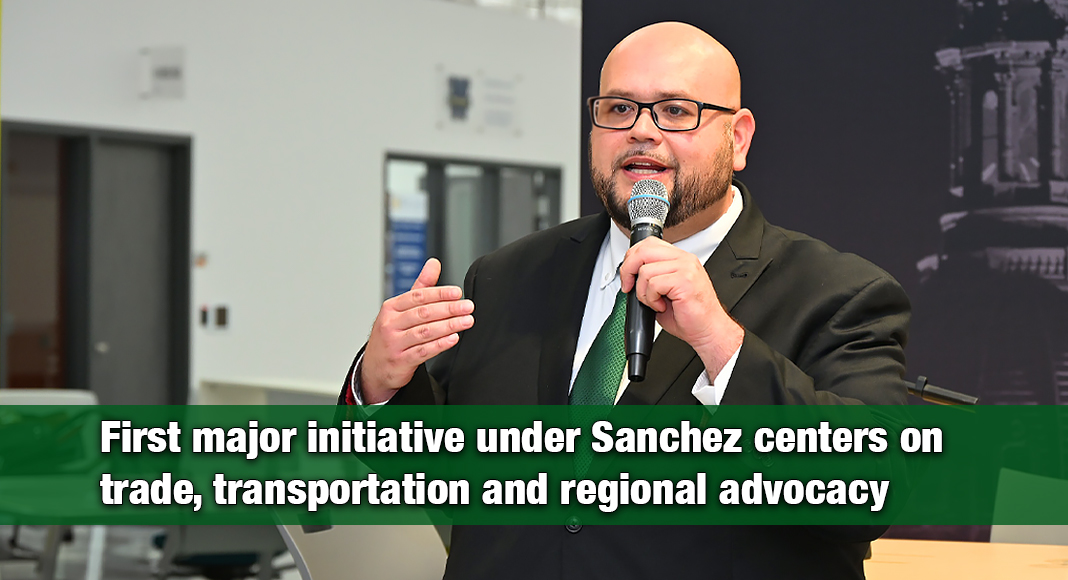
Soon after assuming the role, Sanchez led the Partnership’s first RGV Connect session, launching a new initiative to strengthen regional collaboration and advocacy. The meeting was organized with support from the City of Mission and Mission Economic Development Corporation.
“Good morning, everyone. I’m Paco Sanchez, President and CEO of the Rio Grande Valley Partnership,” Sanchez said. “I want to thank the City of Mission, Mission EDC, and their staff for helping us put this event together.”
Teclo Garcia, Mission EDC President and CEO, welcomed him to the position. “Paco, thank you for taking the job. We’re incredibly proud of you and glad to see someone who knows the Valley, Austin, and D.C. so well,” Garcia said.
Sanchez described the Partnership as “a business-led nonprofit focused on advancing advocacy and collaboration across the four counties of the Rio Grande Valley.” He said the organization brings together business leaders, community stakeholders, and elected officials to set regional priorities and carry them to Austin and Washington, D.C., with the goal of strengthening infrastructure and competitiveness.

He said RGV Connect complements the organization’s signature RGV Legislative Tour, which brings state lawmakers and staff to the Valley to review projects and funding needs. “The RGV Legislative Tour and RGV Connect serve as key tools to facilitate community discussions, shape our regional advocacy strategy, and guide our legislative agenda,” Sanchez said.
The first session focused on trade and transportation. Sanchez called the topic “timely and critical,” emphasizing that challenges in Cameron County affect Hidalgo, Willacy, and Starr counties alike. “The Rio Grande Valley is not siloed, and our challenges are not isolated. They affect all of us,” he said.
Panelists highlighted the lack of a complete interstate corridor as an economic disadvantage and cited limited rail connectivity and overweight freight corridor links as priorities. Expansion of commercial bridge infrastructure, including the Donna-Rio Bravo Bridge project, was discussed as ready to advance but stalled by funding constraints.
Sanchez said RGV Connect is designed to build momentum for the region’s advocacy efforts in Austin and Washington as the next legislative cycle approaches.