





Texas Border Business

By Roberto Hugo González / Texas Border Business
New tariff requirements taking effect in 2025 are creating what trade experts describe as one of the most challenging compliance environments in years. According to Jorge A. Torres, President of Interlink Trade Services and a licensed U.S. Customs Broker, many companies are underestimating the scale and seriousness of the changes.
“2025 has been a challenging year for trade with all the new tariffs imposed by the current administration,” Torres said. “Importers need to be aware that compliance with the current tariffs is of upmost importance.”

Torres emphasized that tariff compliance is no longer a routine paperwork issue. “Importers cannot underestimate compliance when it comes to tariffs,” he said. “Providing accurate information to CBP that is fully supported and documented is critical to avoid penalties and under- or over-payments of tariffs.”
See the image below for examples of the tariffs:
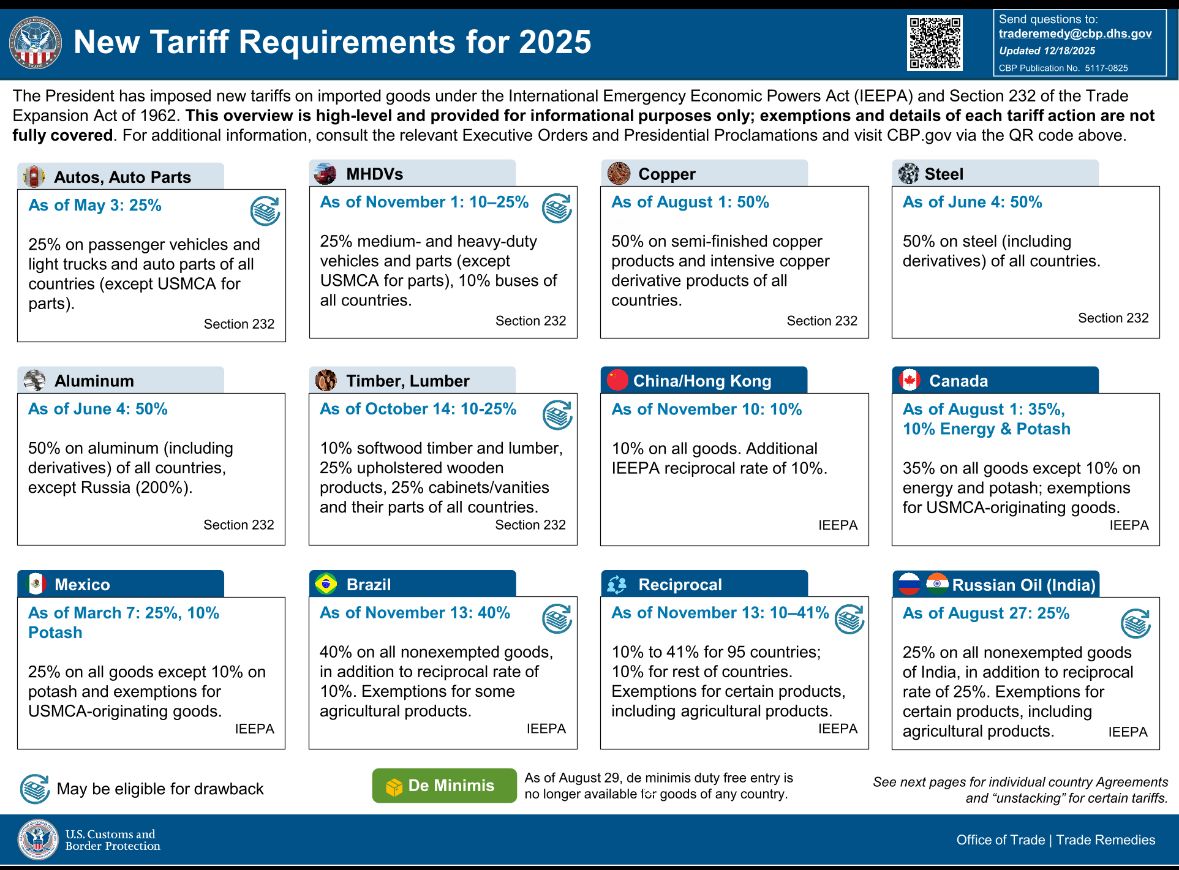
One of the most complex issues companies face is tariff stacking, where multiple tariffs apply to the same product. These can include product-specific tariffs layered with country-based or reciprocal tariffs. Torres said mistakes in this area are common.
“The stacking rules can be confusing and subject to interpretation,” he said. “Therefore, understanding them and correctly implementing them is crucial to avoid under or overpayment of tariffs.”
He warned that errors do not go unnoticed. “If CBP reviews an entry and determines that there is an incorrect application of a stacking rule, they will issue a bill for any tariffs owed,” Torres said.
While some importers may believe exemptions under the U.S.-Mexico-Canada Agreement provide relief, Torres said qualifying for those exemptions is far from automatic. Certain tariffs, including the IEEPA fentanyl tariff and Section 232 tariffs on automotive parts, are exempt only if the product qualifies for preferential treatment under the USMCA.
“To qualify for USMCA preferential treatment, producers need to comply with the specific rule of origin,” Torres said. He explained that these rules are based on the product’s harmonized tariff classification and may require a tariff shift, a regional value content calculation, or both.
“Therefore, it is important to apply the rule of origin correctly and with supporting documentation to claim USMCA preferential treatment,” he said. “Companies need to have qualified trade compliance personnel and/or consultants that can perform these analyses correctly.”
Another major change affecting trade in 2025 is the elimination of the de minimis duty-free entry for low-value shipments, a provision heavily used by e-commerce businesses and small importers.
“The elimination of the De Minimis provision for low value e-commerce shipments has had a substantial impact on trade,” Torres said. “Now importers must file formal entries for these low value shipments and duties and tariffs are being assessed.”
He noted that the consequences are both financial and operational. “Therefore, the impact has been operational and financial,” Torres said. “Since the De Minimis provision was eliminated, CBP has collected $1 billion USD.”
Torres said tariffs are no longer just a compliance concern but are increasingly shaping business decisions. When asked whether tariffs eventually become more of a supply-chain strategy issue than a customs issue, he said the two are inseparable.
“I think they will always be both,” Torres said. “Applying the tariff provisions correctly is needed to avoid penalties and under or overpayments.” At the same time, he noted that companies are adjusting where they source goods. “Importers are implementing sourcing from lower tariff countries to reduce their financial exposure, which is re-shaping their supply-chain strategies,” he said.
The impact of the 2025 tariffs is expected to be widespread. Torres said several industries will feel the effects quickly and sharply. “All the above,” he said, referring to autos, construction, electronics, furniture, and energy. He added, “In particular the automotive and metallurgical industries.”
Errors in applying the new rules are already emerging. Torres pointed to valuation issues as a major risk area. “In the case of Section 232 for steel/aluminum/copper, the incorrect valuation of the metal content,” he said. He also said both importers and customs brokers are struggling with the correct order of applying stacked tariffs.
“Importers need to be auditing their entries and be in constant communication with their customs brokers to minimize errors in their filings,” Torres said.
For companies preparing for the rest of 2025, Torres offered three practical recommendations. First, he urged businesses to rely on official and credible information. “Get your information from official sources such as Executive Orders, Federal Register Publications, and CSMS messages from CBP, and from reputable trade consultants,” he said. “Do not rely on social media or even the mainstream media.”
Second, he stressed the importance of staffing and training. “Hire the necessary resources to ensure a robust trade compliance program in your company and train them appropriately,” Torres said.
Finally, he said compliance must be part of broader business planning. “Incorporate trade compliance into your company’s strategic planning,” Torres said. “Get data visibility for proper impact analysis and decision-making process.”
Torres brings more than 30 years of experience in customs brokerage and international trade. His message to importers navigating the 2025 tariff landscape is consistent and direct: accuracy, documentation, and preparation are no longer optional.