







Texas Border Business

By Amanda Sotelo
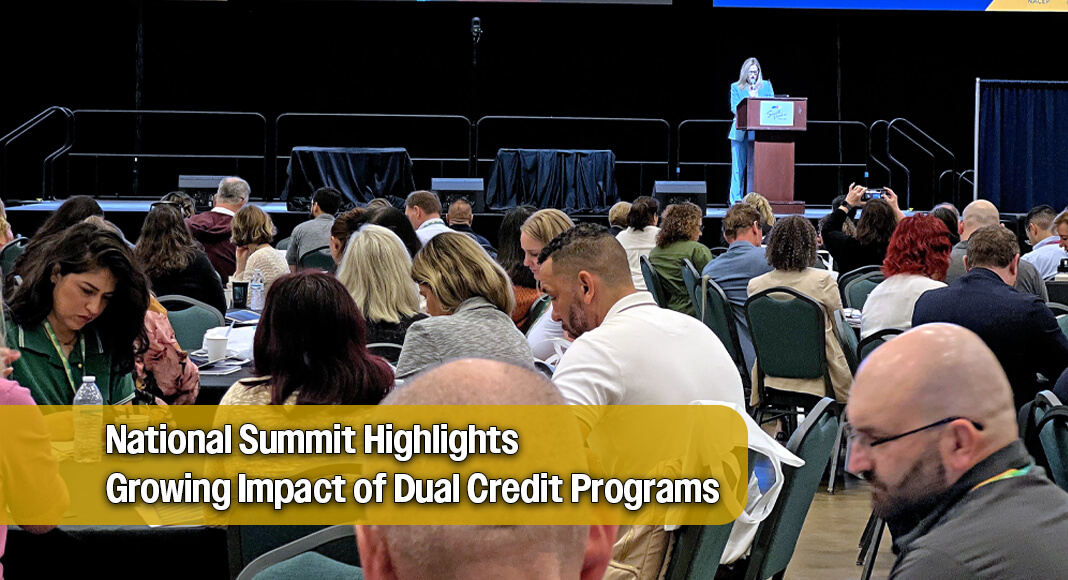
McALLEN, Texas – February at South Texas College means hundreds of education professionals from across the nation gather at South Padre Island for the college’s annual Dual Credit Summit, in collaboration with the National Alliance of Concurrent Enrollment Partnerships (NACEP).
This year, nearly 300 K-12 and post-secondary education leaders, advisors and counselors attended the three-day event that included keynote speakers, breakout sessions and networking opportunities.

Rebecca De Leon, Ed.D., STC associate vice president of Dual Credit Programs and School District Partnerships and NACEP board of directors, president-elect, said the summit continues to grow, and each year, it helps expand the accessibility of college for thousands of students across the country.
“Together, through NACEP, we are creating a college-going culture by providing dual credit opportunities for students while still in high school. For some, this is the gateway to believing in themselves and many achieving a college certificate or degree,” she said. “By hosting the dual credit summit, presenters from across the country share best practices, policies and curriculum that can help K-12 schools, colleges and universities create or expand dual credit and improve student outcomes.”
STC, a national leader in dual credit, has served more than 150,000 students since 2000, saving students and families more than $464 million in tuition.
With keynote speakers like John Fink, senior research associate and program lead at the Community College Research Center at Teacher’s College in Columbia University and Danny Goldberg, culture expert, acclaimed speaker and award-winning entrepreneur, covering topics such as a “Deep Dive into Dual Credit Data” or “Putting Care in Front of Leadership,” respectively, provided attendees with a shared eye-opening experience.
Those in attendance, like first-time attendee and presenter Katie Grimes, college and career counselor from GEO Next Generation High School in Baton Rouge, Louisiana, said she is excited to gain new knowledge and return with a new outlook on dual credit and how it can continue to benefit her students.

Grimes also hosted a breakout session to discuss bridging the gap with wraparound support with a focus on K-12.
“A lot of the work I do centers on dual credit and overall support, so I want to share my knowledge and help others who may need or want more information in this area,” she said. “I’ve learned so much about collaboration and how to improve partnerships. I can’t wait to attend more of these summits and conferences to expand my knowledge and take home information that is vital to our students’ success, especially those underrepresented in our communities.”
Dianne Laffai Parker, deputy executive director in Program and Policy Strategy for NACEP, said it’s an honor to be a cosponsor of the annual summit alongside STC.
“Our partnership with STC and working with the college has been amazing. Their dual credit program is an exemplary model to follow,” Parker said. “With over 34 different states represented at the conference this week, we are providing enriching content and in-depth conversations about quality programming that you can’t get anywhere else. This summit is always a great opportunity to sit back, relax at the beautiful beach and share best practices because dual credit is a unique space within education.”
NACEP Program Manager Carla Yorke shares Parker’s sentiment and added that although this year’s summit was her first, she is excited that she plays a part in supporting NACEP’s dual credit partners.
“Everyone plays such an important role in developing, enhancing and shaping dual credit programs that impact academic and workforce development,” said Yorke. “It’s partners like STC, that have such excellent leadership and are doing a great job bringing everyone together to continue impacting academic and workforce development. Preparing students for the workforce is the next phase in dual credit.”
STC offers more than 20 dual credit Career and Technical Education certificates in programs such as Welding, Automotive Maintenance and Light Repair, Electrician Assistant, Heating, Ventilation and Air Conditioning (HVAC) and Precision Manufacturing Technology.
Ricardo J. Solis, Ph.D., STC president, whose career has also focused on workforce and economic development, said it’s crucial for community colleges and K-12 schools to recognize that the demand for short-term certificates and two-year degrees is on the rise and it’s important to create pathways through dual credit that also focuses in this area.
“Not every student is made for a four-year degree, and that’s okay, but we need to give them options too,” said Solis. “Our Dual Credit Programs offer technical education pathways that can provide students with industry certifications right out of high school, allowing them to begin their careers. This is a huge opportunity for our students, especially those right here in the RGV who live along the U.S./Mexico border. It’s an honor to share this with the rest of the country.”
For more information on STC’s Dual Credit Programs, visit southtexascollege.edu/dual.
Information source: STC