






Texas Border Business

By David Vergun, Pentagon News / US DOW
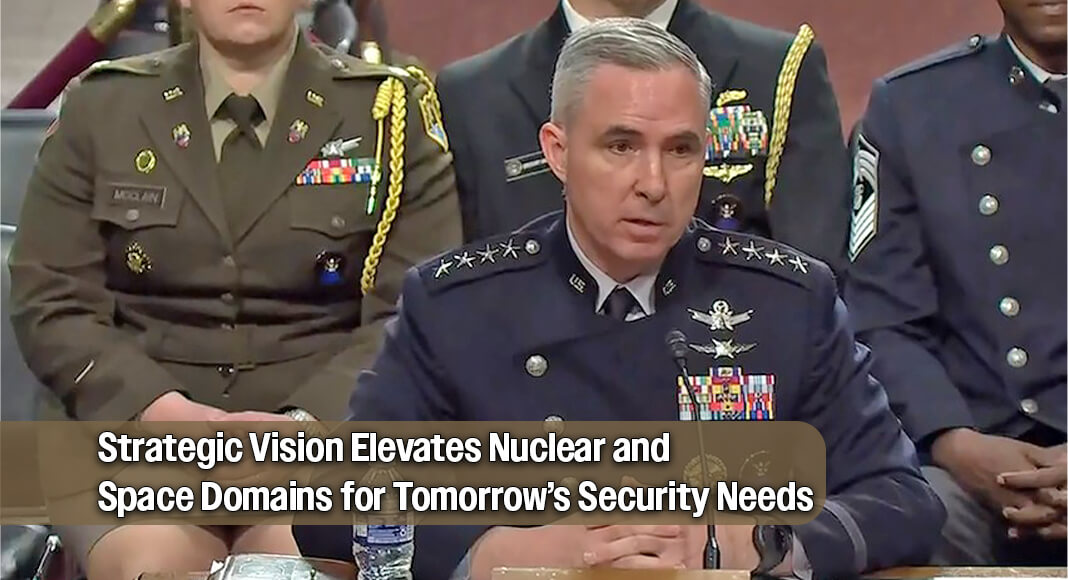
Protecting America’s space systems is essential for national security because so many military capabilities rely on them — including precision navigation, global communications, missile warning and real-time intelligence, said Space Force Gen. Stephen N. Whiting, commander of U.S. Space Command, who testified in Washington before the Senate Armed Services Committee.
Space systems were critical to mission success in recent operations, including Midnight Hammer, Absolute Resolve and currently Epic Fury, he said.

“Should an adversary degrade or destroy our space capabilities, the joint force’s ability to fight as it is sized and designed would be immediately and materially impacted,” Whiting said, adding that opponents are moving at an alarming pace, developing and deploying capabilities to deny the War Department the use of space.
China’s space presence has grown exponentially, operating over 1,300 active satellites, a 667% increase since 2015, including more than 510 intelligence, surveillance and reconnaissance satellites.
They are using these capabilities to integrate military, space-enabled effects and fielding weapons designed to outmaneuver and destroy U.S. satellites, he said.
Russia has capabilities designed to disrupt U.S. space assets, “including the potential placement of a nuclear weapon [in] orbit — the single greatest threat to our space architecture,” Whiting said. “Armed conflict in space is not inevitable, but should deterrence fail, the integrated space power of our team will provide a decisive advantage.”
The general listed his top funding priorities for fiscal year 2027, which include fielding integrated space fires, active protection of satellites, enhancing battlespace awareness, building an integrated command and control system, and providing sufficient cyber defenses for the space domain.
The command is making good progress in moving its headquarters from Peterson Space Force Base in Colorado to Redstone Arsenal in Alabama, he said.
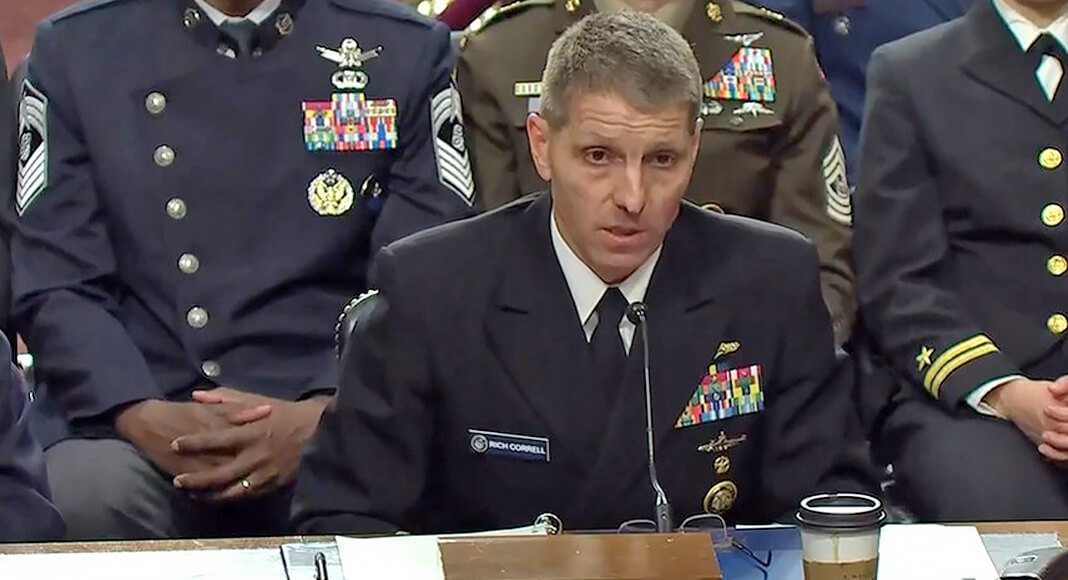
Navy Adm. Richard A. Correll, commander of U.S. Strategic Command, who also testified today, said that the nation’s nuclear forces are the foundation of national security.
“Stratcom and its components stand ready, not seeking out confrontation, but deterring strategic attack and underpinning all Department of War operational plans,” the admiral said.
The challenge is to deter great power conflict and manage the complexities of deterring multiple nuclear competitors simultaneously, all while adapting to rapid technological change and advancements, Correll said.
Some of those challenges include cyber threats, counter-U.S. space capabilities, a contested electromagnetic spectrum, novel enemy missile systems and supply chain issues.
“As we bring the B-21 [Raider] bomber, the Columbia-class submarines and the Sentinel intercontinental ballistic missile system online, we will ensure the credibility of our deterrence for decades to come,” he said.