








Texas Border Business

Texas Border Business
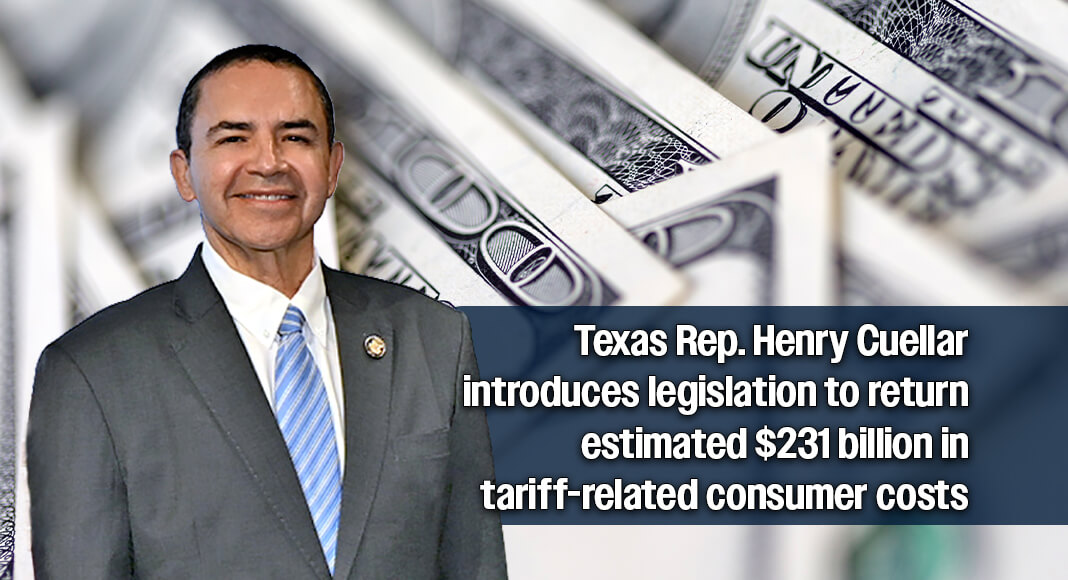
WASHINGTON — U.S. Rep. Henry Cuellar of Texas introduced legislation in the House of Representatives that would provide direct payments to taxpayers to offset higher consumer costs attributed to tariffs imposed without congressional authorization.
The bill, H.R. 7865, titled the “American Consumer Tariff Rebate Act of 2026,” was introduced on March 9, 2026, during the 119th Congress and referred to the House Committee on Ways and Means. According to the bill text, the legislation would provide a one-time rebate to taxpayers to offset price increases resulting from certain tariffs.

The bill states that “Article I, Section 8 of the Constitution vests exclusively in Congress the authority to lay and collect duties and tariffs.” It further states that duties imposed through presidential action under the International Emergency Economic Powers Act without explicit congressional authorization “resulted in increased consumer prices nationwide.”
Congress cited estimates from the Congressional Budget Office and the Joint Economic Committee indicating that the total consumer costs associated with those tariffs reached approximately $231.35 billion. The bill says Congress has a responsibility “to provide direct restitution to taxpayers for these unlawful cost increases.”
Under the proposal, the U.S. Treasury would distribute a one-time payment to taxpayers based on their most recent federal income tax return. Eligible returns include those of single taxpayers, married couples filing jointly or separately, heads of household, and qualifying surviving spouses.
The legislation places an income limit on the payments. No rebate would be issued to taxpayers reporting adjusted gross income above $400,000. The bill sets a total funding cap of $231.35 billion for all payments.
The Treasury Secretary would determine a base payment amount by dividing the total funding pool among eligible taxpayers using a formula that accounts for filing status. According to the bill, single filers and married taxpayers filing separately would receive 100 percent of the base amount, heads of household would receive 150 percent, and married couples filing jointly or qualifying surviving spouses would receive 200 percent.
The proposal also includes a supplemental payment for families with children. The bill directs the Treasury to provide a “Child Bonus” of $125 for each qualified child claimed on an eligible tax return.
The child payments would be funded using savings generated by excluding high-income taxpayers from the rebate program. The legislation states that payments for the child bonus and the base rebates combined may not exceed the overall cap of $231.35 billion.
The bill defines “covered tariffs” as duties imposed through presidential action under the International Emergency Economic Powers Act that were later determined to lack congressional authorization.
If enacted, the legislation would require the Secretary of the Treasury to administer and distribute the payments to eligible taxpayers based on available tax return data. The measure will now be reviewed by the House Committee on Ways and Means for consideration.
See the bill below: