







Texas Border Business

Federal Bureau of Investigation (FBI)
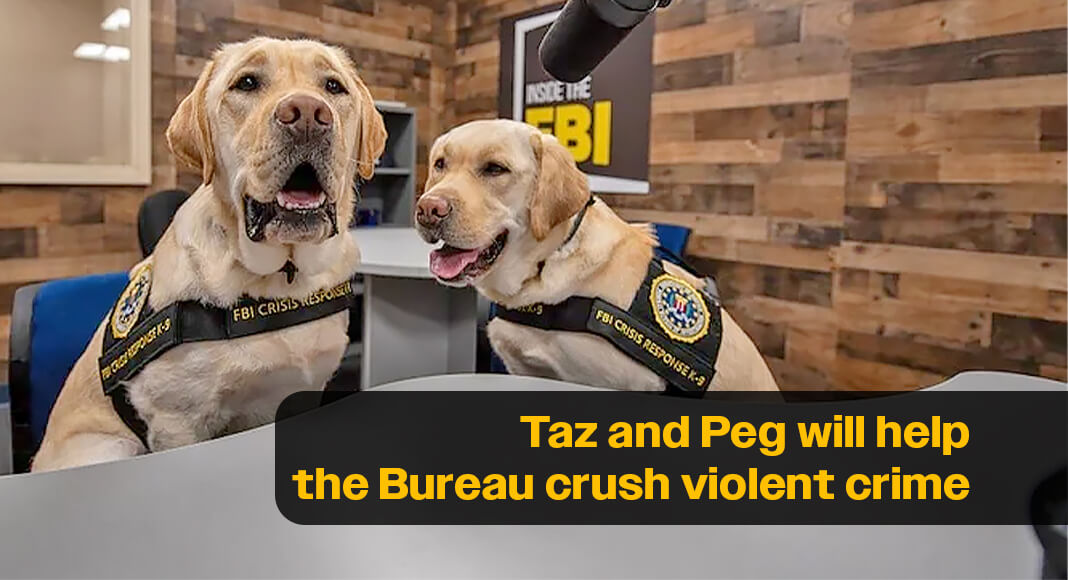
The FBI’s Victim Services Division has welcomed two new recruits: yellow English Labradors named Taz and Peg.
Taz and Peg join the FBI family as certified crisis response canines (CRCs). These dogs are specially trained to support victims of crime and foster trust among impacted communities. CRCs also help victims find the courage and confidence to share their experiences in sensitive settings, such as investigative interviews and on the witness stand in court.

In this way, these four-legged first responders help the Justice Department secure convictions in violent crime and counterterrorism cases.
Training days
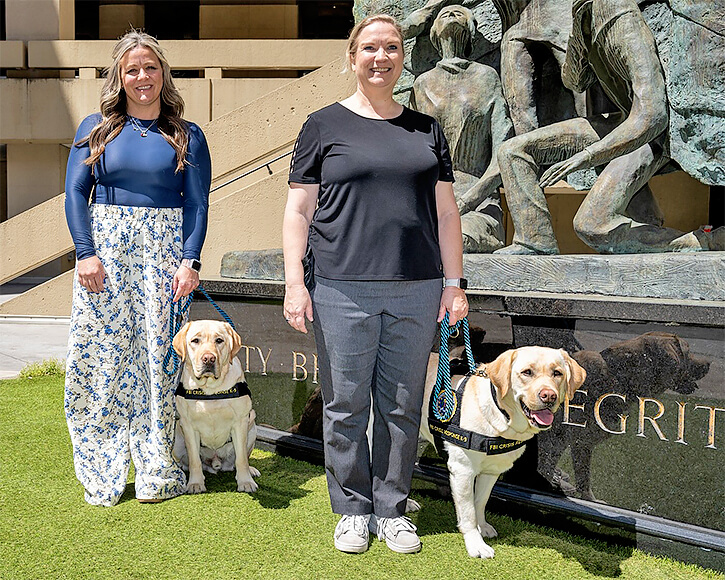
Taz and Peg, along with their handlers Amanda and Melissa, recently traveled to the Washington, D.C., area for a week of intensive training for their new jobs at the Bureau.
Our partners at Assistance Dogs of the West (ADW)—a nonprofit dedicated to breeding and training not only crisis response canines but also other types of mobility and service dogs—led the training. The FBI has worked with ADW to acquire CRCs and train them and their handlers since 2015.
During training, the dogs and handlers learned how to move together and how to communicate via cues that the dogs learned when they were puppies. Then, they all practiced navigating urban streets, courtroom settings, and the halls of FBI Headquarters.
Finally, they deployed to their new homes in the field. There, they each passed their final assignments to become certified to support victims on behalf of the Bureau.
az and Peg are now based in the FBI’s Atlanta and Dallas field offices, respectively. That way, they can quickly deploy nationwide to the scenes of violent crimes, mass violence incidents, courtroom appearances, forensic interviews, and other sensitive scenarios to support victims.
While the dogs recently completed their last round of training, their journeys to public service actually started as soon as they were born into human hands at ADW’s puppy enrichment center in New Mexico.
ADW trainers begin exposing their puppies to unfamiliar smells, sounds, and other stimuli while some of their senses are still fully forming.
“So, of course, they cannot see, they cannot hear until about 14 days old, but they can smell,” said ADW Lead Instructor and Trainer Aimee Brown. “They’re moving around. They feel vibrations. They have taste. And so, they’re being exposed to a wide variety of things.”
The puppies also learn to love people from their earliest days.
As they grow, the trainers keep an eye on traits that can make or break their success as service or facility dogs—such as their gait and their ability to take commands from multiple people. The trainers also look for natural areas of interest or aptitude, essentially allowing the dogs to choose their own vocational adventure.
“They tell us through the training,” explained Jill Felice, founder, vice president, and program director at Assistance Dogs of the West.
The science behind the canines
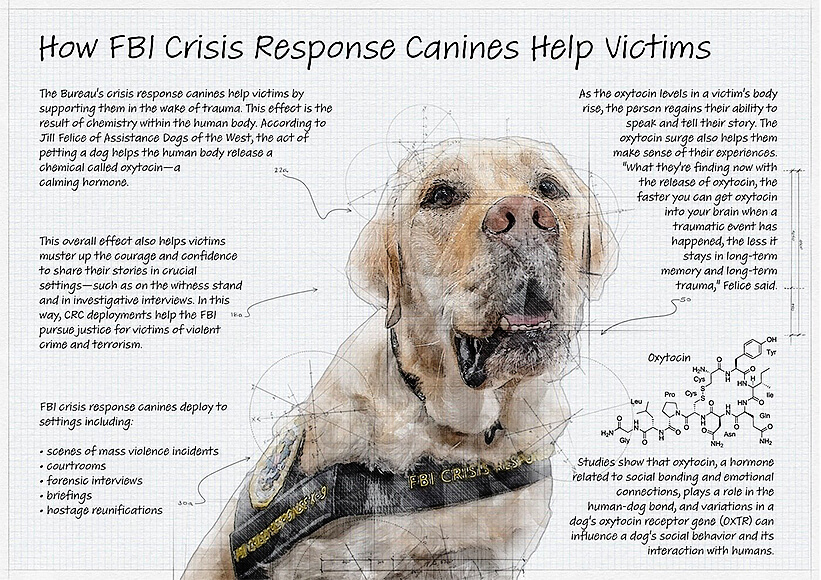
The dogs’ presence in the immediate aftermath of a crisis has a scientifically proven ability to decrease the likelihood of victims’ bodies storing their experiences as long-term trauma.
According to Assistance Dogs of the West Vice President and Program Director Jill Felice, this is because the mere act of petting a dog causes the human body to release oxytocin—a hormone that induces calmness.
“What they’re finding now with the release of oxytocin,” she added, “is the faster you can get oxytocin into your brain when a traumatic event has happened, the less it stays in long-term memory and long-term trauma. And that’s one of the hardest things about crises.”
And over the course of an investigation and judicial process, crisis response canines can help victims calm their nerves enough to share their stories with investigators and juries, alike. In turn, this helps our Justice Department partners secure convictions in violent crime and terrorism cases.
The dogs also help the Bureau establish rapport and build trust with victims.
“Victims are volunteers,” explained Staci, a victim services coordinator. Staci became the Bureau’s second-ever crisis-response canine handler when she was paired with English Labrador Wally. “They don’t have to speak with us.
“In a lot of cases, without victims, you don’t have a case. And so, if we can implement tools to assist victims to be able to want to speak with us—to make it easier for them to speak with us—it’s a win-win, because if victims speak with us, it gives us more information to help with our investigations and hopefully holding people accountable for their victimization, which keeps our streets safer and really helps society overall.”
In this way, these canine-handler teams are critical to the Bureau’s efforts to crush violent crime, defend the homeland, and rebuild public trust.
Following in unparalleled paw prints

The FBI’s inaugural crisis response canines, Wally and Gio, joined the Bureau in October 2015 after their ADW training.
“Early on, the mission of the program really was to leverage the canine-human bond to mitigate stress and anxiety of victims following mass violence incidents,” said Melody, who was paired with Gio in what became one of the Bureau’s first crisis response canine teams.
“Soon after that, we branched out, and we started providing support to critical incidents and violent crime. So, that means Gio and Wally would assist across all threat programs in the Bureau. And that could look like court support, forensic interviews, briefings, hostage reunifications, and so on.”
The December 2015 mass shooting in San Bernardino, California, marked their first deployment to a mass violence incident. The canines and their handlers went on to support victims in the wake of eight additional mass violence incidents—including the Pulse nightclub, Parkland, and Route 91 Harvest Festival mass shootings.
But they’ve also supported victims in other settings. Notably, Gio and Wally became the first two facility dogs to ever support victims in a courtroom setting.
The success of these human-canine teams didn’t just lead the Victim Services Division to expand its crisis response canine program to the field. It also inspired the next generation of Victim Services personnel to become handlers.
Peg’s handler, Melissa, was first exposed to the power of dogs as a military social worker, where she saw the impact of canines on combat soldiers’ emotions. But seeing the original class of FBI crisis response canines in action cemented her calling to serve as a handler.
“When I joined the Bureau and met Wally and Gio and started going out to mass violence incidents, seeing Wally and Gio work and the true impact it has on that community and what they bring to the table, I knew that this was something I wanted to pursue,” recalled Melissa, who worked as an FBI victim specialist before moving to her current role.
The legacy that Melody and Gio and Staci and Wally have built has similarly inspired Amanda.
“We have seen the work that these dogs do on deployments when we’ve worked really long hours and the way they work with victims,” she said. Amanda, who also worked as an FBI victim specialist, now serves as Taz’s handler.
“And then,” she continued, “we’ve seen them work with victims in our cases … and then, we bring these dogs in to maybe help during court when they have to go testify against their abuser. And just seeing what those dogs bring to those victims? It’s life-changing.”