







Texas Border Business
By Katie Lange, Pentagon News / U.S. Department of War
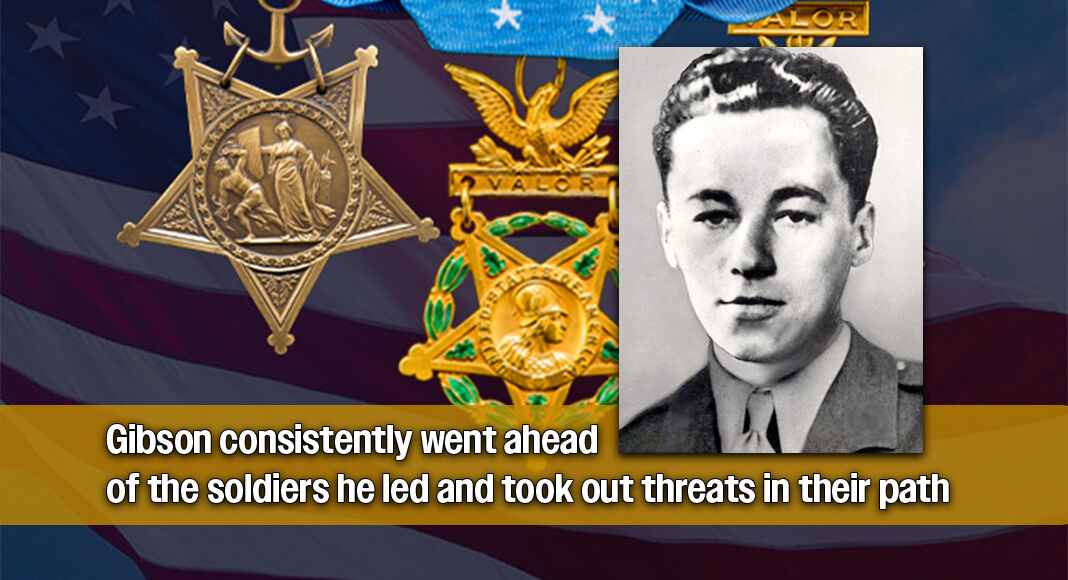
Army Tech. 5th Grade Eric Gibson served as a cook during World War II, but his desire for more led him to work out a deal with his superiors to fight on the front lines. During one intense battle in Italy, Gibson consistently went ahead of the soldiers he led and took out threats in their path. He didn’t survive the ordeal, but his bravery and leadership earned him the Medal of Honor.

Gibson was born Oct. 3, 1919, in Nysund, Sweden, to Erland and Agda Gibson. In 1924, after his younger brother, Sven, was born, the family moved to Chicago, where Gibson grew up.
Few details of his early life have been published. Still, by February 1941, Gibson had enlisted in the Army as troop numbers soared ahead of America’s inevitable involvement in World War II. After basic training, he was assigned as a cook for the 30th Infantry Regiment, 3rd Infantry Division.
In November 1942, the division deployed to North Africa, where Gibson, as part of Company I, took part in that invasion and the subsequent invasion of Sicily.
As the division plowed through enemy territory, Gibson decided he wanted to make a bigger impact than just being a cook. So, he worked out a deal with his commanding officer that allowed him to serve as a rifleman in an infantry squad whenever the company went into battle, according to the U.S. Army Quartermaster Museum.

In the mountainous terrain of Sicily, where motorized Army vehicles weren’t useful, Gibson is credited with leading a pack of mules carrying supplies across several miles of rugged landscape. Later, as the company’s main scout, he located several enemy positions and even killed and wounded two German soldiers during ensuing firefights.
In mid-January 1944, the division landed on the Anzio beachhead in Italy. As Gibson’s company moved up the coastline, he continued with his dual missions, repeatedly distinguishing himself in combat, according to the museum.
On Jan. 28, 1944, Gibson’s company had made it all the way to northern Italy and was near the island of Isola Bella when they came under attack. Gibson quickly mobilized and led a squad of unseasoned soldiers — those sent to the front lines to fill vacancies left by casualties — through a “baptism by fire,” his Medal of Honor citation stated. But their efforts bore fruit. They managed to destroy four enemy positions, kill five and capture two German soldiers, all while also securing their company’s left flank.
Gibson then continued ahead of his fellow soldiers, moving through a wide stream ditch until he came within 20 yards of a concealed enemy soldier, who opened up on him with automatic fire. Several bullets nearly hit Gibson, but that didn’t stop him. He charged, firing his submachine gun every few steps until he got to the enemy position and fired at point-blank range, killing his opponent.
As a smattering of artillery landed in and around the ditch, the impact from one knocked Gibson flat. As soon as he got to his feet, he was fired on by two enemy soldiers who were about 75 yards away. Gibson immediately raced toward them and didn’t stop, even when machine gun fire opened up on him about halfway to the position. Gibson killed one foe and captured the other.
Shortly after that, during another spray of heavy machine gun fire coming from about 200 yards further down the ditch, Gibson crawled back to his squad and ordered them to direct as much fire as possible toward the enemy so he could flank that machine gun nest.
Getting to the emplacement required Gibson to crawl 125 yards through an intense artillery barrage that included crossfire from two machine guns, which showered dirt all over him. He made it, however, and once he reached the nest, he threw two hand grenades into it before charging forward with his submachine gun, killing two enemy soldiers and capturing a third.
When his squad got to a bend in the ditch, Gibson moved forward alone to scout out the situation. That’s the last time his fellow soldiers saw him alive.
Gibson’s squad later told officials that when they heard an exchange of gunfire, they moved around the bend. About 35 yards toward an enemy outpost, they found Gibson dead. However, before he fell, he managed to kill one more German soldier.
Gibson’s fearless actions kept the men in his squad alive, even if it meant his own death. For that, he was posthumously awarded the Medal of Honor. His parents were gifted it on his behalf Sept. 15, 1944, during a ceremony at Camp McCoy, Wisconsin.
When Gibson’s body was returned to the U.S. in 1948, he was buried in Nora Cemetery in Rice Lake, Wisconsin, where his parents had moved while he was overseas.
Gibson has not been forgotten. Over the years, an Army Reserve center in Berwyn, Illinois, and a dining facility on Fort Lee, Virginia, were named in his honor. In 1995, a Navy container ship was renamed for the fallen soldier, and in 1999, Gibson was inducted into the Quartermaster Hall of Fame.
Information source: US Department of War