









Texas Border Business

Texas Border Business
Elon Musk Sounds the Alarm Over Record-Low Fertility Rates
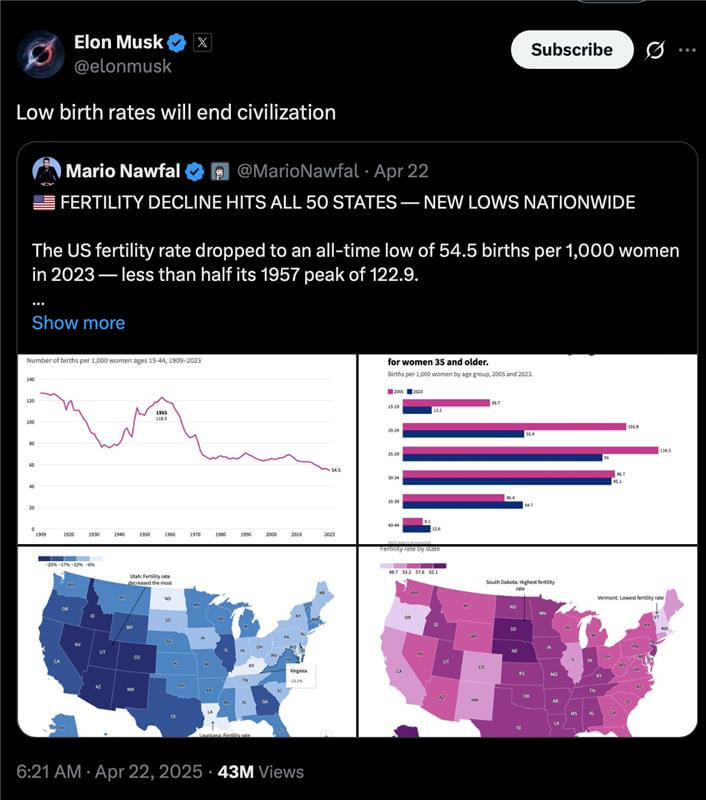
April 23, 2025– Elon Musk has once again turned the spotlight on a looming demographic crisis. In a post on X, he warned: “Low birth rates will end civilization.” While the statement may sound dramatic, the underlying data supports a sobering reality—America is experiencing a steep and widespread fertility decline.

According to newly released figures shared by entrepreneur Mario Nawfal, the U.S. fertility rate dropped to a record low of 54.5 births per 1,000 women aged 15–44 in 2023. This marks a significant decline from the post-World War II baby boom peak in 1957, when it was 122.9.
What’s striking is that the fertility drop is not localized—it spans all 50 states. While Utah managed to maintain a relatively small decline, Virginia’s fertility rate plummeted more dramatically than any other state. South Dakota led the nation with the highest rate, whereas Vermont had the lowest.
The decline also reflects shifting societal patterns. Women are increasingly postponing childbirth, with births among women aged 35–39 and even 40+ showing modest increases. However, this older maternal age trend is insufficient to compensate for the sharp decline in younger brackets.
Why It Matters

Demographers and economists have long warned that sustained low fertility rates can lead to social issues: labor shortages, increased pressure on social safety nets, declining economic growth, and the challenge of supporting an aging population with a shrinking workforce.
Musk, who has often voiced concerns about population collapse, is not alone in sounding alarms. The data supports a future where the U.S.—and much of the developed world—could face population stagnation or decline, with far-reaching consequences.
Is There a Solution?
Reversing the trend is no simple task. Addressing economic insecurity, improving work-life balance, offering affordable childcare, and creating more supportive family policies are often cited as ways to encourage family growth.
But cultural and economic shifts—like delayed marriage, career prioritization, and urban living—make this a complex issue with no silver bullet.
See related story: