






Texas Border Business

Attorney Leah Wise built her career by stepping into a legal space where few women owned firms and even fewer led them. At the City of Edinburg’s “Women Leading with Purpose” luncheon, Wise shared how determination, risk, and authenticity shaped her path from a young lawyer with student debt to the leader of the largest 100% women-run law firm in the Rio Grande Valley. Her story offers a candid look at resilience, entrepreneurship, and the power of women claiming their place in the legal profession. Please share this article. Read this article for FREE by subscribing for FREE.
Leah Wise on Building a Law Firm and a Public Voice

By Roberto Hugo González / Texas Border Business
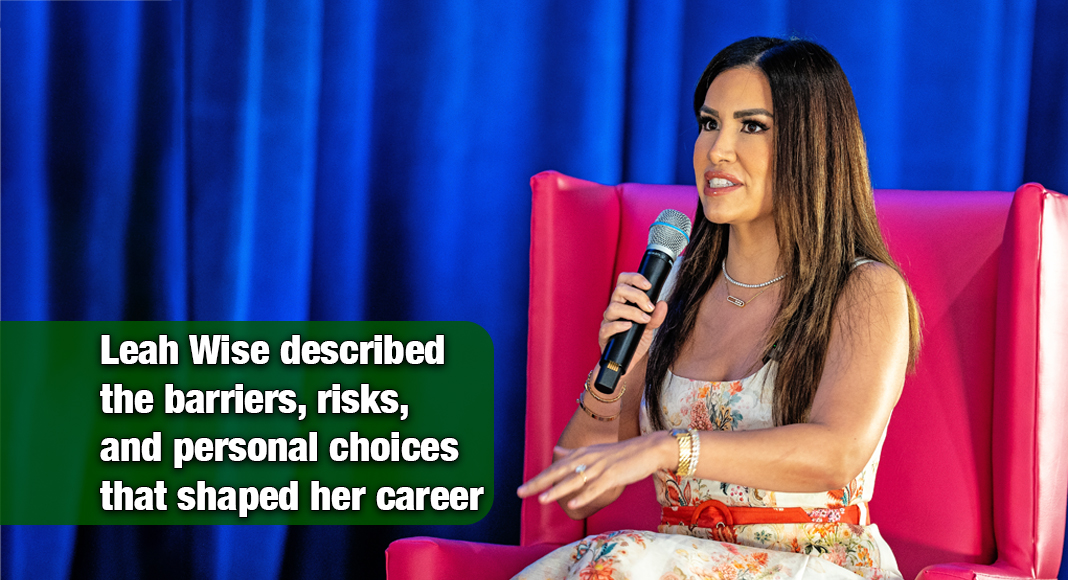
At the City of Edinburg Human Resources Department’s “Women Leading with Purpose” luncheon on Monday, March 9, 2026, attorney and entrepreneur Leah Wise told city employees that she built her career by entering a part of the legal profession where she saw few women in ownership roles and by refusing to hide parts of her identity to fit expectations.
The event, held at the Edinburg Arts, Culture and Events Center, featured Wise alongside Veronica Gonzales and Natalia Velasquez in a panel discussion about leadership, career growth, mentorship, and confidence. In introducing Wise, the moderator said she was born and raised in Primera, studied political communication with a concentration in women’s and gender studies at the University of Texas at Austin, later earned her law degree from St. Mary’s University School of Law, opened her own law practice in 2016, and now leads “the largest 100% women-run law firm in the entire Rio Grande Valley.”
Wise said one of the defining challenges of her early career was entering plaintiff-side law as a young woman without a clear model to follow. “When I graduated and took the bar exam in 2016, I didn’t know a single woman-owned law firm that was doing 100% plaintiff’s work,” she said. She described that absence as both a barrier and a motivation, saying she wanted “to pave a way for more women to be plaintiff’s lawyers.”
She also said she faced direct skepticism about whether she belonged in the profession at all. Wise told the audience that at the start of her career, she was told “that I should apply for a job,” and that she “had no business starting my own practice,” especially a plaintiff’s firm. In one courtroom, she said, “I almost got kicked out of a courtroom because they thought I wasn’t a lawyer, because I was 26 years old.”
Wise said the economics of starting her practice were also difficult. “It was very costly to do that,” she said of breaking into the plaintiff’s work. She said she began with “$60,000 of student debt and almost no savings” and launched her office with “a refurbished computer that my dad bought for me, my cell phone, and a free tool called social media.” She credited social media with helping her “grow my audience” and show potential clients “who I was as a person and as an attorney.”
Her comments presented entrepreneurship less as a polished long-term plan than as a decision made under pressure and uncertainty. “It was a very spur-of-the-moment decision to start my law practice, having no experience as an attorney,” she said. Wise said there were times she considered quitting, getting a job at an established firm, and giving up on the business. “There were a lot of times that I would cry,” she said, recalling moments outside the courthouse when she felt overwhelmed and unsure of what she was doing.
At the same time, Wise said the local legal community helped her persist. She told the audience she sometimes asked other lawyers basic procedural questions in and around the courtroom and said, “To their credit, they were so, so helpful. The local bar down here is just so helpful.” Her account framed success not only as individual determination, but also as something shaped by professional support from others.
Wise repeatedly returned to authenticity as a business and personal principle. She said that early in her career, she suppressed her femininity because she believed lawyers were expected to look and act a certain way. Recalling advice she heard in law school, she said, “Wear navy, wear black. And wear pantyhose.” Over time, she rejected that model. “I decided to be girly,” she said, describing an office, public image, and online presence that are “very pink” and “very feminine.”
According to Wise, that shift was not cosmetic. She said it changed the trajectory of her business. “Once I stopped suppressing that part of myself, that’s when my business blew up,” she said. She added that she had been warned this branding might alienate male clients, but said it did not. “Half of my clients are still men,” she said, explaining that many found her through recommendations from wives, daughters, or sisters.
Wise also linked her business decisions to a broader mission of helping women, especially Latinas. The moderator said Wise founded the Wise Women Foundation “to support minority women” and established a scholarship fund for Latina law students facing financial hardship. Wise connected those efforts to her own law school experience, saying she remembered “the financial struggle of law school” and wanted to make that path easier for others.
On career planning, Wise did not describe herself as methodical. “I am not a long-term thinking kind of person,” she said. “I am a very impulsive. If it feels right in the moment, I go for it.” Still, she said her decisions are guided by a consistent set of values: growth, service, and a desire to help younger women see that success does not require fitting a narrow template.
She gave similar answers when the discussion turned to work-life balance and boundaries. Wise said she is “still learning” how to say no and that one of her goals for 2026 was “to do less and say no more.” She urged younger women to practice setting boundaries early, saying, “No is a full sentence.” She argued that self-care is necessary for sustained leadership, adding, “You cannot appropriately give to others if you yourself are not healthy.”
By the end of the discussion, Wise’s message was less about a fixed formula for advancement than about claiming space without waiting for permission. Her closing advice to the audience was, “Be authentically you.” She said the parts of a person that may seem risky to show are often the ones that attract the right clients, allies, and community. “I’m not for everybody,” Wise said, “and I’m 100% okay with that.”
Within the panel, Wise was presented as both a legal entrepreneur and a public example of a newer model of professional womanhood in the Rio Grande Valley. Her remarks did not suggest that barriers have disappeared. Instead, they described a career built in direct response to them, through visibility, persistence, and a deliberate refusal to become the version of a lawyer that others expected. Please share this article
See related stories: