






Texas Border Business

Roberto Hugo González
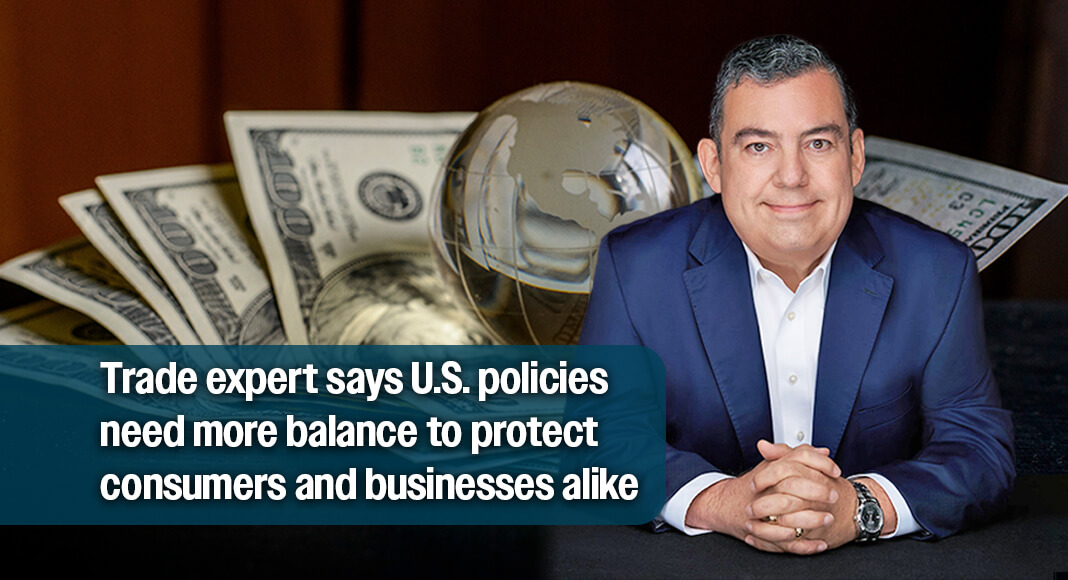
Jorge Torres, President of Interlink Trade Services and a leading authority on international commerce, has raised concerns about the U.S. Commerce Department’s evolving approach to tariffs, warning that recent policy changes could drive up consumer costs and strain industries.
Torres, a licensed customs broker with more than 30 years of experience, pointed to the Commerce Department’s shift from exclusion petitions to inclusion requests as a turning point. “This new process opens the door for domestic manufacturers to include products that are imported to the U.S. that they produce domestically,” Torres explained. While intended to protect local producers, he cautioned, it “can also create a lack of competition and higher prices for the consumers.”

Critics argue that the rebuttal system is equally problematic. In the latest round of reviews, nearly all inclusion requests were approved while rebuttals were denied. Torres described the process as “mainly one sided,” adding that the Department “must be fairer and uniform in its application and review process.”
The use of national security as a rationale for tariffs has also drawn scrutiny. Many products, including kettlebells and washing machines, have been classified under Section 232’s national security framework. Torres questioned the logic: “Claiming national security on every product is not logical… having something used in military applications does not necessarily make it a matter of national security.”
For importers, compliance requirements have become a significant burden. In one recent case, 407 new tariff classifications were announced late on a Friday, effective the following Monday. “This caught everyone by surprise,” Torres said, noting that companies were suddenly required to report detailed data on steel and aluminum sourcing. “It is not a simple task,” he said, describing how firms have resorted to either paying tariffs on the full value of goods or relying on estimates while filing corrections later. Both strategies, he warned, create unnecessary costs and administrative hurdles.
The financial implications are significant. Torres observed that paying tariffs across the full value of products may protect firms from compliance errors, but it risks a “negative financial impact on importers” through overpayment. He noted that the customs brokerage industry, through the National Customs Brokers and Freight Forwarders Association of America (NCBFAA), is advocating for earlier notice of new tariff rules from the administration.
Beyond compliance, Torres highlighted a deeper divide between domestic manufacturers and importers. While tariffs may shield local industries, they also drive up the cost of raw materials. “All of this creates an increase in pricing, whether it is raw materials or components or actual finished goods,” he said.
So far, the inflationary impact on consumers has been muted, with companies essentially absorbing the added costs. But Torres cautioned that “by the beginning of Q4 2025, there will be a shift, and exporters and importers will begin passing the tariffs to the consumers to a greater extent.”
Global supply chains further complicate the issue. Torres called for a more nuanced approach, pointing to companies like GE Appliances that argue U.S. production cannot meet domestic demand. “Tariffs are being applied on a very generalized and global manner, which can be dangerous,” he said. He suggested alternatives, such as quota systems that match imports to domestic capacity shortfalls.
Predictability remains one of Torres’s biggest concerns. The U.S. Chamber of Commerce has criticized abrupt tariff expansions, and Torres echoed that frustration. “Having certainty and some sort of predictability is crucial for companies to make decisions to expand and invest,” he said. Constant changes, he warned, make it nearly impossible for businesses to plan or negotiate pricing. “Once a tariff is set, let it go through the implementation process and, if any, make downward adjustments, not upward adjustments.”
Looking ahead, Torres said all industries should brace for scrutiny. With auto parts next in line, he advised companies to prepare for worst-case scenarios. “At this point, all products and industries are fair game for tariffs,” he said. “Like we say, hope for the best but prepare for the worst.”
Torres, who founded Interlink Trade Services in McAllen, Texas, has built his reputation on guiding companies through complex trade regulations. With decades of experience in U.S.-Mexico trade and a background in accounting from Texas A&M, his insights carry weight at a time when tariff policy is reshaping the global trade landscape.