








Texas Border Business
By Roberto Hugo González / Texas Border Business
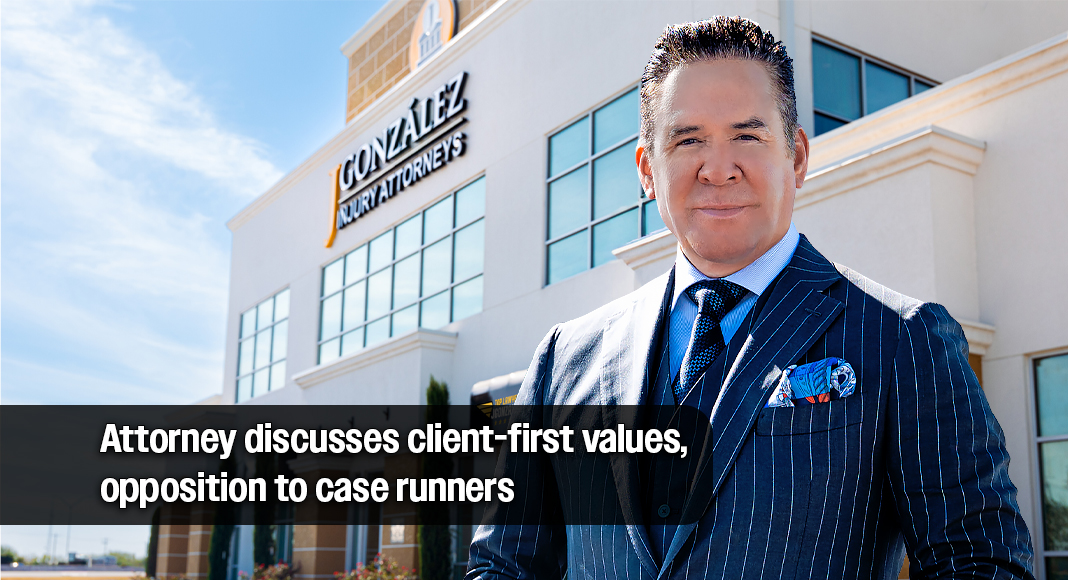
In a wide-ranging interview, personal injury attorney Jesse Gonzalez reflected on his career, values, and long-term goals, returning repeatedly to the idea that his work is defined not by money or visibility but by impact, ethics, and service to the Rio Grande Valley. He told Texas Border Business that the guiding theme of his career has been building something that lasts and serves others.

Asked what legacy means to him at this stage of his life and career, Gonzalez said it is about “lasting impact.” He explained that legacy includes “my reputation as a whole, contributions I’ve made, influence that I’ve had as a lawyer,” and what he leaves behind in “the legal profession, the community, clients, and even the wider field of law.” He stressed that legacy “goes beyond financial success or case wins” and instead focuses on “what endures,” including the people he has inspired, the youth he has influenced, the changes he has advocated for, and the “systemic improvements” he has worked to implement within his firm and beyond it.
Gonzalez said he hopes to be remembered not for a title, but for his character. “Ethical, prepared, fair, trustworthy,” he said, adding that he wants to be known as someone who “fiercely guarded one’s word and was thorough in his work.” He also hopes to be remembered as someone who changed lives by helping people “who basically had no one else to turn to.” He described his work as championing difficult cases, protecting families, and ensuring insurance companies paid “what they owed” and “not a penny less.”
He recalled realizing at a certain point that his work extended beyond individual cases. That awareness, he said, often came when meeting high school or college students who connected his legal work to their own ambitions. Gonzalez said hearing young people say, “Because of you, I want to do what you’ve done,” showed him that his influence reached beyond the courtroom.
Much of his approach to work, Gonzalez explained, stems from his upbringing as a migrant farm worker. He described long days laboring in fields with his family, cutting weeds across large tracts of land and knowing the work would take weeks to complete. The experience taught him patience and endurance. “You just have to keep working,” he said, noting that quitting was never an option, even under difficult conditions. Those lessons, he said, prepared him for the long timelines and uncertainty of business and law.
Gonzalez credited his parents with instilling the values that still guide him. He said they worked daily and brought him along to work beside them in agriculture, construction, or yard labor. There were no shortcuts and no expectation of comfort. Those early lessons, he said, taught him that progress comes from steady effort and sacrifice, principles that apply equally in professional life.
Reflecting on becoming licensed to practice law in 2001, Gonzalez said he wanted to be a lawyer who fought hard for clients and avoided unnecessary losses. He never wanted to give a client bad news because of a lack of preparation or effort. While he hoped to be “resoundingly successful,” he emphasized that money was never the goal. Service, he said, was always central to his work. Experiences at other firms showed him practices he did not want to repeat, motivating him to build what he described as his own “dream law firm,” designed around clients’ best interests.
Ethics, Gonzalez said, have always been non-negotiable. He rejected shortcuts and dishonesty, saying, “I can’t consider it winning if I did it by cheating.” Drawing on his experience coaching youth sports, he said beating teams that cheated brought greater satisfaction than ordinary victories because cheating stripped success of meaning. The same principle, he said, applies to law. “Do things the right way or just don’t do them at all.”
As his firm grew, Gonzalez faced difficult decisions about prioritizing profit versus service. Early success strained customer service, he said, prompting him to reinvest in staff even when it reduced his own profits. Keeping operations small might have increased his income, but it would have hurt clients. Instead, he chose to build systems and hire additional staff to maintain service quality. He described his decision-making framework as a pyramid, with the client at the top, the firm next, the team, and himself last. Staff members, he said, are told that if they make decisions in a client’s best interest, they will never lose their jobs.
Jesse Gonzalez’s legacy is reflected in his forward-thinking approach to accessibility and growth, exemplified by the firm’s innovative “Hummer Response Team.” His connection to the vehicles long predates their use in firm operations; Gonzalez first began investing in Hummers in 2005 and remained loyal to the brand even after General Motors discontinued it in 2010 amid rising fuel costs, economic pressures, and corporate restructuring. During the decade the brand was off the market, he continued using his H3 and H1 models. When GMC reintroduced the Hummer as an all-electric SUV— unveiled in 2021, with production beginning in 2023 and sales launching in the 2024 model year— Gonzalez resumed purchasing new models, acquiring the first black electric Hummer on July 4, 2024. The fleet ultimately grew to ten vehicles, forming what became known as the firm’s “Hummer Response Team,” created to reach clients unable to travel due to injury, lack of transportation, or hospitalization. The initiative complemented the firm’s six offices across McAllen, Brownsville, Rio Grande City, Weslaco, Harlingen, and Edinburg, reinforcing its commitment to accessibility.
As the firm continued to expand—particularly its litigation division—the need for additional space became clear, leading to the construction of a new headquarters in Edinburg designed specifically to house and support the growing litigation team.
Gonzalez also discussed the risks he took to grow his practice, including early investments in television advertising without any guarantee of success. He recalled a period when the phones did not ring, and constant adjustments were required. Over time, those risks paid off. He later pursued non-traditional advertising strategies to stand out in a competitive market, guided by preparation, confidence, and a willingness to work through uncertainty.
A significant portion of the interview focused on Gonzalez’s public opposition to case runners, whom he described as people who “steal cases.” He said he was warned early in his career to avoid personal injury law because such practices made it difficult for ethical lawyers to compete. Instead, he chose to confront the issue by educating the public. He said education empowers people to protect themselves from scams and exploitation and emphasized that his public messaging was about community protection, not self-promotion.
Gonzalez also discussed his responsibility to the Rio Grande Valley. He said his success was possible only because local residents trusted him with their cases, and he believes giving back is essential. He described supporting schools, students, and families, and organizing community events as among the most meaningful aspects of his work. He emphasized that all revenue generated by his firm stays in the Valley, unlike firms headquartered elsewhere.
Over the past year, Gonzalez said his community outreach expanded significantly across the Rio Grande Valley through a coordinated team effort. He credited marketing partners for identifying opportunities and his internal team for executing them, while noting that he committed the resources needed to keep the work focused locally. He said his motivation to give back is rooted in his upbringing, recalling acts of generosity shown to his family during times of hardship. Those experiences, he said, shaped his belief that success carries a responsibility to reinvest in the people and places that made it possible.
As the interview concluded, Gonzalez looked ahead to the future. He said the next chapter of his career may involve expanding services beyond the Rio Grande Valley to other parts of Texas, including Houston, Dallas, and San Antonio, while keeping the firm’s headquarters in Edinburg. Serving clients statewide while remaining rooted in the Valley, he said, would represent a full-circle moment. For Gonzalez, that vision reflects his definition of legacy: building something that endures, serves others, and never forgets where it began.
See related story: