







Texas Border Business

By Roberto Hugo González / Texas Border Business
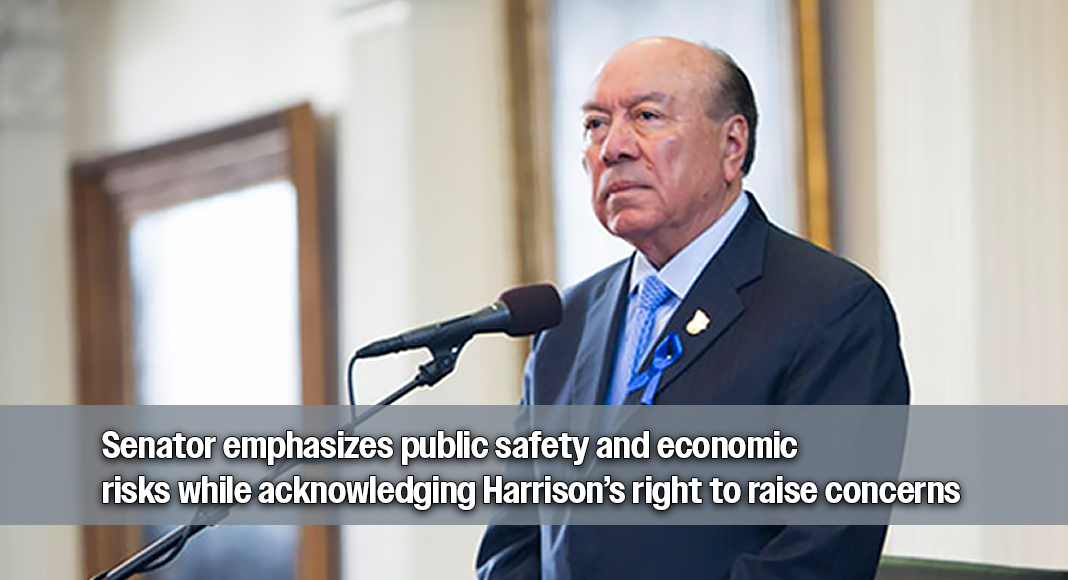
In an extended interview, Texas Senator Juan “Chuy” Hinojosa responded to the attention brought by State Representative Brian Harrison’s November 17 letter urging Governor Greg Abbott to direct the Texas Department of Motor Vehicles to stop undocumented individuals from registering vehicles. Senator Hinojosa began by acknowledging Harrison’s legal right as a legislator to address such issues with the governor. “Representative Harrison has the right to express his concerns to the governor or a state agency about any issue,” Hinojosa said. But while affirming Harrison’s right to ask, the senator made clear that he does not share Harrison’s position. “I do not necessarily agree with the points in his letter or the action that was taken by the agency,” he stated.
Hinojosa stressed that the purpose of vehicle registration is public safety, not immigration enforcement. He said the Texas Department of Motor Vehicles should have accurate ownership information for every vehicle “regardless of that person’s status.” According to him, restricting registration would create new dangers rather than prevent them. He warned that “making it difficult for individuals to register or renew a vehicle registration will lead to more uninsured vehicles, ghost titles being issued, and could lead to law enforcement challenges in being able to trace and identify offenders based on fake registrations — all of which are public safety concerns.”

The senator also addressed the potential impact of sudden ID restrictions on communities in his district, particularly those with mixed-status families. “There will be a negative impact. This directive was not well vetted and will create chaos and confusion, leading to inconsistent implementation across the state,” he said. He added that the concerns extend beyond safety. “It could also have a negative economic impact. People may not want to buy vehicles if they know they cannot have them registered.”
Hinojosa highlighted that the issue affects legally present immigrants, including DACA recipients, who hold federal work authorization. “DACA recipients are in the country legally and are protected. They should be allowed to buy and register a vehicle,” he said. When asked whether Texas should recognize federal Employment Authorization Documents as valid ID for registration, he answered directly: “Yes, anyone in the U.S. with permission to be in the country should be able to purchase and register a vehicle.”
As the debate continues, the senator emphasized that registering vehicles contributes to public safety, not the opposite. Responding to Harrison’s emphasis on insurance and safety issues, Hinojosa warned that the proposed restrictions could undermine the very concerns Harrison raised. “Properly registering vehicles is important for public safety,” he said. “All vehicles should be registered to their owners, and as already required by law, all vehicles should be insured, regardless of the owners’ status in the country.”
Hinojosa made clear that discussions involving DACA, federal authorization, or immigration status must be approached carefully and lawfully. He noted that federal rules may change, explaining, “As of now, DACA recipients are in the country legally; however, a court order could change that status.” For now, however, he said the law is clear that people with lawful presence must not be excluded from required state systems, such as vehicle registration, which are essential for daily life in South Texas. “Families who are legally present in the U.S. will face hardships if they cannot renew their registration,” he said, pointing to the region’s limited public transportation options. “People will struggle to go to the doctor, take their children to school, go to work, or participate in normal daily life.”

As the first part of this two-article series shows, Hinojosa’s position is rooted in public safety, economic stability, and adherence to existing law. While he acknowledges Harrison’s right to raise the issue, he believes the consequences of restricting registration would fall hardest on communities across Texas, regardless of immigration status.
See related stories: