








Texas Border Business

By Roberto Hugo González
In response to the devastating flooding across the Rio Grande Valley (RGV) from March 26 to 28, 2025, a coordinated effort among local, state, and federal leaders led to the federal government approving a Major Disaster Declaration. The declaration has enabled the release of emergency aid and recovery assistance to thousands of residents and businesses affected across the four-county region.
On March 29, Governor Greg Abbott declared a state disaster for Hidalgo, Cameron, Starr, and Willacy counties due to widespread flooding caused by historic rainfall. The declaration initiated a multi-level effort to secure federal support.

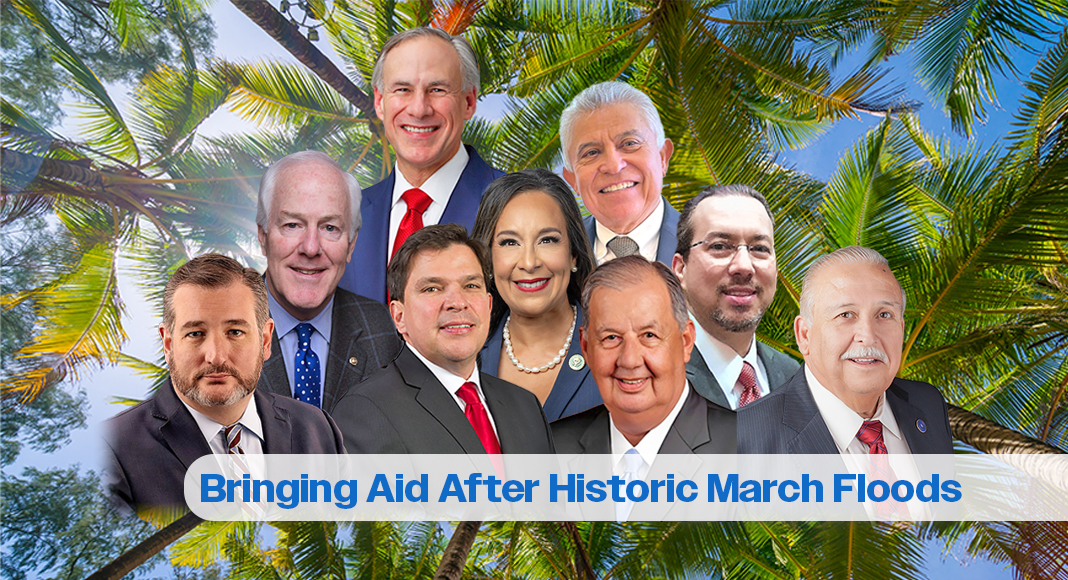
On April 18, Governor Abbott and U.S. Senator John Cornyn formally requested a federal disaster declaration from President Donald J. Trump. The request emphasized the scale of the damage and the need for immediate federal involvement. U.S. Representative Vicente Gonzalez followed with a letter on April 29 urging the President to support the request and draw attention to the impact on vulnerable communities.
Congresswoman Monica De La Cruz also actively supported the relief effort. On April 24, she sent a letter to President Trump endorsing Governor Abbott’s request for an emergency declaration. In her letter, she emphasized the urgent need for federal assistance to address the extensive damage in South Texas. De La Cruz cited the strain on local and state resources and called for federal support to protect public health and assist displaced residents. Following the President’s approval on May 23, De La Cruz publicly stated:
“Thank you, @POTUS, for your prompt action in providing federal funds after declaring a disaster in South Texas due to the March floods. I appreciate your leadership and willingness to help South Texans during these challenging times.”
Federal action followed in late May. On May 23, President Trump approved the Major Disaster Declaration, unlocking resources through the Federal Emergency Management Agency (FEMA). On May 28, FEMA began setting up Disaster Recovery Centers across the region to assist residents with emergency housing, home repairs, and financial recovery.
At the local level, all four county judges declared disasters shortly after the flooding and played key roles in advocating for federal aid. In Hidalgo County, Judge Richard F. Cortez issued a local disaster declaration and worked with state and federal leaders to support the federal request. He publicly thanked Senators Ted Cruz, John Cornyn, Representative Gonzalez, and Governor Abbott for their assistance.
In Cameron County, Judge Eddie Treviño Jr. also declared a disaster and coordinated with officials to facilitate recovery efforts. In Starr County, Judge Eloy Vera joined regional leaders in building support for the declaration. In Willacy County, Judge Aurelio “Keter” Guerra called the flooding the worst he had seen and collaborated with neighboring counties to push for aid.
The flooding caused at least six fatalities and extensive property damage. According to the Texas Division of Emergency Management, 26 homes were destroyed, 1,455 sustained significant damage, and nearly 2,900 more had minor damage. Infrastructure damage included flooded roadways, washed-out bridges, and compromised utilities, with some areas remaining underwater for weeks.
Federal assistance available to eligible residents and businesses includes temporary housing grants, emergency home repair aid, low-interest loans for uninsured losses, and recovery support for small businesses. Applications can be submitted online at DisasterAssistance.gov, by phone at 1-800-621-3362, through the FEMA mobile app, or in person at designated recovery centers.
Governor Abbott described the federal response as a “critical step” in helping the region recover. Leaders throughout the Rio Grande Valley praised the bipartisan cooperation at every level of government. The combined efforts of local officials, state authorities, and federal lawmakers—including Senators Cruz and Cornyn, Representative Gonzalez, and Representative De La Cruz—were key in securing relief for communities affected by the March floods.