







Texas Border Business

Texas Border Business
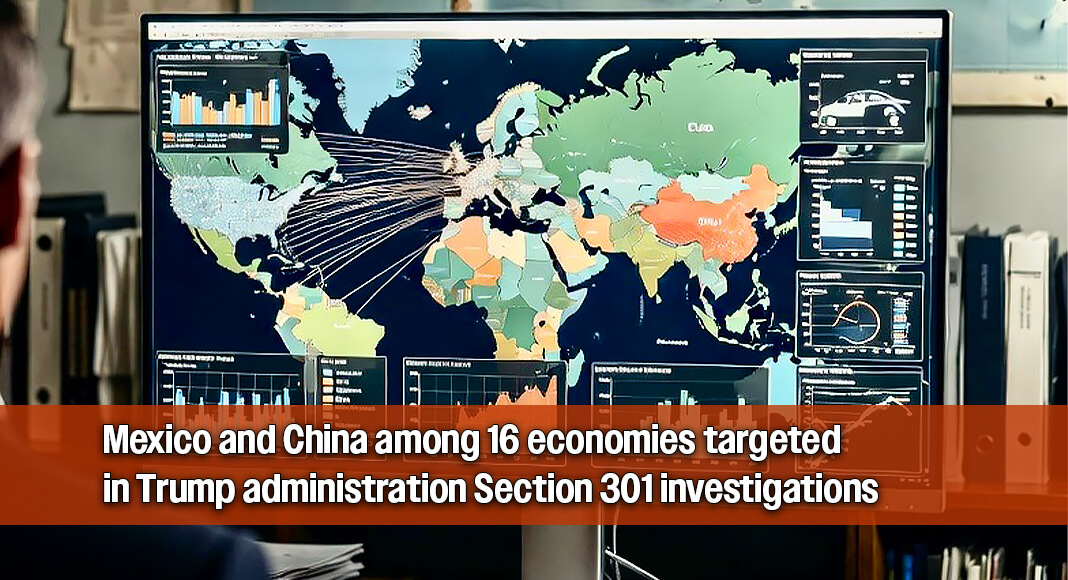
White House — The Office of the United States Trade Representative has launched Section 301 investigations into the trade practices of 16 economies to determine whether their manufacturing policies are creating excess production that harms U.S. industry.
According to the USTR notice, the investigations focus on what officials call “structural excess capacity and production” in manufacturing sectors. The document says some trading partners have built production capacity beyond domestic and global demand, leading to overproduction, persistent trade surpluses, and idle capacity.

The notice states that this overcapacity “presents a serious challenge to U.S. efforts to re-shore supply chains and provide good-paying jobs for American workers.” It also says unused foreign manufacturing capacity can discourage new production and investment in the United States.
The investigations cover China, the European Union, Singapore, Switzerland, Norway, Indonesia, Malaysia, Cambodia, Thailand, Korea, Vietnam, Taiwan, Bangladesh, Mexico, Japan, and India. USTR says these economies appear to show structural excess capacity through large or persistent trade surpluses or underused production capacity.
According to the notice, government interventions that may contribute to excess production include subsidies, state-controlled enterprises, market barriers, currency practices, and policies that suppress domestic demand. USTR says these measures can keep production growing even when market demand does not support it.
The document states that global manufacturing output reached about $16.6 trillion in 2024, while global manufacturing capacity utilization remained between 75 percent and 75.9 percent, below what it describes as a healthy rate of about 80 percent in many sectors. USTR says that gap shows global supply is outpacing demand.

The notice cites sectors including steel, automobiles, batteries, semiconductors, solar modules, electronics, chemicals, machinery, aluminum, and transportation equipment. It says overcapacity in those industries can produce large trade surpluses and redirect exports to the United States, either directly or through third countries.
USTR also points to trade imbalances as evidence of the problem. The notice says the United States posted automotive trade deficits of $157 billion in 2024 and $128 billion in 2025, and it cites estimates that global steel excess capacity could reach 721 million metric tons by 2027.
China is identified as the largest contributor to global goods surpluses. According to the notice, China’s goods trade surplus exceeded $1.2 trillion in 2025, accounting for nearly 70 percent of global goods trade surpluses. Its bilateral trade surplus with the United States reached $361 billion in 2024.
The document also cites the European Union, saying the euro area posted a goods trade surplus of $451 billion in 2024 and a bilateral trade surplus of $147 billion with the United States. It points to Germany as an example of persistent manufacturing surpluses in sectors such as automobiles, machinery, and chemicals.
Other economies named in the investigation show similar patterns. According to the notice, Vietnam’s trade surplus reached $196 billion in 2025, Taiwan’s goods trade surplus reached $73.3 billion in 2024, and Mexico’s bilateral goods trade surplus with the United States reached $197 billion in 2025, led by the automotive sector.
Under Section 301, the trade representative must determine whether the policies under review are “unreasonable or discriminatory and burden or restrict U.S. commerce.” If so, the administration could impose tariffs or other trade restrictions.
USTR is accepting written comments and requests to testify through April 15, 2026. Public hearings before the interagency Section 301 Committee are scheduled to begin May 5, 2026, at the U.S. International Trade Commission in Washington, D.C. The agency says it will review comments, testimony, and consultations with foreign governments before deciding whether to take action.