






Texas Border Business

By Roberto Hugo González / Texas Border Business
The bulletin issued by the Texas Department of Motor Vehicles on November 19, 2025, raises legal and procedural questions about whether the agency acted outside its authority when it changed identification requirements for vehicle registration. The bulletin, sent at 4:01 p.m. and described as “effective immediately,” revised what forms of identification are acceptable when Texans register or renew a vehicle. While the document outlines new rules, the concern now is not the content but the process — or lack of one — that the agency used.
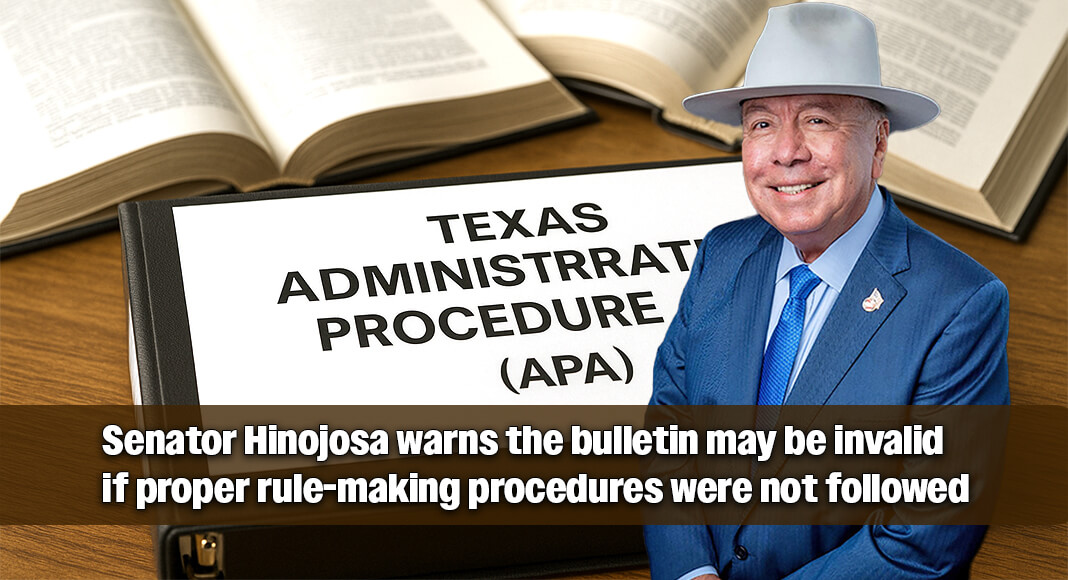
Under Texas law, agencies must follow the Texas Administrative Procedure Act (APA) when creating or changing rules. The APA requires public notice, an opportunity for public comment, publication of proposed rules, and approval by the agency’s governing board. Senator Juan “Chuy” Hinojosa says these steps were not followed before Executive Director Daniel Avitia issued the bulletin. In a letter to the agency, Hinojosa wrote that the bulletin “was issued without proper vetting,” that “the agency did not follow the necessary rule-making process,” and that the action “undermines the Texas Administrative Procedure Act.”

Texas law allows agencies to adopt rules, but only through the formal process outlined in statute. If an agency bypasses that process, the action may be considered an “invalid rule” or an “ultra vires” act, meaning the agency did something it did not have the legal authority to do. This does not mean a crime was committed, but it can have serious consequences. An invalid rule can be overturned, halted, or found unenforceable, and an agency can face legal challenges or administrative scrutiny.
Because the APA procedures appear not to have been followed, the central question becomes whether the bulletin is legally valid. As the senator explained, “The agency did not follow the necessary rule-making process,” leaving open the possibility that the bulletin could be considered an unlawful administrative action. Determining whether any law was actually broken would require a court or authorized investigative body. Still, the concern is clear: an agency cannot change requirements that affect millions of Texans without going through the steps the Legislature requires.
Hinojosa’s warning focuses squarely on process rather than politics. The APA exists to ensure transparency, uniformity, and public participation. When an agency imposes new requirements without following that process, it risks creating confusion, inconsistency, and legal vulnerability. As Hinojosa wrote, the bulletin “was issued without proper vetting,” raising questions about its enforceability and about the limits of the agency’s authority. Whether the bulletin remains in place or is challenged formally, the issue has already highlighted the importance of following Texas law before implementing policy changes that affect the entire state.
See related stories: