








Texas Border Business

By Roberto Hugo González
Texas Border Business
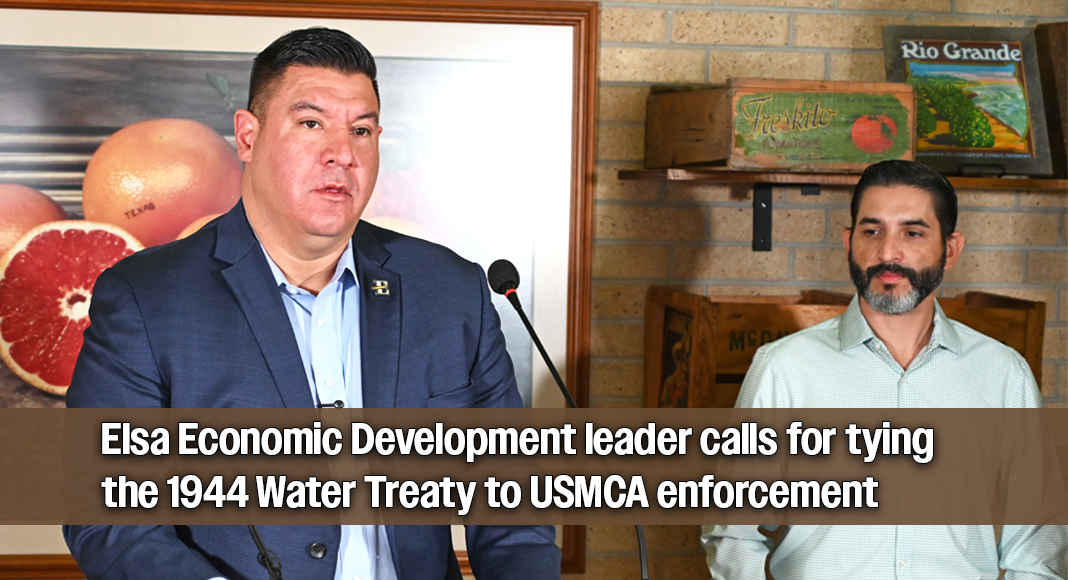
MISSION, Texas — Daniel Rivera, Executive Director of the Elsa Economic Development Corporation, delivered a stark message during Friday’s press conference hosted by the Texas International Produce Association (TIPA): without reliable water from the Rio Grande, South Texas’ growth and stability are at risk.

“In economic development, we talk a lot about roads, broadband, and workforce,” Rivera said. “But the truth is, none of that works without water. Water is the foundation for every home we build, every business park we design, and every factory we hope to land.”
Rivera described how water shortages and inconsistent deliveries from Mexico, under the 1944 Water Treaty, have begun to strain cities and stall regional development. “In Elsa, we’re already paying almost three times as much for our water as we were a couple of years ago,” he said. “That strains families and our city operations.”
According to Rivera, the economic consequences of unreliable water extend far beyond municipal budgets. “When deliveries fall short, everything slows down—construction, investment, and confidence,” he said. “Developers can’t plan. Investors hesitate. Local governments are left stretching already thin budgets to maintain essential services.”
He emphasized that towns like Elsa, though small, are not powerless. “We can’t afford to keep playing catch up,” Rivera said. “Towns like Elsa aren’t big enough to solve these problems alone, but we are big enough to speak up. The 1944 Water Treaty isn’t just an environmental agreement—it’s a trade issue. Water drives production, labor, and infrastructure—the very sectors the USMCA was designed to strengthen.”

U.S. Congresswoman Monica De La Cruz echoed Rivera’s concerns, reinforcing the urgency of making the 1944 Water Treaty enforceable through the United States–Mexico–Canada Agreement (USMCA). “For far too long—80 years—we have been held hostage by the Mexican government, which failed over and over to give us the water that they owed us,” De La Cruz said. “That’s why we lost our sugar cane industry—over 500 jobs and millions of dollars gone. That will not happen under my watch.”
De La Cruz, who represents South Texas in Congress, said linking the treaty to USMCA would provide “teeth” to ensure accountability. “Currently, there are no consequences if Mexico fails to deliver,” she said. “By integrating it into the USMCA, we create enforceable measures that protect our farmers, cities, and communities.”
Both Rivera and De La Cruz called on residents to participate in the public comment process through the U.S. Trade Representative’s website, comments.ustr.gov, before November 3, 2025.
“When the river flows, so does our opportunity,” Rivera said. “If we want a future for our Valley, we must act now.”
Residents across the Rio Grande Valley can take immediate action by submitting comments to the U.S. Trade Representative before November 3, 2025, through https://comments.ustr.gov/s/submit-new-comment?docketNumber=USTR-2025-0004 or by scanning the QR code below.

See related stories: