







Texas Border Business

By Roberto Hugo González
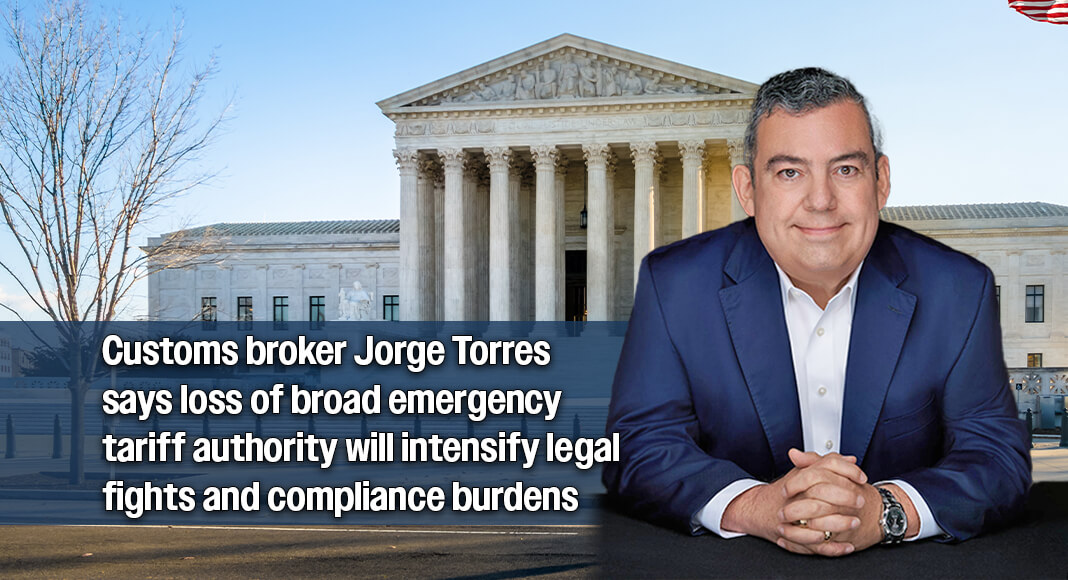
A recent court ruling limiting the president’s ability to impose tariffs under the International Emergency Economic Powers Act has forced the administration to rely on narrower statutory tools, increasing legal risk, political pressure, and compliance challenges, according to Jorge A. Torres, President and CEO of Interlink Trade Services. Torres, a U.S.-licensed customs broker with more than 30 years of experience in international trade and cross-border logistics, said the decision marks a major shift in how tariffs can be imposed and contested.
Torres said the loss of tariff authority under the emergency powers statute is significant because it removes a broad legal pathway that presidents have used to act quickly. “From a legal and political perspective, it is very significant as it limits the president from imposing tariffs under a very broad provision,” he said. He added that although alternative statutes remain available, they are likely to face court challenges. “These will more than likely be legally challenged in the future, and there is solid precedent now with the IEEPA decision.”

The administration has already moved to alternative authorities, including Section 122 of the Trade Act, which Torres described as an immediate pressure tool. “The president immediately invoked Section 122, imposing a 10% tariff, which will likely be increased to 15% soon,” he said. Torres explained that Section 122 is designed for rapid response and short-term leverage, while other authorities, such as Sections 232 and 301, are expected to play a larger role. “The president and his staff have repeatedly stated that they will use Section 232 and Section 301 more aggressively to impose tariffs in lieu of IEEPA,” he said. Section 338 of the Tariff Act of 1930, a rarely used provision, remains an option but is less likely to be used. “Nothing is off the table now,” he said.
Torres said each alternative statute carries its own legal and political constraints. In the short term, domestic politics could shape tariff decisions. “We have mid-term elections in 2026, and since the consensus is that tariffs are not good, the Republicans might lose some House and Senate seats,” he said. Over the longer term, legal and economic factors could limit tariff expansion. “Tariff effects take longer to permeate the economy, as we have seen in the past, and if the president is to be legally challenged, litigation can take years,” he said.
For businesses involved in international trade, the use of multiple tariff authorities simultaneously has increased operational complexity. Torres said companies are facing an environment unlike previous trade cycles. “The use of multiple tariff mechanisms simultaneously has been unprecedented and chaotic,” he said. He explained that importers and exporters must navigate overlapping rules, classifications, and compliance requirements. “The complexities of processing import transactions, along with the financial and legal exposure arising from a lack of understanding and compliance, make it difficult to make sound decisions from a corporate strategy standpoint,” he said.
Torres also warned of potential diplomatic consequences if more aggressive or rarely used tariff authorities are invoked. Retaliation from trading partners remains a risk, particularly if tariffs are imposed under provisions not used in decades. “If it is used, other countries might retaliate against the U.S. with tariffs and restrictions on U.S.-origin goods,” he said, referring to Section 338. He added that policymakers must carefully weigh the broader trade and diplomatic impacts before expanding tariff measures.
The court ruling has reshaped the legal landscape for trade policy, forcing the administration to rely on statutes with more defined procedural limits and greater exposure to judicial review. Torres said this shift is likely to prolong uncertainty for businesses and trade partners as new tariff measures emerge and legal challenges unfold.