







Texas Border Business

Texas Border Business
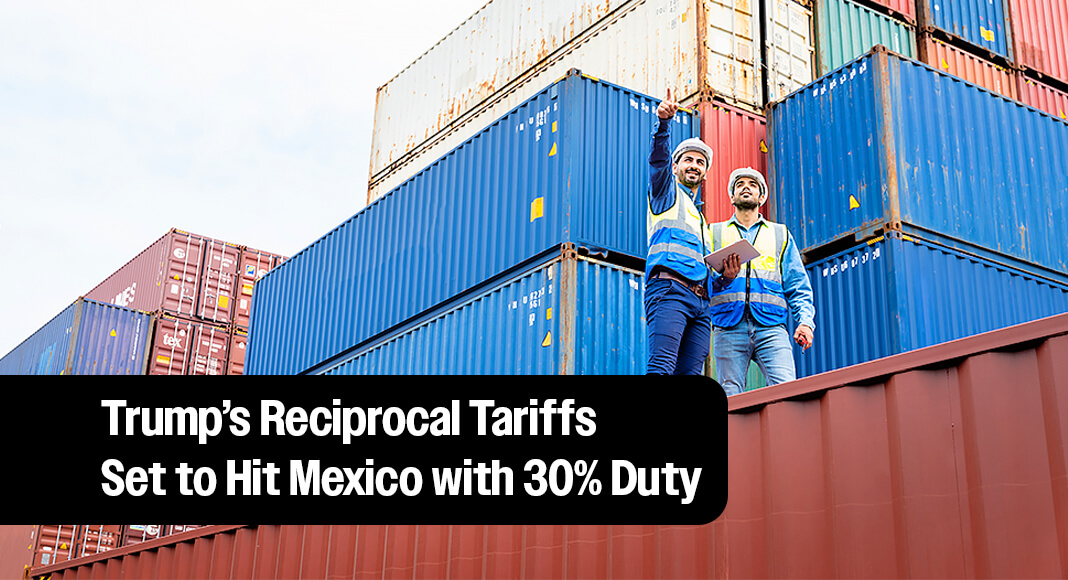
As the August 1, 2025, deadline approaches, the United States is preparing to enforce a sweeping new tariff structure under President Donald J. Trump’s “reciprocal trade” policy. Among the most significant measures is a planned 30% tariff on imports from Mexico, a move that could have far-reaching economic and political consequences across North America.
The tariffs are part of a broader realignment announced under an executive order in April 2025, with the intent to impose duties on countries that, according to the Trump administration, fail to offer the U.S. fair and balanced access to their markets. Initially paused for 90 days, the reciprocal tariffs will now take effect at 12:01 a.m. EDT on August 1, following the expiration of a grace period during which a uniform 10% tariff was temporarily in place for most countries (whitehouse.gov).

Mexico is one of several countries that received a formal letter from the U.S. Department of Commerce confirming the 30% tariff rate. Other countries slated to face the same rate include the European Union, South Africa, Iraq, and Libya (supplychaindive.com). According to U.S. officials, Mexico was notified that unless a new agreement is reached before August 1, the full tariff will be applied to all relevant imports.
Commerce Secretary Howard Lutnick confirmed in a public statement that “no extensions will be granted” beyond the August 1 deadline. “These rates are final unless a trade partner negotiates an acceptable reciprocal agreement before enforcement begins,” he said (timesofindia.indiatimes.com).
President Trump echoed that sentiment in a July 8 post on Truth Social, stating, “All money will be due and payable starting AUGUST 1, 2025 — No extensions will be granted.”
The implications for Mexico are substantial. Mexico is the United States’ second-largest trading partner, and industries ranging from auto manufacturing to agriculture rely on cross-border trade. A 30% tariff could disrupt supply chains, raise prices, and strain bilateral relations just five years after the implementation of the U.S.-Mexico-Canada Agreement (USMCA). As of now, no new agreement has been publicly announced to prevent the tariff from taking effect.
Legal challenges are ongoing. The tariffs were introduced under the International Emergency Economic Powers Act (IEEPA), but some legal experts have argued that the executive branch has overstepped its authority. While a U.S. Court of International Trade ruling found that some aspects of the tariff plan exceed presidential powers, the administration has continued enforcement pending appeal (en.wikipedia.org).
The White House has defended the move as a long-overdue correction of what it sees as an unbalanced trade system. “The days of the U.S. being taken advantage of on trade are over,” Trump said in a recent press briefing. “We are finally standing up for American workers and industry.”
In the coming days, attention will focus on whether last-minute diplomacy can avert the 30% tariff on Mexican goods. If not, the new duties will take effect as scheduled on August 1, 2025, potentially reshaping trade dynamics between the U.S. and its southern neighbor.
For now, the tariff is scheduled to be applied to Mexico, with no exemption or delay currently on the table.