








Texas Border Business

By Roberto Hugo González / Texas Border Business
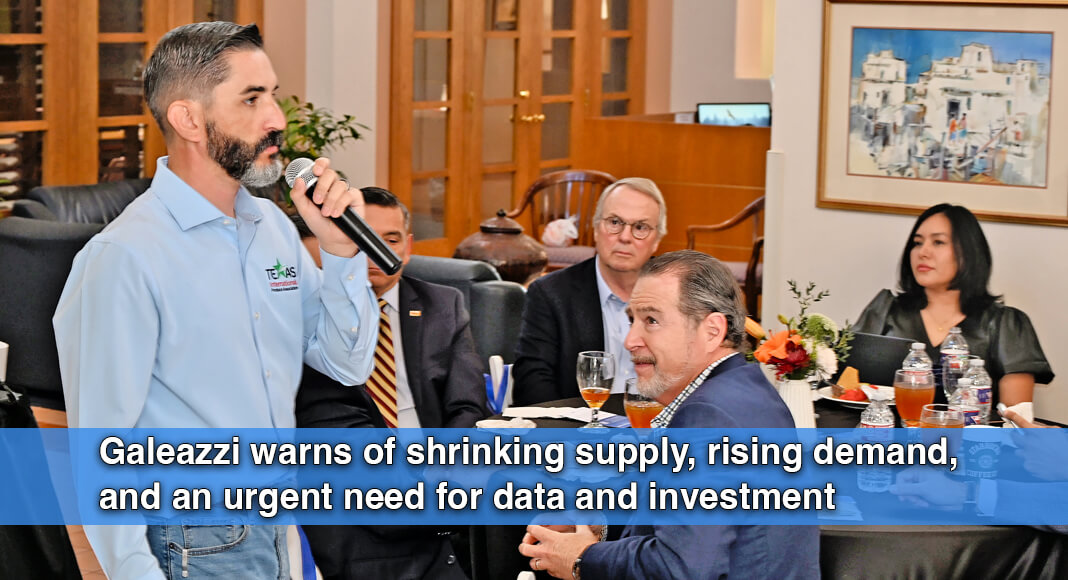
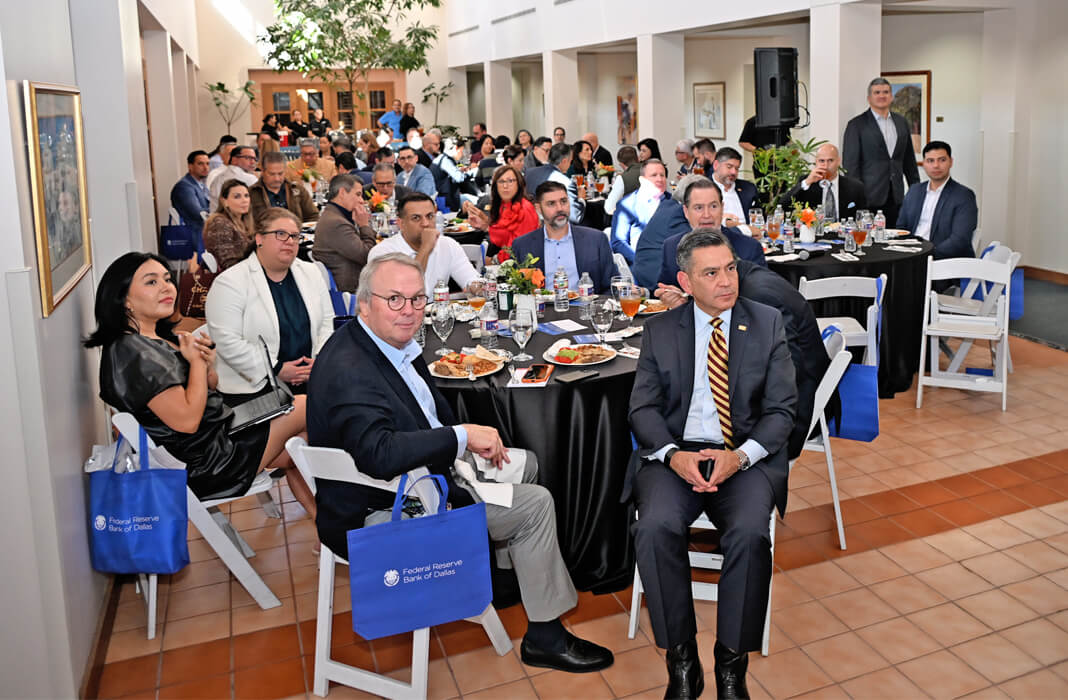
At a February 2026 regional economic forum hosted by Atlas Hall Rodriguez LLP, business leaders and policymakers gathered to discuss economic conditions and infrastructure challenges facing Texas. The annual event, sponsored by the firm for its clients and regional stakeholders, featured multiple presentations, including an update from the Federal Reserve Bank of Dallas and a focused discussion on water, data centers, and resource constraints. The program concluded with a detailed presentation by Dante Galeazzi, president and CEO of the Texas International Produce Association (TIPA), who outlined the scale and urgency of the water crisis in the Rio Grande Valley.
Galeazzi opened by highlighting the water demands of data centers, noting that the issue is not widely understood. “Cooling a 1 megawatt server requires 20 acre-feet of water,” he said, explaining that an acre-foot is roughly half a million gallons. He added that most data centers in Texas operate at much larger scales. “Most data centers in Texas are about 500 megawatts, so you need 10,000 acre-feet,” he said, while newer facilities can reach 800 megawatts, requiring even more water. To illustrate the trade-off, Galeazzi compared this demand to that for agriculture. “If I were to grow one acre of onions, I would only need two acre feet of water,” he said, adding that water redirected to data centers could displace thousands of acres of crop production.

He then described current conditions in the Rio Grande Valley, noting record-low reservoir levels in recent years. “In July of 2024, both Amistad and Falcon Dam reached their lowest levels ever,” he said. While levels have slightly improved, he warned that the situation remains unstable. “As soon as we hit 90 degrees, we will lose 1% of that water per week if there is not more water behind it,” he said, emphasizing the lack of incoming supply.
The region depends heavily on the Rio Grande River for its freshwater. “We get 90% of our fresh water in the valley from the river,” Galeazzi said, referencing the 1944 Water Treaty, under which Mexico is required to deliver 350,000 acre-feet annually. “That’s about a third of the water we need for the Rio Grande Valley,” he said, noting that any shortfall creates immediate pressure on the system.
Beyond external supply, Galeazzi focused on internal inefficiencies in water delivery. “More than 86% of the water we use as citizens in the Rio Grande Valley come through those irrigation districts,” he said. However, he added that losses are significant. “Right now, we lose somewhere between 40 to 60% of all the water that moves through those canal systems,” he said, citing evaporation, seepage, and system inefficiencies. Addressing these losses would require a major investment. “It costs somewhere between three to five million dollars per mile of canal,” he said, noting that the Valley has nearly 4,000 miles of canals.
State funding, he said, does not match the scale of the problem. While recent legislation provides about $1 billion per year for water infrastructure, Galeazzi pointed to estimates that Texas needs far more. He also referenced Texas Senator Chuy Hinojosa’s advocacy to secure funding for the region. “The money will come through the Texas Water Development Board,” Galeazzi said, explaining that recent allocations, including $100 million, are important but limited. “If it costs you $5 million to redo one mile of canal, and you have $100 million, that’s only 20 miles,” he said.

A central part of Galeazzi’s message focused on the need for detailed mapping data to support federal funding proposals. He said a federal effort led by the United States Department of Agriculture aims to identify large-scale water projects that could save between 100,000 and 300,000 acre-feet of water annually. However, progress depends on local participation. “We need as many maps as possible,” he said, referring to GSI and GIS shapefiles. “At this time, we only have maps from irrigation districts… I have zero maps from cities… zero maps from drainage districts… zero maps from future developers,” he said, urging attendees to help gather the data.
Galeazzi also addressed long-term solutions such as desalination, noting both potential and limitations. He referenced a planned project in Brownsville but cautioned that its output will be limited. “That plant is going to come online in 10 years and could not provide enough water to service the population of Brownsville, Texas,” he said. He added that industrial demand is also increasing, citing SpaceX’s operations, which require significant water for rocket launches.
Throughout his remarks, Galeazzi emphasized urgency and collective responsibility. “We have a big job in front of us,” he said, pointing to the scale of infrastructure needs and the importance of coordinated action. He concluded with a direct appeal for participation in the mapping initiative and broader water efforts. “This is a tremendous opportunity for us to do something, but we have to act,” he said.
The forum highlighted the intersection of economic growth, infrastructure, and resource constraints in Texas. Galeazzi’s presentation made clear that without immediate action, water scarcity will continue to shape the region’s future. A big thank you to Atlas, Hall & Rodriguez LLP for sponsoring events that support informed discussion and collaboration for the region’s benefit.