








Texas Border Business

Texas Border Business
On April 1, 2026, NASA is preparing to launch Artemis II, a mission scheduled for this evening that will carry astronauts around the Moon. The agency has described Artemis II as the first crewed lunar mission in more than 50 years.
According to NASA, Artemis II will test the agency’s Orion spacecraft in a crewed environment as part of its Artemis program, which aims to return humans to the Moon. The Orion spacecraft is designed for deep-space missions and will carry astronauts farther than any previous human-rated spacecraft.


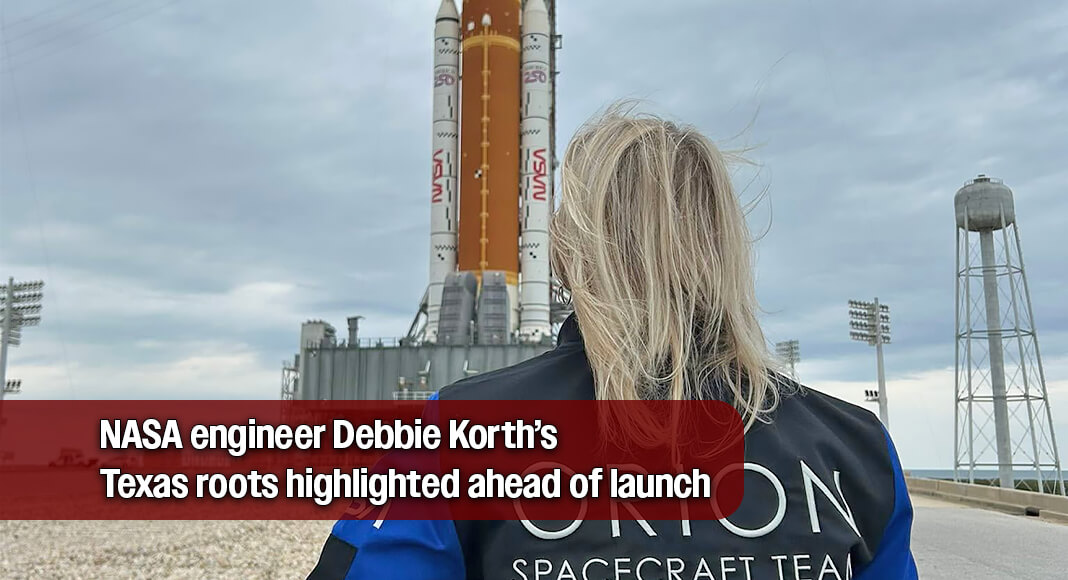
A key figure in the Orion program is Debbie Korth, who serves as Orion deputy program manager at NASA’s Johnson Space Center. In this role, she assists in overseeing the design, development, testing, verification, and certification of the spacecraft. NASA states that her responsibilities include supporting the program manager in ensuring the vehicle meets requirements for human spaceflight.
Korth previously managed the Orion Crew and Service Module office, where she was responsible for the design, development, and testing of the spacecraft’s core systems, including its launch abort system. NASA reports that she has held multiple leadership roles within the Orion program since joining it in 2008.
Before her work on Orion, Korth began her NASA career in 1991 in extravehicular activity and mission operations planning. She later transitioned to life sciences, managing spaceflight hardware for the Space Shuttle and International Space Station programs. NASA states that her work included managing space medical experiments, contributing to the Crew Health Care System aboard the ISS, and collaborating with international partners.
Korth earned a Bachelor of Science degree in aerospace engineering from Texas A&M University. In addition to her professional background, a personal account from a former classmate states that Korth attended Fields Elementary, Travis Junior High, and Memorial High School in McAllen, Texas, before pursuing her university studies. The account also states that she developed an interest in aerospace engineering while taking physics in high school.
NASA records show she has received several honors, including the NASA Exceptional Service Medal, NASA Silver Achievement Medal, Spaceflight Awareness Award, and the Silver Snoopy Award.
NASA has not released additional mission-specific details beyond its stated objectives, but the agency has widely characterized Artemis II as a major step toward future lunar landings.