








Texas Border Business

Texas Border Business
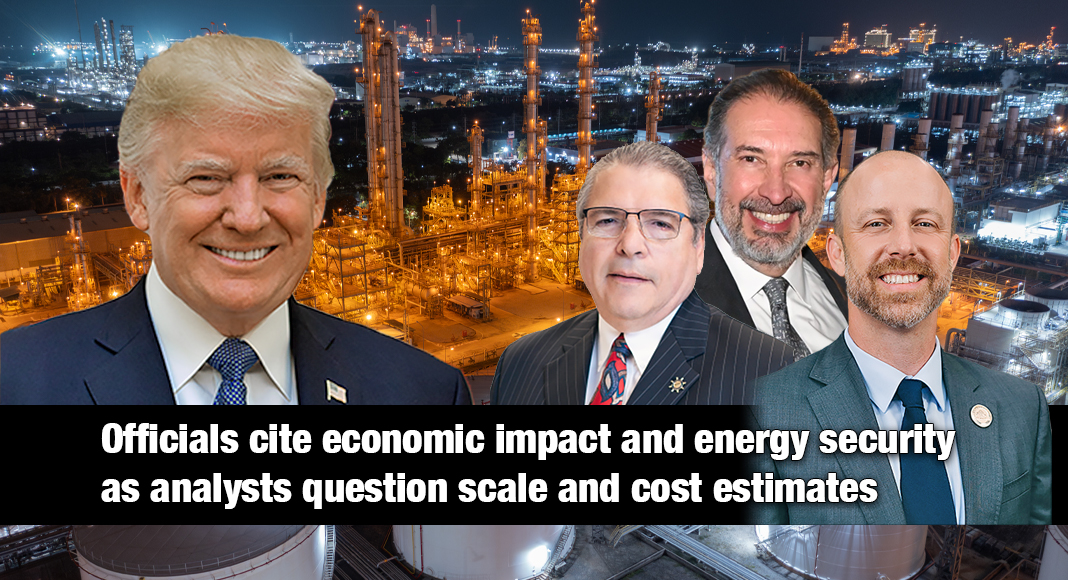
BROWNSVILLE, Texas — President Donald Trump announced plans for a new oil refinery at the Port of Brownsville, describing it as the first newly built U.S. refinery in roughly 50 years and promoting it as a major energy and economic development project.
In a post on social media, Trump said America First Refining would open the refinery in Brownsville and called it a “historic $300 billion deal.” He stated that the facility would strengthen national security, expand domestic energy production, support exports, and bring thousands of jobs to South Texas. He also credited partnerships with India’s Reliance Industries and said the project reflects his administration’s “America First” energy agenda.

According to Reuters and the Financial Times, the refinery would be developed by America First Refining, a startup company led by CEO John Calce, with significant investment from Reliance Industries, India’s largest privately held energy company. Reliance operates the Jamnagar refining complex in India, described by Reuters as the world’s largest.
Reuters reported that the proposed refinery would have a processing capacity of about 168,000 barrels of crude oil per day and would be designed to process American light shale oil. The facility could handle approximately 60 million barrels of crude annually and produce gasoline, diesel, jet fuel, and other petroleum products.
While Trump described the announcement as a $300 billion deal, the Financial Times reported that construction costs are estimated at approximately $4 billion.
Brownsville Mayor John Cowen, in a statement posted on social media, said the refinery would process shale oil from the Permian Basin and include a 20-year agreement to purchase and refine 1.2 billion barrels of U.S. shale oil valued at about $125 billion. He stated that the project could produce up to 50 billion gallons of refined petroleum products, valued at roughly $175 billion, and contribute an estimated $300 billion to the U.S. trade balance. Cowen also said a groundbreaking ceremony is expected in April 2026 at the Port of Brownsville.
The Port of Brownsville, in a separate social media statement, said the project has been under development for more than 12 years and described it as a long-planned investment that would strengthen energy infrastructure and expand economic opportunity in the Rio Grande Valley and Texas.
Analysts cited by Reuters noted that most refinery growth in the United States over the past several decades has come from expansions of existing facilities rather than construction of new ones. If completed, the Brownsville project would represent the first entirely new refinery built in the United States in about half a century.
Joaquin Spamer, president of CiL Group, wrote on social media that the original Element Fuels proposal was estimated between $4 billion and $6 billion, suggesting the larger figure cited by Trump includes long-term trade values rather than construction costs.
Construction is expected to begin in the second quarter of 2026, subject to securing permits and financing, according to Reuters. The Port of Brownsville was selected in part for its deep-water access, proximity to Gulf Coast energy infrastructure, and connections to pipelines that transport U.S. shale oil to export markets.