








Texas Border Business


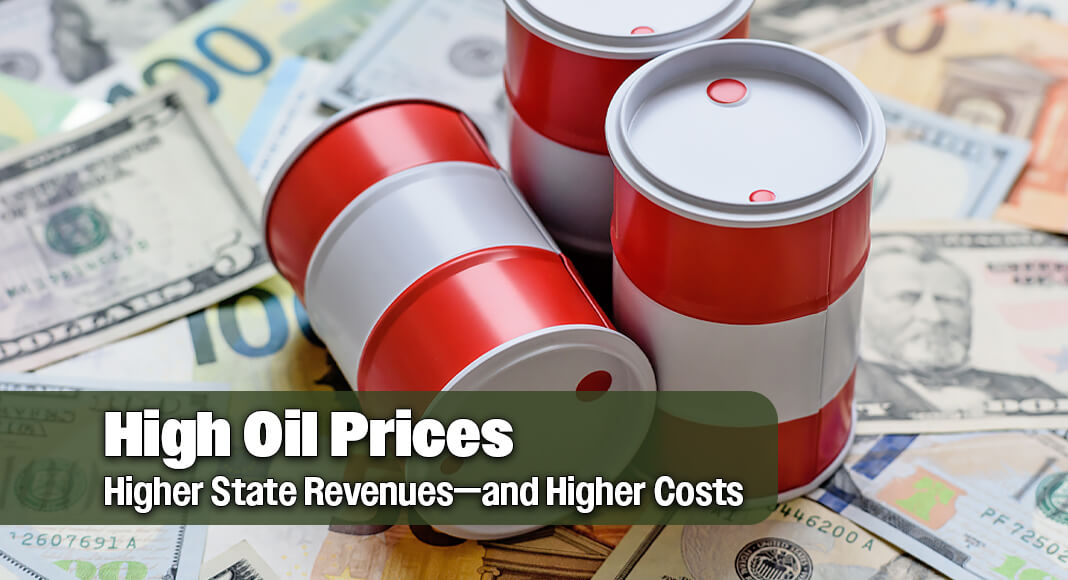
The ongoing conflict in the Middle East has sent oil prices surging, with West Texas Intermediate Crude prices up from below $60 a few months ago to above $100 on several recent days. In addition to disrupting Middle East production capacity, the conflict has brought the de facto closure of the Strait of Hormuz at times. With about 20% of the world’s oil navigating the Strait, supplies have dropped and prices have risen. The current level isn’t unheard of (prices were significantly higher for much of 2022, for example), but effects are nonetheless notable.
As by far the largest producer in the US, Texas is in a unique situation when prices jump. We’re a long way from decades ago when oil was the key determinant of economic health, but it remains important. Producers obviously benefit in terms of near-term revenue, but there are also drawbacks. Let’s examine some of the pros and cons.
Industry participants see an immediate increase in profits with higher prices, as production costs don’t rise as rapidly. However, companies won’t ramp up drilling unless they anticipate a lasting shift in the market and a more certain environment is generally preferable. A spike due to geopolitical conditions which could quickly reverse doesn’t justify major investments. Whether the “new normal” following the conflict is sufficient to significantly accelerate drilling initiatives remains to be seen.

Higher prices also have a notable effect on revenues to the State and local taxing entities. Production taxes are a major source of funding for public schools and universities, roads, and the economic stabilization (Rainy Day) fund. We recently estimated that aggregate taxes to Texas and local governments associated with various aspects of oil and gas activity in the Permian Basin alone totaled $24.4 billion in 2025, with about $5.4 billion of it from production taxes. Higher prices bring higher tax receipts.
Clearly, there’s also a downside to higher fuel prices. They directly affect household budgets, leaving less money for other things such as services, retail, and restaurants. Fuel is also an input to most industries, and high costs are particularly damaging to transportation and agriculture (due to both fuel and fertilizer expenses). Higher transit costs work their way through the economy, leading to higher prices. Although the focus is inevitably on the gasoline prices that we see incessantly, petroleum is the basis for plastics, cosmetics, paints, adhesives, many chemical products and pharmaceuticals, and myriad other products
Higher oil prices clearly bring certain benefits to Texas, but they are somewhat concentrated by industry and geography (though the vast supplier network stretches across the state). The ultimate net effect will only be determined once the immediate and still volatile crisis has passed. Stay safe!
____________________

Dr. M. Ray Perryman is President and Chief Executive Officer of The Perryman Group (www.perrymangroup.com), which has served the needs of over 3,000 clients over the past four decades.